Professor’s Notebook: Wrapping Up your Semester of Teaching

The end of term is a busy time that often involves a lot of final assessment activities for the courses you are teaching. It can be challenging to go the extra distance to make sure that you stay organized during the transition from one semester to the next. Today I’m going to share with you what I consider the “must-dos” to close out your semester, stay organized, and learn and grow as a teacher.

1. Submit your final grades on time

This should be low-hanging fruit but you’d be surprised how many faculty members either do not keep track of the deadlines for grade submission or struggle to get all of their grading done on time (especially with final papers/essays). You need to know your institution’s policy and dates for submitting final grades. It is very helpful to add the relevant dates for each course you teach to your calendar and plan your assignments and exams in a way that gives you enough time to grade them and submit the final grades on time.

As an aside, we usually underestimate how much time it takes to grade assignments so it can also be helpful to do some time tracking when you grade so that you have a more realistic estimate of the time you will need to block off in your calendar for this. Time tracking is simply keeping track of the amount of time you spend doing things and can be as basic as writing it on a piece of paper or in a Word document. Even timing grading a random sample of papers can give you a decent estimate of your average grading time for that assignment.

Obviously, it will vary by course, level, quality of writing, etc. but moving forward, this information can help you make informed decisions about the assignments you develop for your courses. There is also the whole AI thing which means we could be (some are) moving away from more traditional scholarly papers or essays or that we need to allocate more time to grading smaller scaffolded assignments throughout the term. We may (probably) also need more time to deal with AI cheating issues for some types of assignments. Even so, you need to get your grades in on time and make a plan that allows you to do that.

2. Clean up and organize your teaching files

You should have a personal filing system that makes it easy for you to find information. Personally, I have a main folder called TEACHING with a subfolder for each of the different courses I’ve taught and another level of subfolders by year for the courses that I have taught multiple times. You might prefer to organize by year. There isn’t one best way to organize your files but you do need a system that is consistent and works for you.

When it comes to teaching, there are basically three types of files: 1) content that you’ve created for teaching and learning, 2) content that others have created that you are using for teaching and learning while minding copyright laws (e.g., book chapters, journal articles, etc.), and 3) content that your students have created during the course (e.g., assignments, discussion posts, exams, etc.).

In my view, the student-created content and your evaluations of it require the most consideration due to privacy concerns and the potential for grade appeals. As a general rule, I would recommend finding out how long you are required to keep student work at your institution and then deleting the student work once that time has passed. For example, if you need to keep it for 1 year, then at the end of this term you would delete/electronically shred all student work from the Winter 2023 term. This includes discussion posts in your LMS.

The exception to this would be excellent work that you would like to use for accreditation/program review purposes or as examples to share with future classes. If you would like to save specific pieces of work from students for these purposes, you should ask them for permission to save and share their work in those ways now and file it in a special folder. The best time to ask students is now after you’ve just taught them (and after submitting final grades). Generally, I would ask for this permission via email and then if the student replies giving their written permission, I save the email thread as a PDF in the folder with their assignment.

The other types of files that you have (created by you and resources created by others) can be kept indefinitely in your personal filing system. I like to have folders organized by class or by week of the course and then a separate folder for assignments. I also create a brand new folder for each time I teach the same course. While this does create some duplication, it means that I have an archived version of the course for each time I taught it. Note that I always update and revise my courses to improve them so no two offerings are identical.

3. Read your student teaching evaluations

It might not be your favourite thing to do, but you really do need to read your student evaluations. Yes, there are known problems with student teaching evaluations – most students are not experts in teaching and learning, people have personal biases that negatively affect their ratings of women and members of minority groups who are professors, hard classes/subjects are viewed less favourably than others, and students with strong extreme opinions are most likely to complete the evaluation – however, there can still be helpful nuggets that can help you improve as a teacher so I wouldn’t advise ignoring them or sticking your head in the sand.

I would advise you not to take the feedback personally and to approach your teaching evaluations like a researcher instead. This is data after all. Print out your evaluations and go through them with different coloured highlighters. First, highlight all of the positive feedback in one colour. Then, highlight the negative feedback in another colour. I would ignore comments that are irrelevant to teaching (for example, comments about your appearance which yes, does happen when you are a woman). Look for common themes in each category. Are students consistently saying they didn’t like the textbook? Is there a 50:50 split on loving and hating an active learning strategy that you used? What is the data telling you overall? Write a brief summary of the overall feedback and consider what you might do differently next time to improve your teaching and students’ learning. You might also want to talk to your teaching support center or colleagues, do some research about the scholarship of teaching, or attend a teaching professor conference. Excellence does not require perfection, but it does require effort and there is always more to learn.

4. Take a day off (at least)

Lastly, it’s important to take at least a day off and decompress after a busy few weeks. Go do things that you enjoy and let go of the stresses of the semester. If you can take a vacation (at least a full week) I would highly encourage you to. Sometimes it feels like there is never a good time to take one but it is super important for your health and wellbeing, and, perhaps counterintuitively, taking vacation benefits your productivity at work long-term. Burnt-out people are not productive people so let’s avoid going down the burnout path 😉

And that’s it for today. Go wrap up your teaching semester and enjoy a well-deserved break~!
Using your syllabus to manage student expectations

If you want to be an effective university teacher and have a manageable teaching (and email) workload throughout the semester, then you must establish clear expectations for your students. In this post I’m going to discuss how to use your syllabus to establish clear expectations for your students and proactively address student concerns and issues as much as possible. Let’s get started!

The Syllabus

As you know, your course syllabus should provide all of the information that your students need to know about your course and what they need to learn and do to be successful in your course. It also is a tool for setting/managing expectations and establishing boundaries. It is important to be up front with students about things such as: when you are available/unavailable, your email response time, consequences of late assignments, requests for extensions, how to submit assignments, and so forth.

Your institution and/or faculty/department likely has a standard syllabus template that you are asked/required to use or can adapt. Although it is tempting to keep recycling and updating old versions of syllabi, always check to make sure that the information is up to date and that all the hyperlinks still work.

What I include in my syllabi:

  • Course information:
    • Course name, number, and calendar description
    • Course objectives
    • Class schedule
  • Professor information:
    • Professor/Instructor name and contact information
    • Office hours and availability
    • Email policy
    • FAQ discussion board
  • Required learning resources (typically books or software programs)
  • Technology requirements (especially for online classes)
  • Assignment information:
    • List of summative assignments/tests/exams, due dates, and their % grade for the course
    • List of formative assignments/tests and due dates
    • Detailed assignment instructions (may choose to make this a separate document)
    • Assignment grading rubrics (as applicable; may choose to make this a separate document as well)
    • Assignment submission instructions
    • Information about late assignments and/or missed tests/exams
    • Information about requesting extensions
  • Information about unversity student resources including learning accommodations, student services, health and counseling services, etc.
  • Information about plagiarism
  • Information about the appeal process
  • Grading scheme for the course
  • Easter egg for students who read the syllabus

Many of these sections are fairly standard but the ones that I find really make a big difference for students and for me are: Professor information and Assignment information.

Professor Information:

In terms of office hours, I only do these by appointment and try to keep it to business hours M-F. However, some of my master’s students are nurses working shifts so I make sure they know that I am willing to be flexible for them. You may want to block off certain days/times for student meetings. I find that student questions/meeting requests happen when there is a test or assignment coming up or after they get an assignment or test back so I don’t really find it helpful to block off consistent time every week.

I have a lot of rules for students about sending me emails. In terms of my email response time, I tend to be really on top of my inbox and generally respond in less than 24h. However, my official policy is within 48h to give me a buffer and set a reasonable expectation for students. I also ask that students type the name of the course in the subject line and if it is a legit emergency to indicate that it is urgent. When I give back assignments, I ask that students read over all of my feedback and reflect on their assignment AND that they wait at least 24h before they email me to request a time to meet with me about it. I am more than willing to discuss assignments with students but I find that they are in a better frame of mind when they have time to reflect on their work and the feedback I have provided. Recently I have held optional live sessions online for students to ask any questions that they have about an upcoming assignment or test. Often more than one student has the same question so it is an effective way of helping the whole class at once.

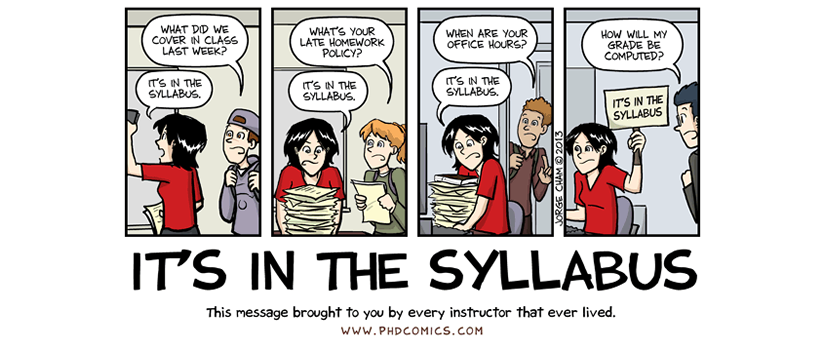
Another tool that I have used within my learning management system (LMS) where the course is housed (we use D2L Brightspace) is to create an FAQ Discussion Board where students can ask questions that they have about the course or assignments. I also encourage students to look in the syllabus and the assignment instructions and grading rubrics to see if they can find the answer to their question before reaching out to me. Nine times out of ten, the information they are looking for has already been provided. This prevents me from getting a lot of repetitive questions via email.

Sometimes a student will email me about something that I hadn’t thought of and that the whole class would benefit from. In these cases, I usually email the entire class or post a news item/announcement in D2L to share the information with everyone.

Assignment Information:

I try my best to provide students with very detailed assignment instructions and marking rubrics (when applicable). I encourage students to mark their due dates in their calendar/planner, start working on their assignments early in the term, and sometimes include smaller low stakes assignments along the way to get them started. When possible I also include example assignments (in the course site, not actually in the syllabus) from previous students (with permission) so that they understand what I am asking them to do. Obviously this isn’t possible for every type of assigment or for tests but it helps clarify expectations tremendously. For tests, I also find it helpful to have a marking key with justification for correct and incorrect answers. Yes, it is time consuming to make this but it is super helpful to have on hand when explaining to students where they went wrong or misunderstood a question/answer. It also helps me check that I didn’t write a wonky question and when I am lucky enough to have TAs, it helps them understand how to mark.

Providing students with information up front about what happens if they submit assignments late (or never) or miss a test or need an extension is also really important. With the current pandemic, many of my students have had additional challenges (many of them are nurses working on the front lines or in management positions and have kids at homes, etc.) so I have tried my best to be supportive and flexible with due dates this year. I usually give students 48 hours of extension time that they can use any time during the term as long as they let me know a few days before the due date. This information is included in the syllabus. Generally, few students use this but it helps reduce their stress because they know they have that buffer if they need it.

The last thing that you may want to include in your syllabus is an easter egg that students will find if they actually read your syllabus. If it is a smaller class and you don’t mind getting a bunch of emails you could ask them to email you a picture of an animal or a car (or whatever). Another approach (which I prefer) is to set up a short survey using Microsoft or Google Forms (depending on what your school uses). Insert the link into your syllabus near the end with brief instructions to the student to click on it.

Example text:

Let me know that you read the syllabus by completing this brief survey: click here.

Sometimes the hyperlinks can be really long so you can shorten the text to display by clicking on the second letter in, typing what you want it to say, and then deleting the first letter and the remaining letters after what you typed. This looks better and also can make the easter egg less obvious to students who aren’t actually reading the syllabus.

So there you have it!

Is there anything I missed?

I would love to hear what you include in your syllabi. Comment on this post if you have something to share.

Perplexed by the NCLEX in Canada

nclex2

To most Canadian nursing educators, the NCLEX is about as welcome in Canada as Donald Trump. I am not alone in being royally PO’d that the provincial nursing regulatory bodies decided to nix the Canadian Registered Nurses’ Exam (commonly known as the CRNE)to replace it with the NCLEX in 2015.

In case you’re not in nursing or you aren’t Canadian, the NCLEX is the American nursing licensing exam that all American nurses must pass after their nursing degree before they can register as a Registered Nurse.  It is an adaptive computerized test that will keep asking tailored questions until the program is 95% sure that the candidate is above or below the passing standard.  To be clear, I think that this format and system of testing is awesome.  What isn’t awesome is having to teach my students content that is American so that they can pass the test (as if we don’t already have enough content!).  The French translation of the NCLEX is also so bad that many Francophone students are failing because they can’t understand the questions (I’m talking outside of Quebec of course because they wisely decided to keep their own nursing exam). Moreover, although French NCLEX practice materials are starting to pop up (after they realized that it was an issue), there aren’t nearly as many resources for French students and educators as for their English-speaking counterparts.  Two giant strikes for the NCLEX.

I have no idea why on earth the provincial nursing regulatory bodies made this decision or if they understood the implications of their decision.  Initially I was told that it would be a Canadian version of the NCLEX and maybe they thought so too. It is not. It is the exact same database of questions for all candidates in all countries. I could be wrong but I think the rationale behind this is that the NCLEX supposedly is “context-free”. I attended an NCLEX workshop for nursing faculty two years ago and the facilitator explained to us how the test worked and how the questions are designed.  She also proudly stated that “the NCLEX has no context”.  What she meant was that the questions are designed to be applicable to all contexts. I would question that. Is nursing really that black and white?  Maybe some things are but I’d argue that real life requires professional judgement calls too.

There are also huge differences between the US and Canada in terms of how we view health care (as a service to be bought through insurance versus as a basic human right).  Specific examples of the “Americaness” of the exam include “the five rights of delegation” and the scope of practice for an RN versus and LPN (Licensed Practical Nurse)[or RPN (Registered Practical Nurse) in Ontario]. In Ontario where I started my nursing career, I worked on a hospital unit with half RNs and half RPNs. We both had our own patient assignments and although the RNs were able to be in charge and dealt with the more complex patients, we were never assigned an RPN to delegate work to and have them report back to us. They had autonomy and we all worked together as a team (for the most part). In the US, LPNs report directly to RNs and the RN assigns patients or patient care duties to them. LPNs are not allowed to engage in patient teaching or any of the nursing process (assessment, planning, evaluation, nursing judgment). (See the Joint Statement of the American Nurses Association and the National Council of State Boards of Nursing here). Why does this even matter? Well, now we have to teach our nursing students about delegation in their own province and the rest of Canada (it is not exactly the same from province to province) AND America. If we don’t tell them that delegation rules for the NCLEX they are going to answer those questions incorrectly and it sure as heck isn’t because we don’t teach them about delegation in Canada.

Some have argued that it is not an American test, to which I respond, then why are Canadian-specific NCLEX prep books popping up?  Is it because we are just another market that companies want to exploit, or is it because there is American content that Canadian students need to learn in order to do well on the test?

So where does this put us?  Precisely in a giant head-lock. We have excellent nursing programs across Canada and in general our nurses have more education and better quality education than nurses in the US. Many of their students still take 2-year associate degrees whereas in Canada all RNs have to have a four-year bachelor’s degree. Every day I am impressed with the quality of the education that the students get at UNB and especially with the amount of real life clinical they get (over 1400 hours).  However, now we need to add in NCLEX-specific content to make sure that our students are prepared to take an American nursing test. Not to prepare them for their practice as an RN – we do that exceptionally well already!

Clearly I have strong feelings about the NCLEX and not everyone will agree with me but I don’t think that Canadian nursing students should have to learn American content in order to become nurses in Canada. I also don’t think that nursing schools should be judged by their NCLEX pass rates. Passing the NCLEX or not doesn’t necessarily reflect the quality of a nursing program, but, rather the “NCLEX test readiness” of graduates. Some schools are starting to make it a requirement for nursing students to write the HESI NCLEX practice test and obtain a certain score before they can graduate and write the NCLEX. This ensures that pass rates on the actual NCLEX are high because it increases candidates’ test-taking skills and ensures that they don’t write until they are ready (sometimes after writing the HESI numerous times).  As a result, high NCLEX pass rates are not necessarily a reflection of the quality of the nursing school, but of the readiness of the student to write the NCLEX. I don’t think that it is a bad thing to take the HESI per se, but I do think it is misleading to compare first-time NCLEX pass rates between schools who have a HESI score requirement and those who do not. Taking these tests (the HESI and the NCLEX), attending NCLEX review sessions, and purchasing NCLEX study guides are also very expensive so making the decision to require the HESI is not one to take lightly.

So there you have it. The NCLEX has made it harder to become a nurse in Canada and more challenging to be a Canadian nursing educator. Arguably, it has also made it easier for Canadian nurses to practice in the US (if you don’t mind working in a f0r-profit health care system). I’m not a fan and I think that it was strange decision. It is also possible that I am not privy to confidential information about why this decision was made and, thus, do not fully understand the rationale behind it. That being said, until the situation changes, it really doesn’t matter if I agree or not, no matter how logical my arguments are; the fact is that we need to do what we can to prepare our students for an American test.