Simple Stress Busters to Cope with Mid-Semester Overwhelm

It’s that time of the semester again! The end is in sight but the work is piling up! You have a lot to do before the holiday break including finishing everything for your current classes and preparing for next term so that you can actually relax for a bit.

Research suggests that a wide range of stress coping strategies can be effective. These include social support, emotion-focused coping strategies (aimed at making you feel better), problem-focused coping strategies (aimed at improving or solving the problems/situations that are the source of your stress), and cognitive reappraisal (reframing the stressor and your interpretation of it).

Here are some Simple Stress Busters to Cope with Mid-Semester Overwhelm:

  1. Do a short guided relaxation or meditation. Apps like Calm and Headspace are particularly helpful for this. Schedule 10 min in your day to do this so that it becoms a habit. I like to do it in the car at the end of the work day before I go pick up my son and dog from daycare. It puts me in a much calmer, more mindful state of mind and provides a transition from work to non-work that I find helpful.
  2. Have a mini dance party! Listen to 2-3 of your favourite songs and rock out. This is such an awesome way to release pent up stress energy and add a bit of fun/play to your day 🙂 Often the songs we love also remind us of fun times with friends.
  3. Speaking of which… Connecting with a good friend can also be a great mood booster. Taking 10 min to message a friend or family member and let them know you’re thinking of them is never a bad idea. Making use of commute time to have a longer conversation is also an excellent way to build in meaningful connections during your busy life.
  4. Do something physical. There is a lot of research showing that physical activity and exercise have positive effects on your mental and physical health. You probably already know this! If you’re finding it challenging to get motivated, just commit to doing 10 min/day to start. You will probably feel better once you get going and even a 10 min walk/workout can help break up your grading marathons and give you some fresh air.
  5. Go the F to sleep! I mean that as nicely as possible. If you are not getting enough sleep you are living life on hard mode. Getting a good night sleep when you are stressed out can be challenging, I totally get it! However, there are many things you can do to set yourself up for the best opportunity to have a good night sleep. These include creating a dark, quiet, cool sleeping space, turning off electronics an hour before bedtime (also you should absolutely have a consistent bedtime), having a caffeine cutoff time in the early afternoon, and doing a brain dump so that you can put your mind to rest.
  6. Stop checking your email first thing in the morning. You have more important things to do most of the time. I like to plan my most important work for early in the work day because it ensures that it actually gets done. Your inbox is a black hole of other people’s priorities. It is a bit different for me now in my current role as an Associate Dean because I do need to be available for my team and there can be urgent things that need to be responded to. Our students are in clinical so serious things can happen (knock on wood they don’t). But if you are in a regular faculty position, you may want to consider scheduling certain times each day for email management and communication.
  7. Book a massage or spa treatment. Find a local day spa or massage therapist that specializes in relaxation. Book an appointment. Go. Enjoy. Forget all the things. It’s that easy.
  8. Stop comparing yourself to others. You might feel like you are “behind” or that you don’t measure up to the amazing superstar researcher that you look up to. Stop wasting your energy on that! Instead, focus on the unique value and expertise that you have to share. You are awesome and one of a kind! Take 5 min to write down what makes your teaching and/or research unique. Pin that on your bulletin board so you can look at it and remind yourself.

You certainly don’t need to do all of these but consider trying one out today and see how you feel afterward – maybe you will want to keep doing it 🙂

Have a great week and hang in there!

Emily

Need some more time for self-care? Download this awesome freebie I made just for you. Click here to subscribe to my weekly newsletter and get your free PDF of “How to Find Time for Self-Care”.
Using your syllabus to manage student expectations

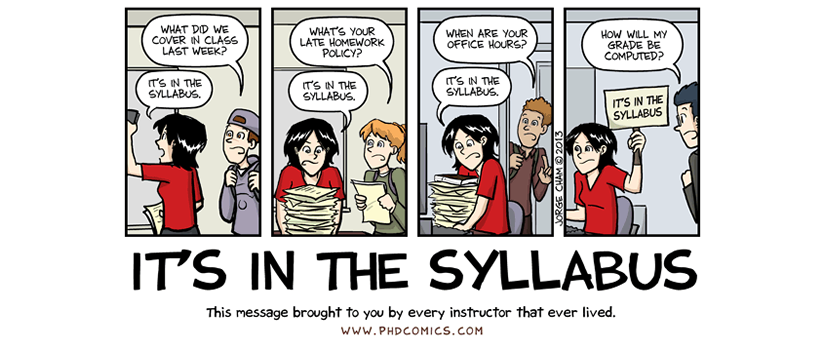
If you want to be an effective university teacher and have a manageable teaching (and email) workload throughout the semester, then you must establish clear expectations for your students. In this post I’m going to discuss how to use your syllabus to establish clear expectations for your students and proactively address student concerns and issues as much as possible. Let’s get started!

The Syllabus

As you know, your course syllabus should provide all of the information that your students need to know about your course and what they need to learn and do to be successful in your course. It also is a tool for setting/managing expectations and establishing boundaries. It is important to be up front with students about things such as: when you are available/unavailable, your email response time, consequences of late assignments, requests for extensions, how to submit assignments, and so forth.

Your institution and/or faculty/department likely has a standard syllabus template that you are asked/required to use or can adapt. Although it is tempting to keep recycling and updating old versions of syllabi, always check to make sure that the information is up to date and that all the hyperlinks still work.

What I include in my syllabi:

  • Course information:
    • Course name, number, and calendar description
    • Course objectives
    • Class schedule
  • Professor information:
    • Professor/Instructor name and contact information
    • Office hours and availability
    • Email policy
    • FAQ discussion board
  • Required learning resources (typically books or software programs)
  • Technology requirements (especially for online classes)
  • Assignment information:
    • List of summative assignments/tests/exams, due dates, and their % grade for the course
    • List of formative assignments/tests and due dates
    • Detailed assignment instructions (may choose to make this a separate document)
    • Assignment grading rubrics (as applicable; may choose to make this a separate document as well)
    • Assignment submission instructions
    • Information about late assignments and/or missed tests/exams
    • Information about requesting extensions
  • Information about unversity student resources including learning accommodations, student services, health and counseling services, etc.
  • Information about plagiarism
  • Information about the appeal process
  • Grading scheme for the course
  • Easter egg for students who read the syllabus

Many of these sections are fairly standard but the ones that I find really make a big difference for students and for me are: Professor information and Assignment information.

Professor Information:

In terms of office hours, I only do these by appointment and try to keep it to business hours M-F. However, some of my master’s students are nurses working shifts so I make sure they know that I am willing to be flexible for them. You may want to block off certain days/times for student meetings. I find that student questions/meeting requests happen when there is a test or assignment coming up or after they get an assignment or test back so I don’t really find it helpful to block off consistent time every week.

I have a lot of rules for students about sending me emails. In terms of my email response time, I tend to be really on top of my inbox and generally respond in less than 24h. However, my official policy is within 48h to give me a buffer and set a reasonable expectation for students. I also ask that students type the name of the course in the subject line and if it is a legit emergency to indicate that it is urgent. When I give back assignments, I ask that students read over all of my feedback and reflect on their assignment AND that they wait at least 24h before they email me to request a time to meet with me about it. I am more than willing to discuss assignments with students but I find that they are in a better frame of mind when they have time to reflect on their work and the feedback I have provided. Recently I have held optional live sessions online for students to ask any questions that they have about an upcoming assignment or test. Often more than one student has the same question so it is an effective way of helping the whole class at once.

Another tool that I have used within my learning management system (LMS) where the course is housed (we use D2L Brightspace) is to create an FAQ Discussion Board where students can ask questions that they have about the course or assignments. I also encourage students to look in the syllabus and the assignment instructions and grading rubrics to see if they can find the answer to their question before reaching out to me. Nine times out of ten, the information they are looking for has already been provided. This prevents me from getting a lot of repetitive questions via email.

Sometimes a student will email me about something that I hadn’t thought of and that the whole class would benefit from. In these cases, I usually email the entire class or post a news item/announcement in D2L to share the information with everyone.

Assignment Information:

I try my best to provide students with very detailed assignment instructions and marking rubrics (when applicable). I encourage students to mark their due dates in their calendar/planner, start working on their assignments early in the term, and sometimes include smaller low stakes assignments along the way to get them started. When possible I also include example assignments (in the course site, not actually in the syllabus) from previous students (with permission) so that they understand what I am asking them to do. Obviously this isn’t possible for every type of assigment or for tests but it helps clarify expectations tremendously. For tests, I also find it helpful to have a marking key with justification for correct and incorrect answers. Yes, it is time consuming to make this but it is super helpful to have on hand when explaining to students where they went wrong or misunderstood a question/answer. It also helps me check that I didn’t write a wonky question and when I am lucky enough to have TAs, it helps them understand how to mark.

Providing students with information up front about what happens if they submit assignments late (or never) or miss a test or need an extension is also really important. With the current pandemic, many of my students have had additional challenges (many of them are nurses working on the front lines or in management positions and have kids at homes, etc.) so I have tried my best to be supportive and flexible with due dates this year. I usually give students 48 hours of extension time that they can use any time during the term as long as they let me know a few days before the due date. This information is included in the syllabus. Generally, few students use this but it helps reduce their stress because they know they have that buffer if they need it.

The last thing that you may want to include in your syllabus is an easter egg that students will find if they actually read your syllabus. If it is a smaller class and you don’t mind getting a bunch of emails you could ask them to email you a picture of an animal or a car (or whatever). Another approach (which I prefer) is to set up a short survey using Microsoft or Google Forms (depending on what your school uses). Insert the link into your syllabus near the end with brief instructions to the student to click on it.

Example text:

Let me know that you read the syllabus by completing this brief survey: click here.

Sometimes the hyperlinks can be really long so you can shorten the text to display by clicking on the second letter in, typing what you want it to say, and then deleting the first letter and the remaining letters after what you typed. This looks better and also can make the easter egg less obvious to students who aren’t actually reading the syllabus.

So there you have it!

Is there anything I missed?

I would love to hear what you include in your syllabi. Comment on this post if you have something to share.

Annual planning as an academic

As an academic, I think it’s important to understand the ebb and flow of your academic year in order to plan ahead and be strategic with how you invest your time and energy at different times of the year.

Hallelujah! 2020 is almost over forever. I’m sure I’m not the only one who felt like this year was 15 years long. I am done with it and ready to move on. Who’s with me?!

While January 1st is not my first choice for the “start of the year”, it is an opportunity for a fresh start and a time when many of us reflect on the past year and think about what we want to accomplish in the year ahead.

In this post, I’m going to talk about the different “years” that we deal with in academia (and as a parent if that is applicable to you) and how you can use that information to strategically plan your year.

As an academic, I think it’s important to understand the ebb and flow of your academic year in order to plan ahead and be strategic with how you invest your time and energy.

There are multiple “years” that you need to be aware of: 1) the calendar year, 2) the employment year, 3) the academic year, and 4) your children’s academic year (if applicable).

1. The calendar year. January 1st to December 31st. This is the most obvious year but other than taxes, vacation time, and the normal calendar, it is not actually the schedule that we really live by in academia. That being said, the calendar year can sometimes be used to your advantage (or not) when it comes to publications, conference presentations, and research grants.

2. The (university) academic year. This is another year that we are very familiar with since we have spent most of our adult lives at the university in some capacity. In Canada the academic year runs from September of one calendar year until August of the following one. It is divided into Fall Term (Sept-Dec), Winter Term (Jan-Apr), and Summer Term (which includes multiple course timeframes between May-Aug). For me, the academic year is all about teaching responsibilities, graduate student progress, and administrative deadlines. Normally professors are required to teach during 2/3 of these semesters/terms, with one term to focus more on research. That looks great on paper but in real life, most research happens over the full year, not just over 4 months. However, knowing your teaching responsiblities does allow you to prioritize the most time-consuming aspects of your research when you have less/no teaching.  

3. The employment year. Typically, this year is from July 1st of one year to June 30th of the following year. This is the “year” that counts towards probation, tenure, promotion, and years of service. Often you will be required to provide an updated CV or progress report by June 30th every year to show what you have done in the last year. This year is also used to determine when you are eligible for sabbatical leave and your possible retirement dates.

The employment year is a bit awkward because it includes parts of two academic years: a) Academic Year 1: Tail end of summer term (July/August), and b) Academic Year 2: Fall term, Winter term, and first half of summer term (May/June). However, I still think it is the best year to use for planning as an academic.

If you are on the tenure track or pursuing promotion to full professor, you should absolutely print out a copy of your employment contract and write down the key dates related to submission of your applications for probationary review, tenure, and promotion. I also encourage you to go buy a sturdy 2-3′ binder and start creating your portfolio of evidence of meeting the criteria for tenure as you go. It is so much easier to do this as you go than waiting until the last minute!

4. Your kids’ academic year. If you have school-age children like I do, then you also deal with their academic calendar in your planning. In Canada, the school year runs from after labour day in September until the end of June. This year aligns almost perfectly with your employment year, minus the summer (July/August). Remember how the summer semester was supposed to have “extra” time for research? About that…

Seriously though, if you have kids, you need to find something for them to do when you are working in the summer and also plan for some family vacation time. If you are going to have students working for you in the summer you also need to consider how you are going to deal with that. Are you going to make them take vacation at the same time you do? Are there things that they can work on independently? Or maybe you have a post-doctoral fellow or senior graduate student who can step up and provide some leadership while you are on vacation?

Putting all these years together we get the following:

Note that I used the employment year as the base year for this because in my opinion it is the most important one as an academic employee. From this perspective, we are actually halfway through our “year” rather than at the beginning of it.

Planning Strategically for the next 6 months:

  1. Make a list of the things that you must do in the next 6 months.
  2. Is there anything that you can delegate, defer, or make easier? If yes, take action to make those things happen.
  3. Schedule your remaining must dos into your calendar.
  4. Make a list of the things that you want to do in the next 6 months.
  5. Rank the items on your want list.
  6. Schedule your want list by priority.

Example:

  1. My MUST DO list for January-June 2021 looks like this:
    1. Teach graduate course on healthy public policy & determinants of health (online, synchronous)
    2. Teach undergraduate course on professional practice (online, asynchronous)
    3. Oversee development of specialty nursing professional development certificate
    4. Transition to Associate Dean role
    5. Move to Moncton for new role (sell house, find new place to live, etc.)
    6. Graduate student supervision (currently 4 students)
    7. Co-lead of 1 major research project
    8. Co-investigator on another major research project
    9. Sign up kiddo for summer day camps
  2. Is there anything that you can delegate, defer, or make easier? Not really lol…
  3. Schedule your remaining must dos into your calendar. Many of my must do commitments have weekly times allocated to them. For teaching, I also make sure that I put all of the assignment and test dates into my calendar and block off time for marking and meeting with students afterwards. Selling my house and moving is going to take up a lot of time and energy so I am going to wait until I am done teaching in April before I start looking for a realtor and putting the gears into motion for that. I have the advantage of having a lot of experience moving which will help but it is still a lot of work! Day camp sign ups are usually in May/June so I will put a reminder in my calendar for that.
  4. My WANT to do list for January-June 2021 looks like this:
    1. Finish and submit 2 journal articles that I have been working on
    2. Have a big BBQ party to say goodbye to our Fredericton friends (depending on COVID19)
    3. Compete in a powerlifting competition
    4. Lose 20lb
    5. Plan a fun camping trip vacation
  5. RANKED LIST:
    1. Plan a fun camping trip vacation
    2. Lose 20lb
    3. Finish and submit 2 journal articles that I have been working on
    4. Compete in a powerlifting competition
    5. Have a big BBQ party to say goodbye to our Fredericton friends (depending on COVID19).
  6. Schedule your want list by priority.
    1. Planning for the camping trip vacation will actually have to happen later on once I have sold my house and have specific dates for moving. I am confident it will happen but even though it is #1 on the want list, it will have to wait.
    2. Losing 20# is an important goal for me this year. I have been sitting so much the past year and feel unhealthy. To work towards this goal I have scheduled in time for walking the dog twice a day and working out in my home gym. I also schdeuled in time for weekly meal planning, grocery pickup, and meal prep.
    3. These 2 articles are so close to being done! I blocked off time in the next 3 weeks to work on each of them and polish them up.
    4. I haven’t competed in powerlifting for 6 years (yikes) but it is something that I really like doing and would be fun to do with my powerlifting friends. The one I want to do is in early April on PEI which has been super strict with COVID19 restrictions. I’m still on the fence about this one because it is during a busy part of the semester and there is still a lot of uncertainty about COVID19. I also just realized that it is on Easter weekend so I think that specific competition is going to be a no for me this year. The next 6 months is going to be busy so while I will still work on my strength and fitness, I think the wise choice is to look at competing next year instead.
    5. BBQ party TBD…will have to wait and see!

I hope this process helps you with your planning for the next 6 months 🙂

Happy planning!