Professor’s Notebook: Wrapping Up your Semester of Teaching

The end of term is a busy time that often involves a lot of final assessment activities for the courses you are teaching. It can be challenging to go the extra distance to make sure that you stay organized during the transition from one semester to the next. Today I’m going to share with you what I consider the “must-dos” to close out your semester, stay organized, and learn and grow as a teacher.

1. Submit your final grades on time

This should be low-hanging fruit but you’d be surprised how many faculty members either do not keep track of the deadlines for grade submission or struggle to get all of their grading done on time (especially with final papers/essays). You need to know your institution’s policy and dates for submitting final grades. It is very helpful to add the relevant dates for each course you teach to your calendar and plan your assignments and exams in a way that gives you enough time to grade them and submit the final grades on time.

As an aside, we usually underestimate how much time it takes to grade assignments so it can also be helpful to do some time tracking when you grade so that you have a more realistic estimate of the time you will need to block off in your calendar for this. Time tracking is simply keeping track of the amount of time you spend doing things and can be as basic as writing it on a piece of paper or in a Word document. Even timing grading a random sample of papers can give you a decent estimate of your average grading time for that assignment.

Obviously, it will vary by course, level, quality of writing, etc. but moving forward, this information can help you make informed decisions about the assignments you develop for your courses. There is also the whole AI thing which means we could be (some are) moving away from more traditional scholarly papers or essays or that we need to allocate more time to grading smaller scaffolded assignments throughout the term. We may (probably) also need more time to deal with AI cheating issues for some types of assignments. Even so, you need to get your grades in on time and make a plan that allows you to do that.

2. Clean up and organize your teaching files

You should have a personal filing system that makes it easy for you to find information. Personally, I have a main folder called TEACHING with a subfolder for each of the different courses I’ve taught and another level of subfolders by year for the courses that I have taught multiple times. You might prefer to organize by year. There isn’t one best way to organize your files but you do need a system that is consistent and works for you.

When it comes to teaching, there are basically three types of files: 1) content that you’ve created for teaching and learning, 2) content that others have created that you are using for teaching and learning while minding copyright laws (e.g., book chapters, journal articles, etc.), and 3) content that your students have created during the course (e.g., assignments, discussion posts, exams, etc.).

In my view, the student-created content and your evaluations of it require the most consideration due to privacy concerns and the potential for grade appeals. As a general rule, I would recommend finding out how long you are required to keep student work at your institution and then deleting the student work once that time has passed. For example, if you need to keep it for 1 year, then at the end of this term you would delete/electronically shred all student work from the Winter 2023 term. This includes discussion posts in your LMS.

The exception to this would be excellent work that you would like to use for accreditation/program review purposes or as examples to share with future classes. If you would like to save specific pieces of work from students for these purposes, you should ask them for permission to save and share their work in those ways now and file it in a special folder. The best time to ask students is now after you’ve just taught them (and after submitting final grades). Generally, I would ask for this permission via email and then if the student replies giving their written permission, I save the email thread as a PDF in the folder with their assignment.

The other types of files that you have (created by you and resources created by others) can be kept indefinitely in your personal filing system. I like to have folders organized by class or by week of the course and then a separate folder for assignments. I also create a brand new folder for each time I teach the same course. While this does create some duplication, it means that I have an archived version of the course for each time I taught it. Note that I always update and revise my courses to improve them so no two offerings are identical.

3. Read your student teaching evaluations

It might not be your favourite thing to do, but you really do need to read your student evaluations. Yes, there are known problems with student teaching evaluations – most students are not experts in teaching and learning, people have personal biases that negatively affect their ratings of women and members of minority groups who are professors, hard classes/subjects are viewed less favourably than others, and students with strong extreme opinions are most likely to complete the evaluation – however, there can still be helpful nuggets that can help you improve as a teacher so I wouldn’t advise ignoring them or sticking your head in the sand.

I would advise you not to take the feedback personally and to approach your teaching evaluations like a researcher instead. This is data after all. Print out your evaluations and go through them with different coloured highlighters. First, highlight all of the positive feedback in one colour. Then, highlight the negative feedback in another colour. I would ignore comments that are irrelevant to teaching (for example, comments about your appearance which yes, does happen when you are a woman). Look for common themes in each category. Are students consistently saying they didn’t like the textbook? Is there a 50:50 split on loving and hating an active learning strategy that you used? What is the data telling you overall? Write a brief summary of the overall feedback and consider what you might do differently next time to improve your teaching and students’ learning. You might also want to talk to your teaching support center or colleagues, do some research about the scholarship of teaching, or attend a teaching professor conference. Excellence does not require perfection, but it does require effort and there is always more to learn.

4. Take a day off (at least)

Lastly, it’s important to take at least a day off and decompress after a busy few weeks. Go do things that you enjoy and let go of the stresses of the semester. If you can take a vacation (at least a full week) I would highly encourage you to. Sometimes it feels like there is never a good time to take one but it is super important for your health and wellbeing, and, perhaps counterintuitively, taking vacation benefits your productivity at work long-term. Burnt-out people are not productive people so let’s avoid going down the burnout path 😉

And that’s it for today. Go wrap up your teaching semester and enjoy a well-deserved break~!
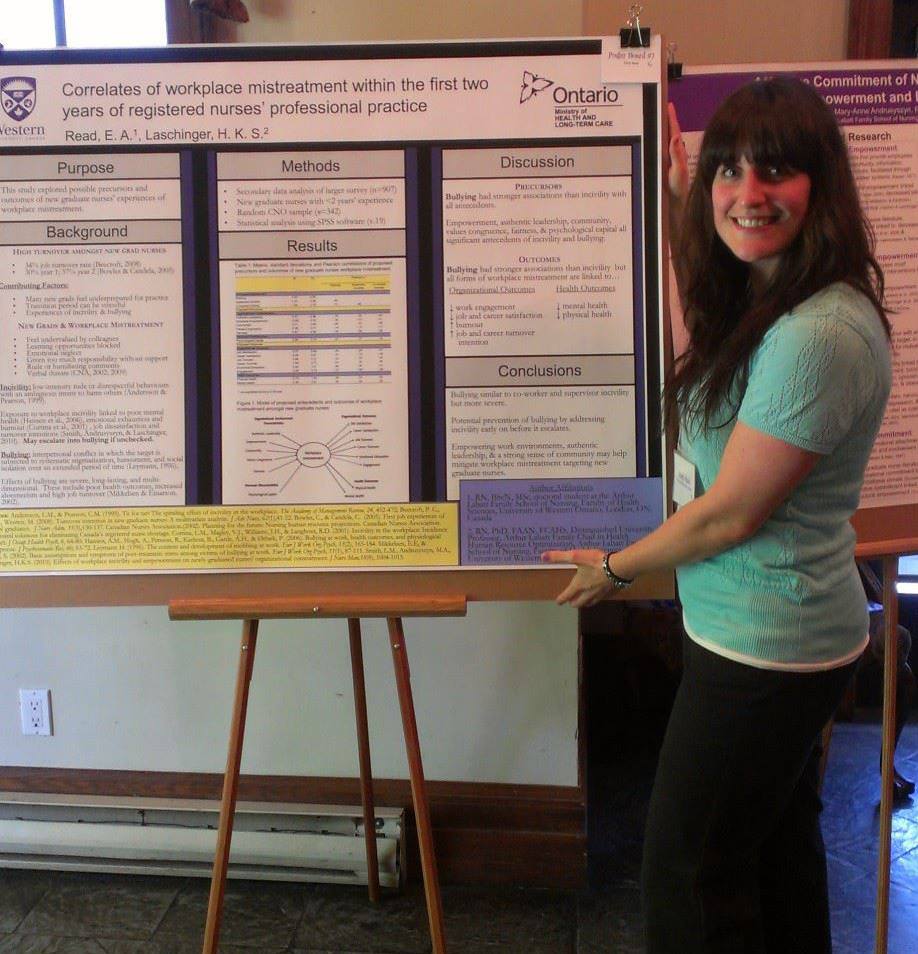
International New Graduate Nurse Research Colloquium

On June 20th, 2013, my supervisor, Dr. Heather Laschinger, hosted a wonderful research colloquium with invited researchers from around the world who all have a special interest in gaining a better understanding of the challenges facing new grads during their transition from student to professional nurse.

I feel so fortunate to have been invited!  It was a fantastic day of sharing ideas and research results, as well as thinking about what we can do moving forward to help nurses transition into their new roles.  I also had a chance to share a poster of my recent work about correlates of workplace mistreatment (i.e. incivility and bullying) directed towards new nurses in Ontario.   I wish that kind of research wasn’t needed to begin with but I think a lot of it has to do with structural factors of the work environment (e.g. leadership, workload, resources, support, etc. available to do your job) and personal factors that individuals bring with them to their job.  It is challenging to be kind and happy when you’re working overtime, have a heavy patient load, and are exhausted!    Nurses are valuable health human resources and we definitely have some work to do in supporting them/us and in particular, during transitions to new career roles (new grads or otherwise!).

Overall it was an inspiring day and I am so thankful that so many knowledgeable and fabulous guests were able to attend!    Christine also did a terrific job putting the event together and making the day run seamlessly 🙂  Nicely done everyone!

emily poster 2013

Are nurses too fat?

The most recent issue of Canadian Nurse contains an article about the sad state of nurses’ health but I don’t think it provided the whole picture.  Although I am a nurse, my background is in exercise science and personal training so I have a few things I’d like to add.

1. Most nurses are middle-aged women.  This affects nurses’ health for a few reasons.  Physiologically women have higher body fat percentages than men because of our hormone profile which supports our reproductive role.  Having less muscle mass and high levels of estrogens in our bodies influence our metabolic rate and our body composition.

From a sociocultural perspective, women are still (!) bombarded with messages that they should be thin, rather than fit, making many prone to following fad diets and restricting calories.  This generally results in a “yo-yo dieting” pattern whereby the dieter loses weight while restricting, only to regain it all back, plus a little extra.  Over time, this can make you heavier than you were to start with and make it more difficult to lose weight.  Another thing that people often don’t think about is that the number on the scale does not tell you if you’ve lost fat or muscle. If you lose weight too quickly or are not eating enough calories you are likely losing muscle as well as fat.  As mentioned earlier, this reduces your metabolic rate and doesn’t help you over the long run.  As we age, our metabolism slows down naturally so keeping muscle is a good thing!

As if we don’t have enough on our plate, women generally take on the roles of caregiver, organizer, cleaner, cooker, etc. at home.  So after taking care of patients for 12-hour shifts women often take on their “second shift”, leaving little time for sleeping, let alone physical activity.  And yes, this can apply to men who take on these roles as well but generally speaking our profession is still dominated by women.

2. Most people don’t really understand exercise and nutrition.

Before I knew what a peer-reviewed journal article was, I sought out expert advice about fitness and nutrition from my local library.  While the information from magazines and books isn’t all bad, there is a lot of misinformation out there.  Just because some celebrity follows a certain regime doesn’t mean that it is healthy or appropriate for everyone!

I truly believe that there is no one-size-fits-all approach.  Individuals have different preferences, activity levels, genetics, and budgets to consider.  I am a big advocate of exercise and nutrition as medicine, unfortunately the fitness and nutrition industries are largely unregulated, making it challenging to find professionals who actually know what they are doing.

Which brings me to my next question: how much do most nurses actually know about exercise and nutrition?  Should we be providing advice to patients if we are not experts in this area?  I have mixed feelings about this.  On one hand, as nurses we are often asked to provide general information to our patients and we are readily accessed by the public. Our services are covered under our public health care plan.  On the other hand, we have lots of keen people graduating with degrees in kinesiology and nutrition who ARE experts in these areas but their services are largely available only through the private sector.  Yes, we have physiotherapists and dieticians working in hospitals and clinics, but the opportunities to use them are limited. If you want to hire a personal trainer and invest in healthy food, you are largely on your own.

Really this comes down to the current system’s general focus on disease management rather than preventative health care.  We spend millions on rehab, surgeries, cancer care, etc. and I’m not saying that we don’t need those things too but if we focused more on preventative health care and influencing the social determinants of change that affect people’s everyday lives we could save a lot of suffering and a lot of money down the road.  That applies to nurses too!

We need to create healthy work environments with the structure and culture to support nurses’ health and wellbeing.  Personal choices are also important, but there are real barriers to being able to take good care of yourself when you are a staff nurse working shifts.  Colleagues call in sick so you work short-staffed or work extra-hours to fill in for them – often this results in you becoming run down and getting sick, perpetuating the vicious cycle.  Patients are getting heavier, older, and sicker, adding to the workload we are expected to handle.  There are physiological effects of working nights, not getting enough sleep, and working in a high-stress environment.  To add insult to injury, the less fit we are, the lower our capacity to handle our workloads and the physical and mental strain from working.  Unlike machines, nurses do need time to rest and recover. Unfortunately working out is another stressor added to the mix. Sometimes what your body needs most is sleep.

I hope this doesn’t sound too negative.  There are nurses who manage to take very good care of themselves despite the obstacles.  I am one of them.  I’m not perfect by any means but after a few years of running around trying to be everything to everyone, I have found what works for me.  I have my road bike set up on a trainer in my bedroom and free weights kicking around so I can always do a quick workout at home if I can’t make it to the gym. I make my own food and bring it to work and I eat vegetarian most of the time.  I don’t have cable (but I do watch movies sometimes).  And yes, sometimes I choose sleep or a warm bath over exercise but I feel refreshed and ready to go the next day.  It is about finding balance and for each of us that is going to mean something individual.

Regardless of public perceptions, health is not about being skinny or having a certain BMI (according to which, almost every athlete would be considered overweight or obese!).  Are we role models for health because we are nurses?  Absolutely, whether it is fair or not.  But how is it that we define health?  Are we embracing the unrealistic body image ideals of our culture instead of a holistic view that appreciates multiple dimensions of well being?

While I think that we need to raise awareness of nurses’ health issues through articles such as the one in the current issue of Canadian Nurse, there are a lot of things to consider that were not brought up in the article.  I hope my thoughts contribute to the discussion and I would love to hear what others have to say on this topic!

Have a terrific day!

-Emily

STTI Conference Reflections

I just arrived home from the Sigma Theta Tau International (STTI) conference in Indianapolis about creating healthy work environments.  It was a full day of driving there and back from Ontario but well worth the journey!   Everyone I met was so positive and inspiring – I wish we could spread this positive energy to the four corners of the earth and remind our colleagues that healthy workplaces are possible.  Are there barriers?  For sure.  But without a vision and passion for change, we are going to stay where we are, which unfortunately isn’t always  ideal.

Some of the highlights of the conference for me were listening to the panel discussion that kickstarted the conference on Friday morning, hearing Dr. Cindy Clarke speak later that day, and having a discussion about some of the challenges of having an academic career in nursing.

I had a real “light bulb” moment on Saturday when we were discussing the importance of recruiting and retaining doctoral-prepared nurses in academic positions and the value of  staying current in our clinical practice in addition to balancing the demands of teaching, research, and service while pursing tenure.

It dawned on me that the academy was not built with practice disciplines in mind, therefore clinical practice is not valued at many institutions in the same way as the traditional tripod of responsibilities (i.e. teaching, research, and service).   How can we be expected to prepare undergraduate students to become professional nurses if we are not up to date on our nursing skills and current best practices?  On the other hand, how can we possibly become and remain experts in all domains and still have a life?!    I’ll be the first to admit that I work 50-60 hours/week on research and schoolwork and the remainder of my time is spent with my son, working out, squeezing in other activities (like writing and grocery shopping) and sleeping.

Although I love my job as a staff nurse I am dreading going back to work in September when my maternity leave ends.   I know from experience that spreading yourself too thin takes a toll on my body and my mental health.  Not to mention that when quantity of activities increases past a manageable level, quality often suffers.   Having to choose between spending time with my son (which I will never get back) and running around like a crazy person trying to build my CV and establish my career is not easy.   I care deeply about nursing and I want to contribute to our profession in a meaningful way.  I also love my son and cherish all the time we have together.

Women already face enough challenges pursuing academic careers without the added obstacles of pursing one in nursing.  How can we expect nurses to give up their high-paying (and often unionized) staff nursing jobs to go back to school and still support their families?  Moreover, how can we expect nurses to complete their doctoral work while teaching or working full-time and often working the second shift at home as a mom and house manager?   Yet, so many do.   If we are going to successfully recruit and retain nursing faculty, we need to be more supportive of talented nurses who want to become educators and researchers.  We need to recognize and appreciate that as individuals we cannot and need not be experts in everything.  Every nurse has different gifts and strengths to offer that bring a wealth of knowledge and ways of being that enrich our profession.

For me, valuing, respecting, and embracing diversity is fundamental to creating a healthy profession and a healthy work environment.  Just because I have a passion for research and teaching and a few extra letters next to my name doesn’t mean I don’t admire and value the experience and expertise of seasoned staff nurses.  It would be completely ignorant of me to think that I know more or better than others; I simply know differently.  I would be gravely mistaken if I thought that what others have to offer makes me “less than”.  I can only hope that my colleagues in practice embrace the same attitude: I might be pursing an academic career but I am still a “real” nurse.

Thankfully, my nurse colleagues in academia have been so supportive and encouraging!   I have so much to learn and a long way to go but I am inspired by the courage, wisdom, and strength of the nurses who have led the way before me.   I am so fortunate to be surrounded by such wonderful scholars and nursing leaders.   Together we are all going to accomplish so much!