Professor’s Notebook: Wrapping Up your Semester of Teaching

The end of term is a busy time that often involves a lot of final assessment activities for the courses you are teaching. It can be challenging to go the extra distance to make sure that you stay organized during the transition from one semester to the next. Today I’m going to share with you what I consider the “must-dos” to close out your semester, stay organized, and learn and grow as a teacher.

1. Submit your final grades on time

This should be low-hanging fruit but you’d be surprised how many faculty members either do not keep track of the deadlines for grade submission or struggle to get all of their grading done on time (especially with final papers/essays). You need to know your institution’s policy and dates for submitting final grades. It is very helpful to add the relevant dates for each course you teach to your calendar and plan your assignments and exams in a way that gives you enough time to grade them and submit the final grades on time.

As an aside, we usually underestimate how much time it takes to grade assignments so it can also be helpful to do some time tracking when you grade so that you have a more realistic estimate of the time you will need to block off in your calendar for this. Time tracking is simply keeping track of the amount of time you spend doing things and can be as basic as writing it on a piece of paper or in a Word document. Even timing grading a random sample of papers can give you a decent estimate of your average grading time for that assignment.

Obviously, it will vary by course, level, quality of writing, etc. but moving forward, this information can help you make informed decisions about the assignments you develop for your courses. There is also the whole AI thing which means we could be (some are) moving away from more traditional scholarly papers or essays or that we need to allocate more time to grading smaller scaffolded assignments throughout the term. We may (probably) also need more time to deal with AI cheating issues for some types of assignments. Even so, you need to get your grades in on time and make a plan that allows you to do that.

2. Clean up and organize your teaching files

You should have a personal filing system that makes it easy for you to find information. Personally, I have a main folder called TEACHING with a subfolder for each of the different courses I’ve taught and another level of subfolders by year for the courses that I have taught multiple times. You might prefer to organize by year. There isn’t one best way to organize your files but you do need a system that is consistent and works for you.

When it comes to teaching, there are basically three types of files: 1) content that you’ve created for teaching and learning, 2) content that others have created that you are using for teaching and learning while minding copyright laws (e.g., book chapters, journal articles, etc.), and 3) content that your students have created during the course (e.g., assignments, discussion posts, exams, etc.).

In my view, the student-created content and your evaluations of it require the most consideration due to privacy concerns and the potential for grade appeals. As a general rule, I would recommend finding out how long you are required to keep student work at your institution and then deleting the student work once that time has passed. For example, if you need to keep it for 1 year, then at the end of this term you would delete/electronically shred all student work from the Winter 2023 term. This includes discussion posts in your LMS.

The exception to this would be excellent work that you would like to use for accreditation/program review purposes or as examples to share with future classes. If you would like to save specific pieces of work from students for these purposes, you should ask them for permission to save and share their work in those ways now and file it in a special folder. The best time to ask students is now after you’ve just taught them (and after submitting final grades). Generally, I would ask for this permission via email and then if the student replies giving their written permission, I save the email thread as a PDF in the folder with their assignment.

The other types of files that you have (created by you and resources created by others) can be kept indefinitely in your personal filing system. I like to have folders organized by class or by week of the course and then a separate folder for assignments. I also create a brand new folder for each time I teach the same course. While this does create some duplication, it means that I have an archived version of the course for each time I taught it. Note that I always update and revise my courses to improve them so no two offerings are identical.

3. Read your student teaching evaluations

It might not be your favourite thing to do, but you really do need to read your student evaluations. Yes, there are known problems with student teaching evaluations – most students are not experts in teaching and learning, people have personal biases that negatively affect their ratings of women and members of minority groups who are professors, hard classes/subjects are viewed less favourably than others, and students with strong extreme opinions are most likely to complete the evaluation – however, there can still be helpful nuggets that can help you improve as a teacher so I wouldn’t advise ignoring them or sticking your head in the sand.

I would advise you not to take the feedback personally and to approach your teaching evaluations like a researcher instead. This is data after all. Print out your evaluations and go through them with different coloured highlighters. First, highlight all of the positive feedback in one colour. Then, highlight the negative feedback in another colour. I would ignore comments that are irrelevant to teaching (for example, comments about your appearance which yes, does happen when you are a woman). Look for common themes in each category. Are students consistently saying they didn’t like the textbook? Is there a 50:50 split on loving and hating an active learning strategy that you used? What is the data telling you overall? Write a brief summary of the overall feedback and consider what you might do differently next time to improve your teaching and students’ learning. You might also want to talk to your teaching support center or colleagues, do some research about the scholarship of teaching, or attend a teaching professor conference. Excellence does not require perfection, but it does require effort and there is always more to learn.

4. Take a day off (at least)

Lastly, it’s important to take at least a day off and decompress after a busy few weeks. Go do things that you enjoy and let go of the stresses of the semester. If you can take a vacation (at least a full week) I would highly encourage you to. Sometimes it feels like there is never a good time to take one but it is super important for your health and wellbeing, and, perhaps counterintuitively, taking vacation benefits your productivity at work long-term. Burnt-out people are not productive people so let’s avoid going down the burnout path 😉

And that’s it for today. Go wrap up your teaching semester and enjoy a well-deserved break~!

Academic Coaching for Student Success

In sports the role of a coach is obvious to most people: the coach’s job is to bring out the best in their players and team and win. In my books winning doesn’t just mean beating the other team on the scoreboard – it means doing your very best and holding nothing back. In the words of John Wooden, one of my favourite coaches of all time “Success comes from knowing that you did your best to become the best that you are capable of becoming.”

The best coaches help people identify and set goals and develop a plan to achieve them. They provide specific, constructive feedback and help their coachees identify strategies to overcome roadblocks. Coaches can also make learning and practicing new skills interesting and fun, and therefore help people stay motivated to achieve their goals.

Coaching is also relevant to many other contexts outside of sport such as parenting, personal training, and career coaching. In higher education, academic coaching is becoming more prevalent in response to increased numbers of students who are unprepared for university. In my discipline of nursing, we also see clinical coaching emerging as an effective strategy to support students who need extra support to develop their competence in clinical practice.

So what exactly is academic coaching?

The Coaching in Higher Education Consortium defines academic coaching as “fostering individualized relationships with students that promote their agency, self-understanding, growth, effectiveness, and persistence within the realm of education and across their lifespan” (1).

Academic coaching services usually provide students with tailored, individual sessions with a skilled academic coach to identify goals, strengths, areas for improvement, and strategies for success. Collaborating with an academic coach can empower students to build and refine skills required for academic success including self-regulation, time management, notetaking, studying, test-taking strategies, and planning and writing academic papers.

It’s worth noting that many universities and colleges have dedicated academic coaches with expertise in academic coaching. Professors are not expected to be academic coaches, nor are academic advisors who focus on academic regulations and course/program planning. Alzen et al. (2) provide a nice diagram showing the differences between counseling, academic coaching, and student advising which you can find here.

That being said, in nursing, my experience has been that faculty members invest a tremendous amount of time and energy supporting the learning needs of students because we tend to be a passionate and caring bunch. Knowing many faculty members in other disciplines, I’m sure we’re not the only ones. However, as much as we care about our students, academic coaching adds another thing to our already very full plates and there is a power imbalance between students and professors that can make it difficult for students to share all of their needs and challenges. Dedicated academic coaches provide better support for students and free up professors’ valuable time and energy to focus on what they do best.

What does the evidence say about the effectiveness of academic coaching?

Overall, there is a need for more research but evidence to date suggests that academic coaching can be an effective approach to supporting university students. For example, in a 2021 study, Howlett et al. (3) found that students who participated in academic coaching experienced an increase in meta-cognition (thinking about thinking) and that online coaching was just as effective as in-person coaching (good news for our distance students!). In another recent study, Alzen et al. (2) found that an academic coaching intervention had positive impacts on GPA, credits earned, and student retention for first-year students in Arts and Sciences at risk of not continuing (GPA < 2.0). Not surprisingly, in this study students who completed the academic coaching program had better outcomes than those who did not. While there remains a need for more research, the preliminary evidence does support the use of academic coaching for student success.

The tricky part, as with any intervention, is to figure out what works best, for who, and in what conditions. It’s possible (and perhaps likely) that while struggling students stand to benefit the most from academic coaching, they may also be the least likely to seek it out or take advantage of it.

References

  1. https://www.higheredcoaching.org/
  2. https://link.springer.com/article/10.1007/s10755-020-09533-7
  3. https://link.springer.com/content/pdf/10.1007/s10755-021-09554-w.pdf

Graduate Student Supervision: Fostering an empowering work environment in your lab/research group

Today we’re going to discuss how to foster an empowering work environment in your lab/research group. Over the last year, the “great resignation” has highlighted the importance of work environments on employee satisfaction, commitment, and turnover. People are done tolerating jobs (and people) that make them unhappy – and that includes higher education. We (the university/academy) can and need to do better.

As a graduate student supervisor, you play a major role in creating the work environment and culture for your graduate students and research personnel/team. How intentional have you been in creating that work environment? What supports and structures have you put in place to empower your team? Where do you even start?

Well, let’s start with Kanter’s (1993) theory of structural empowerment. Structural empowerment is all about providing people (usually employees but in this case graduate students) with access to the support, resources, information, and opportunities to learn and grow that they need to have in order to be able to actually do their work. There is a ton of research evidence showing that structural empowerment has positive impacts on employee and organizational outcomes. In addition, support has been identified as a key determinant of graduate student satisfaction.

It is also the case that when people don’t have access to these key empowerment structures it can make it really challenging – and frustrating – to accomplish their work. It’s pretty obvious that not having the information, resources, support, and opportunities you need to get the job done makes life difficult!

So when it comes to empowering your graduate students, how exactly do you do that?

Support

This might be both the easiest and most challenging source of empowerment to provide to your students because it doesn’t cost you money but it can cost you time, which is one of your most precious and scarce resources. However, you do not need to be/should not be the only source of support for your graduate students. Support can come from peers, committee members, and the university as well.

Resources

Providing graduate students with resources is all about making sure that they have what they need to successfully complete their degree. This could be financial support, time, access to equipment and/or software or access to space, among other things. This is one reason why getting research grants is so important – it gives you resources to share with your students.

Information

This is such an important aspect of empowerment for graduate students. It obviously includes access to the university library and research articles or databases, but there is also a whole heck of a lot of information (intellectual capital) in that brain of yours that you can share with your students ranging from content expertise, research methods, who’s who, and how to get things done as a researcher.

Opportunities to learn and grow

Each one of your students is going to be unique in terms of their strengths and learning needs. Discussing learning goals each semester can help you identify opportunities of value and interest to each of your students. For example, you may have a fresh master’s student who has never written a conference abstract and a more experienced grad student with lots of experience doing this – why not pair them together? The less experienced student will benefit from the mentorship and experience of the more experienced student and the more experienced student will have an opportunity to mentor and teach. (Of course, you should still provide some guidance and feedback to both students).

Other examples of providing opportunities include sharing information about key conferences and encouraging/requiring students to submit abstracts, providing opportunities to contribute to research projects, presentations, and projects that you are working on, providing hands-on training that advance your students’ skills and knowledge relevant to your field, and introducing your students to people within your professional network, to name a few.

Conclusion

So there you have it – you now know what structural empowerment is and have some ideas about how you can provide it for your graduate students 🙂

Until next week!

Creating a weekly research writing practice

Creating a consistent writing practice is an essential habit that will help you be more productive and impactful as a researcher. If you don’t prioritize your research writing in your calendar other activities (often meetings and teaching-related work) will take over that time, leaving you feeling like you just don’t have enough hours in the day to get everything done. (Pro tip: you don’t and never will have enough time to do ALL the things so you must prioritize and choose what matters most).

Why weekly instead of daily? 

A lot of people recommend daily writing but I find that a week is a better unit of time for planning and time management, especially as a professor. There are just so many different roles and activities that we must do as part of our job that to try to do all of them in a single day would make you crazy!  Not to mention the cognitive costs of frequent task switching between diverse activities. Personally, I find that a 2-4 hour block of writing time allows me to really focus on what I am writing and make progress. Academic writing often involves searching the literature, reading articles, and interpreting/synthesizing results as you write too, so it can be a slow process! If you only have one hour/week or find that works for you, fill your boots but I do recommend a larger block of time if you can.

How to create a weekly research writing practice: 

Step 1: Decide what day and time each week works best for you to write. This may be based on your schedule or on when you feel like you write best. Unfortunately, these don’t always match up, so if that is the case, I recommend being practical and going by what works for your schedule. I recommend picking a time on Tuesday, Wednesday, or Thursday if possible so that you don’t skip weeks due to holidays.

Step 2: Create a recurring event in your calendar for the same day and time each week. This is your dedicated research writing time. Do not use it for anything else!

Step 3: Turn off emails and other distractions during your research writing time. Note that it may take some time for other people to get used to the fact that you are not available to them during this time. Reinforce that writing is an essential part of being a productive researcher and remind them of when you are available. 

Step 4: Write! Work on high-impact research outputs such as grant proposals, research papers (and revisions), and conference abstracts. 

And that’s it! It is actually very simple to set this up. The challenging part is showing up and writing every single week consistently. There are about 46 work weeks/year once you account for holidays and vacation time. So, if you were to write for 4 hours every single work week, that’s 184 hours of dedicated research writing time each year! Obviously (or maybe not?) you will probably need additional writing time at certain times (like before a grant proposal is due). However, during semesters when you have a heavy teaching load, you may find that this dedicated time is particularly helpful and important to keep your research productivity on track.

Have a great week and see you next Sunday!

Emily

How to help struggling graduate students finish their thesis

While it would be great if all of our grad students could finish within the “regular” timeframe, it is completely normal to have some students who take longer. The pandemic has had a huge impact on many students’ personal and professional lives and I think we need to approach this with compassion while also helping these students move forward.

Students who are struggling may need to take a leave from the program to deal with other things that are happening in their life. In my experience, students rarely want to do this, even if you have a heart to heart with them and reassure them that you and their thesis will still be there when they get back, Ultimately, taking a leave (or not) is their decision so your role is to make sure it is an informed one and that they know it is an option.

Setting and maintaining appropriate boundaries with students is also very important. As a professor who is also a nurse, I am perhaps hyper aware of these boundaries and making sure that students have access to the supports they need. I am not their nurse or mental health counselor, but I do care about them and have direct conversations to make sure that they know about the academic and mental health services they have access to on campus and in the community. If they are also working (many of mine are) they often also have access to an Employee Assistance Program. As their thesis supervisor you can provide them with information about resources available to them and keep your role focused on the task at hand: finishing their thesis as soon as possible.  

So how do you actually help them finish their thesis?

1. Provide them with a thesis completion roadmap.

Sometimes the steps required to finish are not entirely clear to students (or faculty!). Create a 1-pager that shows all the steps involved in completing a thesis in your faculty/department. Then you can print it out for the student and show them where they are now and what they have left to do to get to the finish line. This map can be a helpful tool for planning and for breaking up the steps left to complete

2.     Help them establish a daily writing habit.

Some students love doing research but hate writing. They need to get over this aversion real fast if they want to finish their thesis and have an academic career.

Mindset is a huge part of this! Ask your student to brainstorm ways that they can reward themselves for writing and make it something that they look forward to. For me, writing is one of the only times that I get to be alone and think. As an introvert, I love that! Rewards could be things like having a good coffee during writing time, freedom from doing anything else (like answering emails, etc.), or even putting a sticker on a tracking chart, with a bigger reward after so many stickers. Of course, the biggest reward is finishing their thesis which is a huge freaking deal and graduating with their degree!

In addition to working on liking writing (or at least appreciating it as a means to an end), a daily writing habit needs to be scheduled in their calendar. Your student needs to schedule blocks of time every single day to work on writing their thesis. These need to be treated like appointments that they cannot miss! Then they need to show up and do the work.

3. Encourage them to let go of “perfection”.

     This can be a doozy! Some students are reluctant to send you what they have done because they are worried it isn’t good enough yet. They want it to be absolutely “perfect” before you see it.  Honest to goodness, perfection is a lie!  I have yet to see a thesis submitted where the committee did not have suggestions or minor revisions for the student before they were completely done. Getting feedback is a key part of the process and the sooner you can get a draft from your student, the sooner they can get your input. Your expertise and guidance will help make sure they are on the right track.

One of the reasons I was able to finish my PhD under 4 years is that I knew my committee would have feedback no matter what I sent to them! There was no point in me spending an extra week or two on a part of my proposal or thesis to make it “perfect” when it could be in my committee’s hands instead and I could move on to working on the next chapter while I waited.  This being said, I am a strong writer and did not send them unorganized garbage to fix. I’m definitely not encouraging that!  If their writing skills are absolutely horrible that is another issue entirely. 

4. Put the ball in their court.

While you may feel personally responsible for them finishing their thesis (on time or otherwise), ultimately, it is up to them to do the work to finish it and earn their degree. You can and should support them to do this but you cannot do it for them. Grad school isn’t for everyone and achieving this degree is a big deal!

I know the pandemic has been a tough go for a lot of us and some of our students. I hope that the strategies and ideas I shared in this post are useful to you in helping your graduate students move forward with compassion and an actionable plan to get their darn thesis done! 

See you next Sunday! Emily

Non-cash ways to support your grad students

Before we get into this post, I want to highlight the importance of funding your graduate students if you can and as best you can! However, there are times when you may not have a lot of funding or enough to go around OR you just can’t pay your students enough to work for you. The latter happens in nursing most of the time – nursing grad students simply make more working as an RN than I could possibly afford to pay them as a research assistant.

Regardless of your cash flow situation, there are important benefits that you can (and should) provide to your graduate students aside from/over and above direct financial support.

Social capital.

Social capital refers to the resources embedded within and available from our relationships with other people (see my PhD dissertation for more info + references if you would like). Your grad students benefit tremendously from your professional network so make sure that you include them in projects, introduce them to your colleagues, and provide them with exposure to your network at conferences and other events.

Research training & mentorship.

The time and energy you invest in teaching and mentoring your grad students is incredibly valuable. Make sure that you have regular, dedicated time for each of your graduate students and that you provide them with the training they need to develop/enhance their knowledge and skills and be successful.

Experience.

A major part of the grad student journey is gaining experience – both in doing research and sharing it with others. Supporting students to submit abstracts, prepare presentations, and attend conferences can be a major benefit of working with you. Be strategic and pick national/international conferences that are happening close to you (or virtually) to limit the costs of attending – and cover registration if you can. Bonus points if you have a group of students attending together! Pre-covid I was able to support a group of students to go to a conference in Montreal and then to Halifax the following year. They really enjoyed having some social support at the event and it was something that we all looked forward to as a group. Highly recommended!

CV points.

Not to be overlooked, being able to add things to your CV is also important, particularly if you are pursuing an academic career. Your grad students should be given credit for their contributions to research publications and presentations. Unfortunately this doesn’t always happen. One time I wrote an entire article and was gifted 4th author… another time I was a co-author on a paper with another grad student and her supervisor took all the credit! I could write a whole article just about this topic but the bottom line in my opinion is that credit should be given as earned, and only as earned. Having direct up-front conversations with grad students (and everyone involved) about authorship expectations and opportunities is super important.

So there you have it! There are lots of ways that you can support your grad students without giving them cold hard cash (though, if you can do that too, high five!).

Until next time!

Emily

Dealing with RA/Grad student turnover

Research on job turnover typically focuses on how to prevent it. However, turnover of graduate students and research assistants (RAs) is a feature (not a bug) and is somewhat predictable (especially with graduate students). In fact, turnover might not even be the right term to use; perhaps it should be the RA/grad student cycle instead. There are (or will be), of course, subgroups within your research team which have different cycles and timelines: master’s students (2 years), PhD students (4 years), post-docs (1-2 years), research staff (contract/grant-based time frames), and out of sequence/taking longer than expected graduate students.

As a research supervisor, recruiting and training research trainees is an important part of your role but it is also one that can be onerous and time-consuming if you don’t have a plan. In this post I am going to share three key decisions that will help you attract the right people to your research team and make it easier to provide them with a rich and meaningful training experience.

Key Decision #1: Focus your Research

First, you need to decide what your program of research is going to be about. As a naturally curious person interested in learning and discovering new things, this may be difficult for you! I know personally that I had a really hard time with this after I started my tenure-track position. I was invited to work on a lot of different research projects that were super interesting but not necessarily in alignment with my own main area of research. At first I said yes to everything until I realized that saying yes to these opportunities meant saying no to other projects that were more in line with my research priorities/expertise. It also takes way more time and effort to supervise a student working on a project that is not within your direct area of expertise.

The fact is that clearly stating what your program of research IS about also defines what it is NOT about. That means that you will say no to grants, collaborations, and even students who do not align with your research program. Sounds harsh but it will ultimately help you produce high-quality, impactful research in your field and a mentorship experience that truly serves your research trainees.

Key Decision #2: Build your Research Team

Building a research team is a lot like building a varsity sports team – it takes time and as your reputation and research success grows you will find it easier to attract the best students and get research funding.

Before you start building your roster, decide who your ideal graduate student and research staff member is. You need to know this so you can assess the fit of potential students and research team members. This will be partially determined by the type of research you do, the types of programs offered by your faculty/department, your research training model (see below), and your research grants. Some people are not going to be a good fit for you and, lovely as they may be, you should encourage them to work with someone who is going to be.

You also need to be prepared to commit the time and energy each person you bring onto your team requires. Working with grad students is different from hiring an employee who already knows how to do everything you want them to do. Grad students are there to learn from you! Yes, they contribute and add value but you are also investing in them and helping them develop skills and expertise. A research coordinator on the other hand might be hired full time to take the lead on a specific project for a defined period and you might want to have them continue on for your next one.

Key Decision #3: Your research training model

Just because you can do something doesn’t mean you should. One approach I have seen/experienced to maximizing research productivity is to create a sort of research pyramid whereby post docs or senior PhD students are responsible for training those behind them. If done intentionally this can be a valuable opportunity for developing leadership and teaching skills, but often it is done on the fly and can leave students feeling unsupported, undervalued, or resentful of being asked to do work they think their supervisor should be doing. Would you rather create a research training experience where all of your trainees and research staff get to learn from and work with you directly? What is your research training model? What would you like it to be? You may find it helpful to reflect on your experiences as a student and think about what you loved and what could have been better. How can you make the experience awesome for the people working with you?

So there you have it – 3 key decisions that will help you attract the right people to your research program and provide them with an awesome research training experience. Remember, you will need to be patient but if you focus on building a quality program you will attract quality people and success will follow.

Using your syllabus to manage student expectations

If you want to be an effective university teacher and have a manageable teaching (and email) workload throughout the semester, then you must establish clear expectations for your students. In this post I’m going to discuss how to use your syllabus to establish clear expectations for your students and proactively address student concerns and issues as much as possible. Let’s get started!

The Syllabus

As you know, your course syllabus should provide all of the information that your students need to know about your course and what they need to learn and do to be successful in your course. It also is a tool for setting/managing expectations and establishing boundaries. It is important to be up front with students about things such as: when you are available/unavailable, your email response time, consequences of late assignments, requests for extensions, how to submit assignments, and so forth.

Your institution and/or faculty/department likely has a standard syllabus template that you are asked/required to use or can adapt. Although it is tempting to keep recycling and updating old versions of syllabi, always check to make sure that the information is up to date and that all the hyperlinks still work.

What I include in my syllabi:

  • Course information:
    • Course name, number, and calendar description
    • Course objectives
    • Class schedule
  • Professor information:
    • Professor/Instructor name and contact information
    • Office hours and availability
    • Email policy
    • FAQ discussion board
  • Required learning resources (typically books or software programs)
  • Technology requirements (especially for online classes)
  • Assignment information:
    • List of summative assignments/tests/exams, due dates, and their % grade for the course
    • List of formative assignments/tests and due dates
    • Detailed assignment instructions (may choose to make this a separate document)
    • Assignment grading rubrics (as applicable; may choose to make this a separate document as well)
    • Assignment submission instructions
    • Information about late assignments and/or missed tests/exams
    • Information about requesting extensions
  • Information about unversity student resources including learning accommodations, student services, health and counseling services, etc.
  • Information about plagiarism
  • Information about the appeal process
  • Grading scheme for the course
  • Easter egg for students who read the syllabus

Many of these sections are fairly standard but the ones that I find really make a big difference for students and for me are: Professor information and Assignment information.

Professor Information:

In terms of office hours, I only do these by appointment and try to keep it to business hours M-F. However, some of my master’s students are nurses working shifts so I make sure they know that I am willing to be flexible for them. You may want to block off certain days/times for student meetings. I find that student questions/meeting requests happen when there is a test or assignment coming up or after they get an assignment or test back so I don’t really find it helpful to block off consistent time every week.

I have a lot of rules for students about sending me emails. In terms of my email response time, I tend to be really on top of my inbox and generally respond in less than 24h. However, my official policy is within 48h to give me a buffer and set a reasonable expectation for students. I also ask that students type the name of the course in the subject line and if it is a legit emergency to indicate that it is urgent. When I give back assignments, I ask that students read over all of my feedback and reflect on their assignment AND that they wait at least 24h before they email me to request a time to meet with me about it. I am more than willing to discuss assignments with students but I find that they are in a better frame of mind when they have time to reflect on their work and the feedback I have provided. Recently I have held optional live sessions online for students to ask any questions that they have about an upcoming assignment or test. Often more than one student has the same question so it is an effective way of helping the whole class at once.

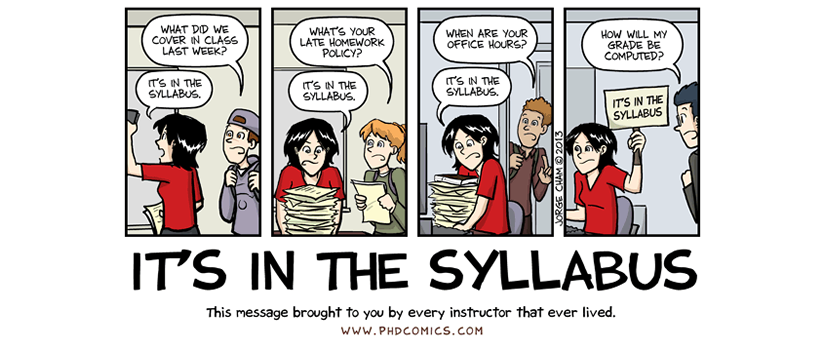
Another tool that I have used within my learning management system (LMS) where the course is housed (we use D2L Brightspace) is to create an FAQ Discussion Board where students can ask questions that they have about the course or assignments. I also encourage students to look in the syllabus and the assignment instructions and grading rubrics to see if they can find the answer to their question before reaching out to me. Nine times out of ten, the information they are looking for has already been provided. This prevents me from getting a lot of repetitive questions via email.

Sometimes a student will email me about something that I hadn’t thought of and that the whole class would benefit from. In these cases, I usually email the entire class or post a news item/announcement in D2L to share the information with everyone.

Assignment Information:

I try my best to provide students with very detailed assignment instructions and marking rubrics (when applicable). I encourage students to mark their due dates in their calendar/planner, start working on their assignments early in the term, and sometimes include smaller low stakes assignments along the way to get them started. When possible I also include example assignments (in the course site, not actually in the syllabus) from previous students (with permission) so that they understand what I am asking them to do. Obviously this isn’t possible for every type of assigment or for tests but it helps clarify expectations tremendously. For tests, I also find it helpful to have a marking key with justification for correct and incorrect answers. Yes, it is time consuming to make this but it is super helpful to have on hand when explaining to students where they went wrong or misunderstood a question/answer. It also helps me check that I didn’t write a wonky question and when I am lucky enough to have TAs, it helps them understand how to mark.

Providing students with information up front about what happens if they submit assignments late (or never) or miss a test or need an extension is also really important. With the current pandemic, many of my students have had additional challenges (many of them are nurses working on the front lines or in management positions and have kids at homes, etc.) so I have tried my best to be supportive and flexible with due dates this year. I usually give students 48 hours of extension time that they can use any time during the term as long as they let me know a few days before the due date. This information is included in the syllabus. Generally, few students use this but it helps reduce their stress because they know they have that buffer if they need it.

The last thing that you may want to include in your syllabus is an easter egg that students will find if they actually read your syllabus. If it is a smaller class and you don’t mind getting a bunch of emails you could ask them to email you a picture of an animal or a car (or whatever). Another approach (which I prefer) is to set up a short survey using Microsoft or Google Forms (depending on what your school uses). Insert the link into your syllabus near the end with brief instructions to the student to click on it.

Example text:

Let me know that you read the syllabus by completing this brief survey: click here.

Sometimes the hyperlinks can be really long so you can shorten the text to display by clicking on the second letter in, typing what you want it to say, and then deleting the first letter and the remaining letters after what you typed. This looks better and also can make the easter egg less obvious to students who aren’t actually reading the syllabus.

So there you have it!

Is there anything I missed?

I would love to hear what you include in your syllabi. Comment on this post if you have something to share.

Annual planning as an academic

As an academic, I think it’s important to understand the ebb and flow of your academic year in order to plan ahead and be strategic with how you invest your time and energy at different times of the year.

Hallelujah! 2020 is almost over forever. I’m sure I’m not the only one who felt like this year was 15 years long. I am done with it and ready to move on. Who’s with me?!

While January 1st is not my first choice for the “start of the year”, it is an opportunity for a fresh start and a time when many of us reflect on the past year and think about what we want to accomplish in the year ahead.

In this post, I’m going to talk about the different “years” that we deal with in academia (and as a parent if that is applicable to you) and how you can use that information to strategically plan your year.

As an academic, I think it’s important to understand the ebb and flow of your academic year in order to plan ahead and be strategic with how you invest your time and energy.

There are multiple “years” that you need to be aware of: 1) the calendar year, 2) the employment year, 3) the academic year, and 4) your children’s academic year (if applicable).

1. The calendar year. January 1st to December 31st. This is the most obvious year but other than taxes, vacation time, and the normal calendar, it is not actually the schedule that we really live by in academia. That being said, the calendar year can sometimes be used to your advantage (or not) when it comes to publications, conference presentations, and research grants.

2. The (university) academic year. This is another year that we are very familiar with since we have spent most of our adult lives at the university in some capacity. In Canada the academic year runs from September of one calendar year until August of the following one. It is divided into Fall Term (Sept-Dec), Winter Term (Jan-Apr), and Summer Term (which includes multiple course timeframes between May-Aug). For me, the academic year is all about teaching responsibilities, graduate student progress, and administrative deadlines. Normally professors are required to teach during 2/3 of these semesters/terms, with one term to focus more on research. That looks great on paper but in real life, most research happens over the full year, not just over 4 months. However, knowing your teaching responsiblities does allow you to prioritize the most time-consuming aspects of your research when you have less/no teaching.  

3. The employment year. Typically, this year is from July 1st of one year to June 30th of the following year. This is the “year” that counts towards probation, tenure, promotion, and years of service. Often you will be required to provide an updated CV or progress report by June 30th every year to show what you have done in the last year. This year is also used to determine when you are eligible for sabbatical leave and your possible retirement dates.

The employment year is a bit awkward because it includes parts of two academic years: a) Academic Year 1: Tail end of summer term (July/August), and b) Academic Year 2: Fall term, Winter term, and first half of summer term (May/June). However, I still think it is the best year to use for planning as an academic.

If you are on the tenure track or pursuing promotion to full professor, you should absolutely print out a copy of your employment contract and write down the key dates related to submission of your applications for probationary review, tenure, and promotion. I also encourage you to go buy a sturdy 2-3′ binder and start creating your portfolio of evidence of meeting the criteria for tenure as you go. It is so much easier to do this as you go than waiting until the last minute!

4. Your kids’ academic year. If you have school-age children like I do, then you also deal with their academic calendar in your planning. In Canada, the school year runs from after labour day in September until the end of June. This year aligns almost perfectly with your employment year, minus the summer (July/August). Remember how the summer semester was supposed to have “extra” time for research? About that…

Seriously though, if you have kids, you need to find something for them to do when you are working in the summer and also plan for some family vacation time. If you are going to have students working for you in the summer you also need to consider how you are going to deal with that. Are you going to make them take vacation at the same time you do? Are there things that they can work on independently? Or maybe you have a post-doctoral fellow or senior graduate student who can step up and provide some leadership while you are on vacation?

Putting all these years together we get the following:

Note that I used the employment year as the base year for this because in my opinion it is the most important one as an academic employee. From this perspective, we are actually halfway through our “year” rather than at the beginning of it.

Planning Strategically for the next 6 months:

  1. Make a list of the things that you must do in the next 6 months.
  2. Is there anything that you can delegate, defer, or make easier? If yes, take action to make those things happen.
  3. Schedule your remaining must dos into your calendar.
  4. Make a list of the things that you want to do in the next 6 months.
  5. Rank the items on your want list.
  6. Schedule your want list by priority.

Example:

  1. My MUST DO list for January-June 2021 looks like this:
    1. Teach graduate course on healthy public policy & determinants of health (online, synchronous)
    2. Teach undergraduate course on professional practice (online, asynchronous)
    3. Oversee development of specialty nursing professional development certificate
    4. Transition to Associate Dean role
    5. Move to Moncton for new role (sell house, find new place to live, etc.)
    6. Graduate student supervision (currently 4 students)
    7. Co-lead of 1 major research project
    8. Co-investigator on another major research project
    9. Sign up kiddo for summer day camps
  2. Is there anything that you can delegate, defer, or make easier? Not really lol…
  3. Schedule your remaining must dos into your calendar. Many of my must do commitments have weekly times allocated to them. For teaching, I also make sure that I put all of the assignment and test dates into my calendar and block off time for marking and meeting with students afterwards. Selling my house and moving is going to take up a lot of time and energy so I am going to wait until I am done teaching in April before I start looking for a realtor and putting the gears into motion for that. I have the advantage of having a lot of experience moving which will help but it is still a lot of work! Day camp sign ups are usually in May/June so I will put a reminder in my calendar for that.
  4. My WANT to do list for January-June 2021 looks like this:
    1. Finish and submit 2 journal articles that I have been working on
    2. Have a big BBQ party to say goodbye to our Fredericton friends (depending on COVID19)
    3. Compete in a powerlifting competition
    4. Lose 20lb
    5. Plan a fun camping trip vacation
  5. RANKED LIST:
    1. Plan a fun camping trip vacation
    2. Lose 20lb
    3. Finish and submit 2 journal articles that I have been working on
    4. Compete in a powerlifting competition
    5. Have a big BBQ party to say goodbye to our Fredericton friends (depending on COVID19).
  6. Schedule your want list by priority.
    1. Planning for the camping trip vacation will actually have to happen later on once I have sold my house and have specific dates for moving. I am confident it will happen but even though it is #1 on the want list, it will have to wait.
    2. Losing 20# is an important goal for me this year. I have been sitting so much the past year and feel unhealthy. To work towards this goal I have scheduled in time for walking the dog twice a day and working out in my home gym. I also schdeuled in time for weekly meal planning, grocery pickup, and meal prep.
    3. These 2 articles are so close to being done! I blocked off time in the next 3 weeks to work on each of them and polish them up.
    4. I haven’t competed in powerlifting for 6 years (yikes) but it is something that I really like doing and would be fun to do with my powerlifting friends. The one I want to do is in early April on PEI which has been super strict with COVID19 restrictions. I’m still on the fence about this one because it is during a busy part of the semester and there is still a lot of uncertainty about COVID19. I also just realized that it is on Easter weekend so I think that specific competition is going to be a no for me this year. The next 6 months is going to be busy so while I will still work on my strength and fitness, I think the wise choice is to look at competing next year instead.
    5. BBQ party TBD…will have to wait and see!

I hope this process helps you with your planning for the next 6 months 🙂

Happy planning!

Unsolicited Advice for Writing a Research Article for a Journal

Writing research articles for peer-reviewed journals requires practice, patience, and persistence.  I am by no means a prolific scholar but I worked with one who was amazing (the late Dr. Heather K. Spence Laschinger) for six years and learned a thing or two about writing journal articles (and my record isn’t too shabby for an early career scholar either). I am also an award-winning peer-reviewer for several journals so I have seen a lot of excellent and not-so-excellent submissions which has made me a better scholar too.

One of the things I really love about this role is being able to provide helpful feedback to others that can help strengthen their work. Chances are I will never be your peer-reviewer (unless you are a nursing or management scholar) but I wanted to share some tips on how to present your best work and improve your chances of publishing your research. From a reviewer perspective I think this guidance is important too because we are volunteering  our time to review papers (yes, that’s right, we do it for free, mostly because we care and are mega-dorks) and trying to review a poorly written and/or disorganized manuscript is frustrating.

So, without further ado, here’s my unsolicited advice for writing a research article.

Select the journal first

But, how do I choose a journal?

First, read the aims and scope of the journal to make sure it is a good fit for your research. For example, if you did a study on job burnout, you might not want to submit it to the Journal of Applied Physiology. Burnout Research would be a better fit for your work. Journal-research fit, if you will, is super important because the editor wants to make sure that the articles are of interest to their readers.  You will not make it past the editor’s desk if your article isn’t a good fit for the journal so save everyone some time and do your homework before you submit (and even better, before you begin writing).

Ideally you should select 2-3 journals that are a good fit for your research and then compare them. Look at their impact factors and take a look at a couple of recent articles from each to get a feel for the kinds of studies they publish. Also look at the word length and author guidelines because sometimes that can be more important than impact factor if you need more space. I recommend always going for the best journal first and then keeping the others in mind in case your work gets rejected from the first choice.

Read the author guidelines and follow them EXACTLY.

Don’t waste your time writing a 10,000 word paper with 10 tables and figures for a journal that wants 5,000 words and a max of 4 tables and figures. Author guidelines are not suggestions – they are rules! Your job as an author is to make it as easy as possible for the editor to give your paper the green light to move on to the peer-reviewers. You also want to make it easy for the reviewers to focus on the content of your paper, not the writing, grammar, and formatting, etc. It is also worth repeating that the journal already gave you the guidelines!  It’s not rocket science, it’s attention to detail (and it’s important!).

Use a reference management software program.

While it is tempting to just use the copy and paste feature from Google Scholar, in the long run, it will save you a ton of time to save and organize your articles systematically. I use Mendeley (it’s free) so I will speak directly about that program. Mendeley has many cool features that make life easier for researchers and students.

  1. You can upload PDFs using drag and drop and the program will populate all of the reference fields automatically (always check for accuracy though because they are often imperfect).
  2. The program then allows you to highlight and make notes directly on PDFs of your articles so you don’t have to print them out.
  3. It has a cite and write feature for Microsoft Word that allows you to insert citations from your reference library while you write.
  4. It generates a reference list for you in the style of your choice. This will save you about a million years if your paper ends up getting rejected and you need to submit to another journal that uses a different referencing style (trust me, it is painful to switch styles manually if you haven’t experienced this).
  5. You are likely to reuse some of your references in the future for grants or papers so a reference management program keeps you organized (and again, saves you time looking up the same article 20 times).
  6. Your Mendeley library is saved on a cloud so you can access it on any computer. I love this feature because I can access my libarary at home and work and on my laptop so I never have to worry about where my files are.

Write the literature review/ theory section first.

Although not everyone emphasizes theory in their work I think it is really important. I am really not impressed by empirically-driven papers that dump a bunch of variables into a statistics program and tell me that they are significantly related to one another statistically. I want to know if those relationships are meaningful. In other words, why and how are things related and what are the implications? This is where theory and logic come in. Let’s pause here and think about an example: both ice cream sales and drownings increase significantly in the summer. Logically, we know that drownings do not cause increased ice cream sales or vice versa, but rather, both are related to an increase in temperature (when it gets hot people are more likely to want to eat ice cream and to cool off in the water). Another example: Mud and rain are positively correlated but we know that rain causes mud, not the other way around! In both examples, the data could support relationships that are not logical, demonstrating the need for theory-driven research. Don’t start with your data; start with why! (“Start with Why” is also the title of an excellent book by Simon Sinek, FYI).  If you are doing a qualitative study then theory is equally important in terms of identifying and explaining the paradigm and method that you are using. Helter skelter coding of interviews or focus groups doesn’t quite cut it.

Write the methods and results sections next.

These should be the easiest parts of your paper to write. In the methods section you simply explain what you did in your study and in the results you describe the findings. Writing these sections makes your paper feel like a “real” article and gives you the content you need for your discussion section and conclusions.

Your methods section should outline your study design, sampling procedures, data collection methods, intervention and control groups (if applicable), and data analysis methods. For quantitative studies, providing accurate information about your measures is really important. Describe each one and provide support for their validity and reliability.

A quick note about tables and figures here – make sure they are formatted the way the journal wants them and that they are easy to read and understand. I suggest using the full names of variables rather than abbreviations (e.g., “job satisfaction” is easier to understand at a glance than “jstotal” or whatever code name you came up with in SPSS or SAS).  Never ever copy and paste output from statistics programs!  Just don’t. As a reviewer it makes me cringe when people do this. You can easily copy it into a word document and reformat it to meet the journal guidelines.  When you don’t it looks like you either didn’t read the journal guidelines or you didn’t care.  For bonus points, if you have space to include a diagram that shows your model of how variables are thought to be related in your study, it is super helpful to reviewers and readers (and arguably to yourself).

Tackling the discussion.

The structure of this section is going to depend on your research and the journal guidelines but generally, it is a good idea to have an introductory paragraph that sums up the overall findings and then subheadings to discuss different key findings in further detail (keep it logical and organized). You should interpret the meaning and implications of your results and discuss how they fit with past research. This is one of the toughest sections to write because it requires the synthesis and integration of ideas from multiple sources. You should not just paraphrase or summarize what was found in other studies; you are explaining, linking, comparing, and analyzing your results and those of other studies.  You are pulling out the meaningfulness of your study.

Limitations.

Despite common limitations for studies with similar designs, most journals still require that you provide a limitations section. For example, obvious and common limitations include sample size and power, response rate, cross-sectional designs, common method bias, sampling bias, and social desirability bias. Pick two or three of these to address (not all of them!). If there is something particular that you think limits the validity or reliability of your results or their generalizability beyond your study, it is important to include it in this section and explain the potential implications or cautionary interpretation needed. As much as possible, keep this section short and sweet.

Introduction section.

You are almost there! Again, make sure you follow the instructions for authors for the journal because some of them are very particular about what to include in each section. Often the introduction includes a statement about the purpose and/or aim of the study and is the place where you need to introduce the reason why your study was needed. The introduction is an excellent place to use some key statistics that highlight the severity or reach of the problem at hand and grab the reader’s attention. At the end of the introduction it should be obvious what the problem is and how your research is going to address that problem.

Writing the abstract.

Think of your abstract as the profile picture of your article. People will decide whether or not to read your paper based just on this short blurb. Whether we approve of it or not, sometimes people only read the abstract because they don’t have access to the full article or they are pressed for time. Abstracts are also used in the systematic review process and for conference presentations so learning to write excellent abstracts is a valuable skill. The biggest challenge is fitting everything you want to say into 150-300 words (just look at the length of this blog post lol!). Not easy and again, every journal has different guidelines. Some want a descriptive paragraph but most have subheadings (e.g., Introduction, Purpose, Methods, Results, Discussion, Conclusion, keywords). Generally you have room for 1-2 sentences for each section so you have to be concise and edit a lot!  The best advice I have for this process is to start from scratch instead of cutting and pasting sentences from your paper (always too long and too detailed) and to write only one essential sentence for each section. Then you can add as needed and as room permits.

Consistency.

The last point I want to make is that it is essential that your entire paper is consistent from start to finish. If you are examining the effectiveness of a weight loss intervention on cardiovascular risk factors in overweight men, then the whole entire paper should focus on that. There shouldn’t be new surprise variables like vitamin D consumption or social support introduced in the middle of the paper! Likewise, your discussion and implications should be logical and realistic. One study never proves anything 100%. Recall that with hypothesis-testing research a significant result just means that you are 95% sure (or 99% sure, depending on your p-value) that your results didn’t happen by chance.  You are contributing to a body of evidence and an ongoing research conversation. To improve consistency, after your first draft is written take a break and read it from start to finish with fresh eyes. Read it critically and ask yourself if there is anything that doesn’t make sense or flow quite right. Talk about your variables in a logical order and keep the same order throughout your paper and in tables and figures. This creates less work for the reader and makes it easier to follow.  Once you are done editing, get someone else to edit it. If you are working in a team and different sections were written by different people, it is especially valuable to have one person edit the whole document and make it flow (everyone has a unique style!). If English is not your first language and you are submitting to an English-language journal definitely try to get it proof-edited by a professional for grammar and spelling before you submit.

Hope you found this helpful and if you are a nurse, please check out my new feature Nursing Research Summaries. I think you’ll find that helpful too!

Happy writing!