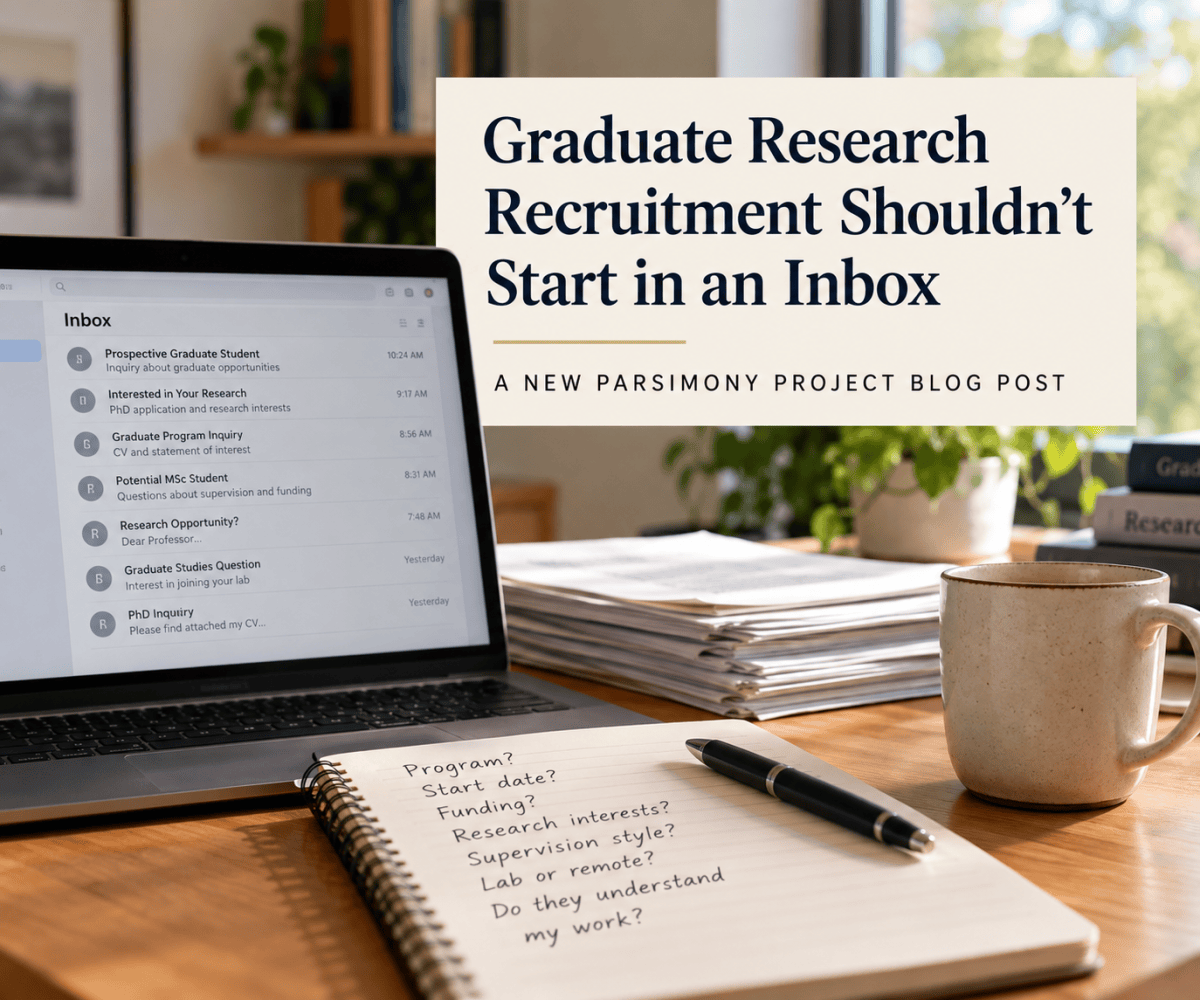
Graduate Research Recruitment Shouldn’t Start in an Inbox

A clearer, more consistent first step could make graduate student recruitment easier for both researchers and students. This post looks at what is missing from the current inbox-based approach and why I built Research Portage as an alternative.

For October’s theme/area of focus, I chose to focus on improving graduate student recruitment.

The current process for most of us is to share our email address and tell interested students to send us an email. Then a student sends an email (often a very long one…), maybe attaches a CV or transcript, maybe explains why they are interested in your work, and maybe provides some information about what they are looking for.

Then the back and forth starts. What program are they applying to? When do they want to start? Are they looking for a funded position? What are their research interests? What kind of supervision are they hoping for? Do they understand what your work is actually about? Do you run a physical lab? Is remote work possible? This list goes on…

None of this is especially complicated, but it creates a surprisingly messy and inconsistent system. It also depends heavily on students knowing what information matters, what a potential supervisor wants to know, and how to communicate all of that in an initial email. Researchers, meanwhile, are often trying to make sense of very different kinds of information arriving in very different formats.

At many universities, faculty profiles are like a mini-CV; you can find out about a professor’s education, research funding and publications, etc. However, these profiles are much less likely to explain how research actually happens or what it’s like to work with someone. Those things matter enormously, but they are often invisible until much later in the process.

That leaves students trying to infer a lot from a publication list, a short biography, and perhaps a few project descriptions. Researchers, meanwhile, receive inquiries from students who may not know the right kinds of questions to ask or who could have identified potential supervisors with a stronger fit if they had better information.

For all these reasons, I felt like the graduate student recruitment process was ready for some work redesign.

What if the first step was simply clearer for everyone involved? Students should be able to learn what a researcher studies, what kinds of opportunities are available, how they supervise, what they expect, and what it might actually be like to work in that research environment before they reach out. Researchers should be able to receive the same core information from interested students in a consistent format before deciding whether a conversation makes sense.

At one point, I considered building a matching tool (after all, questionnaire design and validation is part of my researcher toolkit). But the more I explored this, the less comfortable I became with the idea of reducing something as complex as a student-supervisor relationship to a score. The goal is not to automate judgment. It is to make the first step clearer and give both sides better information before they decide whether a conversation makes sense. That does not require a score, a ranking, or an algorithm deciding who belongs. It just requires a better starting point.

That thinking is what led me to build a web-based platform where researchers can build a recruitment page focused on graduate student recruitment and a standardized alignment fit check tool that prospective graduate students can complete if they are interested. I built Research Portage for myself to use but thought it might be helpful to others who want to improve or streamline their graduate student recruitment process. From a business perspective, I also saw an opportunity to solve a niche problem and make some extra money if people like the idea, because let’s face it, the cost of living is not going down anytime soon…

So without further ado, here is my first (and very amateur) ad for Research Portage. I used an AI tool to generate some clips of a fictional professor for the start and finish but it is my voice and real screen recordings otherwise.

If graduate student recruitment still lives in your inbox, Research Portage was built for you.

Take a look: researchportage.ca

Professor’s Notebook: Wrapping Up your Semester of Teaching

The end of term is a busy time that often involves a lot of final assessment activities for the courses you are teaching. It can be challenging to go the extra distance to make sure that you stay organized during the transition from one semester to the next. Today I’m going to share with you what I consider the “must-dos” to close out your semester, stay organized, and learn and grow as a teacher.

1. Submit your final grades on time

This should be low-hanging fruit but you’d be surprised how many faculty members either do not keep track of the deadlines for grade submission or struggle to get all of their grading done on time (especially with final papers/essays). You need to know your institution’s policy and dates for submitting final grades. It is very helpful to add the relevant dates for each course you teach to your calendar and plan your assignments and exams in a way that gives you enough time to grade them and submit the final grades on time.

As an aside, we usually underestimate how much time it takes to grade assignments so it can also be helpful to do some time tracking when you grade so that you have a more realistic estimate of the time you will need to block off in your calendar for this. Time tracking is simply keeping track of the amount of time you spend doing things and can be as basic as writing it on a piece of paper or in a Word document. Even timing grading a random sample of papers can give you a decent estimate of your average grading time for that assignment.

Obviously, it will vary by course, level, quality of writing, etc. but moving forward, this information can help you make informed decisions about the assignments you develop for your courses. There is also the whole AI thing which means we could be (some are) moving away from more traditional scholarly papers or essays or that we need to allocate more time to grading smaller scaffolded assignments throughout the term. We may (probably) also need more time to deal with AI cheating issues for some types of assignments. Even so, you need to get your grades in on time and make a plan that allows you to do that.

2. Clean up and organize your teaching files

You should have a personal filing system that makes it easy for you to find information. Personally, I have a main folder called TEACHING with a subfolder for each of the different courses I’ve taught and another level of subfolders by year for the courses that I have taught multiple times. You might prefer to organize by year. There isn’t one best way to organize your files but you do need a system that is consistent and works for you.

When it comes to teaching, there are basically three types of files: 1) content that you’ve created for teaching and learning, 2) content that others have created that you are using for teaching and learning while minding copyright laws (e.g., book chapters, journal articles, etc.), and 3) content that your students have created during the course (e.g., assignments, discussion posts, exams, etc.).

In my view, the student-created content and your evaluations of it require the most consideration due to privacy concerns and the potential for grade appeals. As a general rule, I would recommend finding out how long you are required to keep student work at your institution and then deleting the student work once that time has passed. For example, if you need to keep it for 1 year, then at the end of this term you would delete/electronically shred all student work from the Winter 2023 term. This includes discussion posts in your LMS.

The exception to this would be excellent work that you would like to use for accreditation/program review purposes or as examples to share with future classes. If you would like to save specific pieces of work from students for these purposes, you should ask them for permission to save and share their work in those ways now and file it in a special folder. The best time to ask students is now after you’ve just taught them (and after submitting final grades). Generally, I would ask for this permission via email and then if the student replies giving their written permission, I save the email thread as a PDF in the folder with their assignment.

The other types of files that you have (created by you and resources created by others) can be kept indefinitely in your personal filing system. I like to have folders organized by class or by week of the course and then a separate folder for assignments. I also create a brand new folder for each time I teach the same course. While this does create some duplication, it means that I have an archived version of the course for each time I taught it. Note that I always update and revise my courses to improve them so no two offerings are identical.

3. Read your student teaching evaluations

It might not be your favourite thing to do, but you really do need to read your student evaluations. Yes, there are known problems with student teaching evaluations – most students are not experts in teaching and learning, people have personal biases that negatively affect their ratings of women and members of minority groups who are professors, hard classes/subjects are viewed less favourably than others, and students with strong extreme opinions are most likely to complete the evaluation – however, there can still be helpful nuggets that can help you improve as a teacher so I wouldn’t advise ignoring them or sticking your head in the sand.

I would advise you not to take the feedback personally and to approach your teaching evaluations like a researcher instead. This is data after all. Print out your evaluations and go through them with different coloured highlighters. First, highlight all of the positive feedback in one colour. Then, highlight the negative feedback in another colour. I would ignore comments that are irrelevant to teaching (for example, comments about your appearance which yes, does happen when you are a woman). Look for common themes in each category. Are students consistently saying they didn’t like the textbook? Is there a 50:50 split on loving and hating an active learning strategy that you used? What is the data telling you overall? Write a brief summary of the overall feedback and consider what you might do differently next time to improve your teaching and students’ learning. You might also want to talk to your teaching support center or colleagues, do some research about the scholarship of teaching, or attend a teaching professor conference. Excellence does not require perfection, but it does require effort and there is always more to learn.

4. Take a day off (at least)

Lastly, it’s important to take at least a day off and decompress after a busy few weeks. Go do things that you enjoy and let go of the stresses of the semester. If you can take a vacation (at least a full week) I would highly encourage you to. Sometimes it feels like there is never a good time to take one but it is super important for your health and wellbeing, and, perhaps counterintuitively, taking vacation benefits your productivity at work long-term. Burnt-out people are not productive people so let’s avoid going down the burnout path 😉

And that’s it for today. Go wrap up your teaching semester and enjoy a well-deserved break~!

On Liberal Arts Education

Worker shortages across industries are creating intense pressures to create shortcuts to educate people to fill in the holes in the roster as fast as possible. We need tradespeople, we need nurses, teachers, doctors, and the list goes on… Yes, we definitely need more people in the workforce. But, we need the right people and we need them to know what they are doing (and also, to have the insight to know what they do not know and need to learn).

The trend to shorten education programs and view them as a type of factory that produces workers for the system leads to devaluing learning that is not directly linked to on-the-job tasks and skills that are visible and obvious to non-experts outside the field. For example, as a nurse, it is absolutely essential to understand ideas beyond the knowledge and skills necessary to do medical procedures like giving medications, inserting IVs, and so forth. Understanding the human condition, the determinants of health, the structure, history, and politics of the health care system, and the ethical aspects of care are also very important.

Teachers also need to have a broad understanding of the world, civic engagement, human development, social and political issues, science, arts, history, technology, and more, along with developing their skills and knowledge specific to teaching including curriculum and lesson planning, teaching, evaluation, and classroom management. It takes time to learn all of that.

Arguably, the purpose of education is not just to provide graduates with a career (though, yes, this is important too), but also to develop their critical thinking abilities, introduce them to new ideas, inspire them to think differently, and learn more about themselves and the broader world. Liberal arts education especially provides students with the opportunity to do this because it requires students to take a variety of courses across different disciplines and prepares them to be engaged and thoughtful citizens.

As a student, I didn’t really understand what liberal arts education was or why it was important, but in retrospect, I think it has been instrumental in my personal and professional development. For example, the English courses I took early on were challenging and required me to become a critical reader and thinker, as well as further develop my writing skills. These skills were incredible assets as a kinesiology and nursing student, as well as in my career as a professor. I also learned about different ways to think about and understand the world that I had not been exposed to growing up in smalltown rural Nova Scotia.

Even as a PhD student, my supervisor required me to take graduate courses outside of nursing. Instead of the minimum four courses, I took 10, including courses in instrument development in the Department of Psychology and courses in advanced statistics and teamwork at the Ivey School of Business. These courses introduced me to valuable new perspectives and new ideas outside of my home discipline which are still highly relevant to the work that I do now.

The benefits of liberal arts education and the perils of not exposing students to broader ideas and knowledge seem even more relevant today, with the pace of social and technological change. For example, it is readily apparent that we are not well-equipped to deal with the wide-ranging negative consequences of AI, many of which involve ethical and moral dilemmas. We are also living in a society that is increasingly influenced and polarized by the echo chambers of the internet and social media. Unfathomably, science (and education) is under attack and many people lack the knowledge and skills to critically appraise information and sources. Now, more than ever, we need to foster intellectual curiosity, critical thinking, and philosophical conversations and debates about social and ethical issues. We need liberal arts education.