Academic Conferences and Children

I’m excited and slightly overwhelmed by all of the planning currently going on in my life. I have been invited to present at two awesome conferences this summer and am preparing to move to a new city to start my first tenure-track job. Very exciting, but also extremely stressful because I am in charge of organizing everything and I am also getting ready to defend my dissertation at the end of the month (also amazing but stressful).

Regarding conference planning, the biggest stressor for me is figuring out the best plan for my child while I’m away. Sometimes it makes sense to bring him along but that requires an additional responsible adult to come with me so that I can actually present and attend some of the conference. It’s obviously more expensive to do that but it can also be more fun in the end, even if it requires more coordination to plan.

When it doesn’t make sense for him to come, I have the glorious fun time of organizing child care for him. I am fortunate to have lots of social support – in London. Now that I am moving to a new city it’s going to be a little trickier to navigate all this. I am closer to family but they are busy with their own lives and I feel guilty asking for help. I feel ALL the mom guilt – guilt for spending time alone/with other grown-ups. Guilt for having a career that is important to me. Guilt for not making my child the centre of my universe at all times. Guilt for not having a significant other. Guilt for not enjoying my time away as much as I could because I feel guilty about all these other things. Enough with the guilt already, right!

For better or worse, research dissemination and staying current is part of my job. It’s not like you finish your PhD and that’s the end of learning and scholarly work. I feel very fortunate that travel is part of my job but it’s not like it’s an all-expenses paid free-for-all! Unless you are a well-funded researcher (which is the exception rather than the rule), there is little funding to assist with the expenses of conferences. It also takes a tremendous amount of time and energy to prepare an abstract and a good presentation, a fact that often goes unacknowledged.

Sure, you could go to one conference a year but that might be a career-limiting move because fewer people will see your work. It also limits your exposure to interesting research across disciplines which may provide valuable insights and generate new ideas. I value the professional memberships that I have in nursing and management and conferences are an important part of these organizations. Increasingly, there are more and more conferences to go to as well! For example, APA puts on an excellent Work and Stress conference where every presentation is something I am interested in. Obviously you can’t go to everything, but it is not easy to choose or to say no.

So I’m left asking myself the question: “what’s a sane number of conferences to attend each year?”

Not sure that I have an answer yet but I will figure it out 🙂


Sitting is the New Smoking…

sitting-is-killing-you

So apparently, sitting is the new smoking…and therefore, I am probably going to die.  Not really (I hope), but there has been a whole lot of attention to the “sitting epidemic” recently, highlighting how much time most of us spend sitting during a regular work day.  (Clearly, they have not spent any time with a staff nurse lately!).  The solution? A standing desk, of course.  Or a treadmill desk. Or taking frequent breaks. Making sure that you have an ergonomically designed work station….

On perhaps, we need to start asking different questions about how our work is designed. For example, in academe, we do spend a lot of time sitting at our computer working on all kinds of things from research grants to articles, powerpoints, data analysis, etc.  Some of this work is unavoidable I think but I also wonder if some of this time could be used more effectively. For example, do we really need to write 20 research articles using one dataset?  Do we really need another book chapter on such and such that a handful of people will read?  What if we publish one really strong paper and then talk to people about our ideas instead?  How much more fun (and time effective) is it to interview people, record a podcast, or share a conference presentation on YouTube?  Obviously, none of these things completely eliminates computer time but I am guessing that the impact of one really great Ted Talk is much broader and valuable than a research article buried in an academic journal that mostly only other researchers are going to read.  Unless of course, more research articles = more tenure points.

Sometimes collecting tenure points feels a bit like being Mario trying to get all the gold coins within reach (and apparently research activities that require copious sitting are as likely to kill you as sitting on your butt playing too many video games).

mario coins.jpg

So let’s assume that you just have to accept that your job requires some sitting.  What can you do to make it less bad?

  1. Take care of your body. Exercise. Eat nutrition food. Go easy-ish on the coffee (mostly). Get enough sleep.
  2. Plan ahead for the ebbs and flows of the school year. Midterms? Exam period? Research grant deadlines?  These are busy times, but they are not unexpected!  Get a calendar and plan ahead. I like to make extra healthy meals and stick them in the freezer to reduce cooking time. Having some exercise equipment in the basement is also really awesome for saving time when I am busy.  There have also been times when I have had to hire my babysitter to give me an extra morning or afternoon to do work on the weekend. (Fingers crossed that being a professor is more awesome than being a grad student working full time!).  Do I always get to do a full workout? No. But sometimes 10 minutes of exercise is better than nothing 😉
  3. Be super organized. You can waste a lot of time trying to simply locate documents, references, and sort through different versions of things.  Having a logical way to organize files and name documents will save you a ton of time. I even get my students to name their documents in specific ways so that I don’t end up with 25 versions of “Assignment 1”.  Using a reference management software program is also a really great way to save time with citing and reference lists, especially when you need to use different referencing styles for different journals. No more wasted time seeking and downloading the same reference articles over and over!  Lastly, using tags and folders in your email inbox is another strategy that saves oodles of time. If you can use the same main categories as your main files on your computer, that is even better!  I like to use gmail and get all of my other emails forwarded to that one account.
  4. Be reasonable. Sometimes I struggle with this. (e.g. “Of course I can have a baby and do my PhD and publish and compete in powerlifting and work at the hospital and teach, etc. at the same time…).  I like to set big goals and have a tendency to say yes to everything but I have learned that this usually leads to burnout. A better strategy is to take on a few things that you can really focus on. Reading (and re-reading) the Power of Less  is a helpful place to start.  Academia seems to reward people who work hard and do a lot but I think another point to consider is that learning and teaching is exciting!  Research and teaching are (should be) both about learning new things and understanding more about the world around us, as well as sharing that knowledge and excitement about learning.  It is hard to say no when you are excited about learning and sharing ideas!   Is it reasonable to spend 20 hours a week preparing for a class you are teaching for the first time?  Maybe not if you are teaching 3 courses and have other things on your plate.
  5. Aim for excellence, rather than perfection. I don’t think there is such a thing as “perfect”. The pareto principle, or 80:20 rule comes in handy here too. It states that 80% of your outcomes/effects will come from 20% of your work. Do you really need to make 50 slides for a 10 minute presentation?  Or, would 10-12 slides, well-designed, be more captivating and effective in getting your point across?  How much time are you spending sitting, working on things that have little to no impact?  After all, sitting is the new smoking….

I want an academic career. When’s the BEST time to have a baby?

The short answer is that there is no best time and that really, anytime is the best time. Nothing can ever prepare you for the challenges and joys of parenting – regardless of whether or not you are a grad student, a practising nurse, or a stay-at-home mom.

That being said, it helps if you have a committed partner and some sort of plan.  Personally, I did not have that experience. Let’s just say that the pill is not 100% effective.  I stuck with my life plan (sort of) and worked at the hospital as an RN until September and started my PhD 9 months pregnant (against all good sense I think) and took one week off from classes (because my supervisor made me). The “birth plan” involved my wonderful friend driving me and my roommate to the hospital where we streamed episodes of New Girl while I waited for my son to decide to make his grand entrance. My sister and her boyfriend flew in and met us there (he stayed outside).

Lucky for me, in Canada we get a year of paid maternity leave and you can be in school during that time – I didn’t plan this out at all but it definitely made life a lot less stressful. For the first semester we didn’t have a car so we got up early to catch the bus so I could take him to the wonderful home daycare we found, then back on the bus to school. After school I would go back on the bus to get him, and again on the bus to go home or sometimes to the Y and then home.  It was exhausting!  On the plus side, it really made me appreciate the amount of time and energy it takes to coordinate life when you don’t have a car.  Before my son was born I rode my bike a lot and it was hard to not be able to do that anymore.

One of the best things about being a single parent and a nurse was how much support I received from others. The nurses at work threw me a baby shower, offered support and advice, and even offered me lifts to and from work when they could.  My former roommate lived with us for a year until she finished her nursing degree (God bless her) and friends have helped take care of my son so that I could go to work, school, and conferences (one even road-tripped with us to Indianapolis!).  Their love and support made me realize how important relationships are in life and sparked my interest in workplace social capital (my dissertation topic).  In many ways, our lives have been richer because it was obvious to others that we needed them.  I’m not sure that it is always the same when people are married and it is assumed that they have all the support and help they need (I’m sure that it is different for everyone).

I think you can balance a demanding PhD program with being a parent but it requires focus, discipline, and support. The balance is always changing too! The time you get to do homework when you have a baby who sleeps a lot is different from the time you get when you have a busy 3 year old who wants to play all the time.  You have to learn to be more flexible and adapt to what your child (or children) need as they grow up.  My son has helped me slow down and reminds me daily to play and enjoy life.  Not that I didn’t before but children have such an awesome way of looking at the world.

At times I have had to make tough choices about work because of being the only parent – for example, this past fall I chose a day job as a research coordinator (which I find rather stressful) because it had regular hours – but because of that I had to give up my part-time staff nurse position at the hospital (which I love) and go casual. It’s straight-up difficult to find daycare for shift work – especially when you are part-time and don’t have a consistent schedule.  I miss seeing my co-workers and my patients. Research is rewarding and I have learned a lot this year but it’s different.

Ultimately, I think being a parent has made me a better person and has made me more efficient with my time. When I am home, I don’t want to be thinking about work so I work hard at work to be organized and focus on things that are important. I have one dedicated day a week to work on my thesis and try to keep it contained in that time frame. I think one of the big problems with academic culture is this idea that working longer hours makes you a better, more productive member of the academy.  Numerous studies show that overworking people actually makes people less effective, less happy, and has very damaging effects on their health.  That, however, is a topic for another post I think…

Grant Writing Success

In late November I was offered my dream job as an Assistant Professor at the University of New Brunswick in the Faculty of Nursing (I enthusiastically accepted!).  I am getting ready to board the train on the tenure track and plunged right into writing my first CIHR grant as a PI. Not for the reasons you might think either. While I do understand that obtaining funding is valued as a performance outcome for faculty members, having money to do your research allows you to – wait for it – do your research 🙂  That being said, being awarded the money which allows you to accomplish valuable work is not the only reason to write a grant proposal and it is not the only measure of success (although, again, it is super helpful and makes it easier to do what you are trying to do).

So what else defines a successful grant application?  For me, success includes learning more about the research problems that I am interested in examining, learning more about what other researchers have done, and thinking about what we need to know and/or do to solve these problems (ultimately contributing to a healthier health care system and society I hope!). Building connections with other researchers, health care providers, and policy makers can also be a lot of fun!  Over the last few months I have been able to connect with others who share common interests and also have unique expertise and experience to bring to the project that I initiated. Regardless of whether or not we get funded for the project, we now have developed a plan, a budget, and have a good handle on what we want to accomplish through our research.

As a new kid on the block in New Brunswick it has also been really helpful for me to start meeting people and getting a better understanding of my new province. I grew up in Nova Scotia but each province has a different approach to health care delivery and my training and experience in nursing has been in Ontario in an urban centre which is quite different than Fredericton.  Making connections now will make it easier to fit in when I get there and I feel like it is a very welcoming place.

I do think our project is important and worth funding but I also recognize that there are limited funds and lots of great ideas worth funding.  It also depends on who ends up reviewing our application and the other projects that are being submitted.  At this point I’m not sure if you get “tenure points” for submitting applications that don’t get funded but it’s not like a straight-forward sport like track and field where there is a clear winner. Train hard, eat right, be the best, win, right?  Research grant competitions are more like artistic sports like figure skating and gymnastics where judges (reviewers) assess the relative value of competitors/applications and assess whether or not you will be able to successfully do the proposed research. Comparing research projects and teams that are qualitatively diverse makes it harder to decide which projects should be funded.approved

For these reasons, I think it is important to define success not just in terms of getting funded or not. As a novice PI, I am uncertain whether that will go in my favour or not.  After 4 degrees, 3 theses, and being able to balance all the demands of school, work, residence life, teaching, research, and being a single parent while also staying fit, I am 110% confident that I will be a good team leader and that we will be able to carry out the project as a team.  Of course, when you submit a research grant application you can’t put “single mom/time management ninja” or “worked 10 part-time jobs including running a residence hall while completing my undergrad” as part of your accomplishments/skills (and if you did, it would probably count against you).  Again, another reason why I think it is important to always do your best and see the process and the development of the proposal as an accomplishment and an opportunity to learn and grow as a writer and researcher.

Of course, if we do get the grant, it will be icing on the cake and I will be literally jumping for joy because we can start putting our research plan into action.  There is absolutely no denying that actually getting the grant is a successful outcome too!  And a very sweet one at that! However, if it is the only outcome that you focus on, I think that you miss out on a lot of other great things about writing research grants.


Cooking Once a Month is awesome

Some of advice I ever got about Grad School was from a former professor who told me how batch-cooking and freezing meals helped her complete her dissertation. This simple strategy makes a huge difference in terms of productivity and eating healthy (if you choose recipes carefully).  For most of us our leisure time is limited (and sacred), especially if you are balancing family life and a demanding career. Who doesn’t want to spend less time in the kitchen and more time playing, connecting with others, being active, and having a life!

Batch cooking may just be your ticket!  The basic idea is that you cook multiple meals on one day and freeze most of them so that you have less prep down the road.  I’ve been doing this on a weekly basis for a while now but recently I felt like I was in the kitchen all the time so I started looking for new ways to do this.

After scouring the web I found several menu subscription services but nothing that offered many choices – most had 1 menu a month, take it or leave it. So of course I decided to do it on my own but I got quickly frustrated because there are too many recipes to choose from on the internet and I couldn’t decide which ones I wanted to make. It was taking up a lot of my time and the whole point was to save time and make life easier – not spend hours trying to decide what I wanted to have for dinner!

Finally, I found Once a Month Meals – a group of moms who offer several types of menus (e.g. traditional, vegetarian, paleo, etc.) to choose from and make it easy for you to cook meals for an entire month.  For each menu you get the recipes, an organized shopping list, prep day instructions (chopping, etc.), cooking day instructions, thaw list (to help you plan when to take things out of the freezer so you can eat them), serving day instructions (some recipes have add-ons or need cooking), and labels. Obviously it would take a few hours to do all this on your own!

You can also swap meals to make your own custom menu if there is something that you don’t like.  Just enough choice to be flexible without being overwhelming. The other great thing about Once a Month Meals is that they provide very helpful tips and resources to help you every step of the way and save you a lot of headaches.  For example, starting with a mini menu rather than a full menu was a really good idea.

I signed up immediately and yesterday I did my first mini menu.  It was a huge success!  Take a look at how my day went:

Before the big day:

  1. Pick your menu. I chose to do a mini-menu because I only had 1 day free to do everything (shop, prep, and cook).
  2. Decide how many people you are cooking for.  Even though there’s just me and my son I chose to cook for 4 people so that I would get more meals for basically the same amount of work. (Tricky, I know lol) The recipes and shopping list automatically update to correspond to the number of meals you select. Thank you Once a Month Meals!  This is super helpful.
  3. Check supplies and ingredients in your kitchen.  Do you really have 4 apples in the fridge for that recipe? Do you have a slow-cooker if you need one?  Cross-check the shopping list with your inventory and makes notes so you won’t forget.
  4. Add other things you want to buy for the week to your list. The menus don’t cover all of your meals and snacks so add in whatever else you need for the week. For us that’s stuff like milk, yogurt, salad greens for lunches, coffee, etc.

Shopping tips:

  1. Bring a pen so you can check off everything as you put it in your cart.
  2. Be prepared to spend more than your typical shopping trip. You are cooking more than you usually would so obviously it will cost more money. However, it also will save money because you will waste less food and make fewer last-minute trips to the grocery store or fast food joints.  (If you have time and energy for price-matching and/or coupon clipping this can help you save money too).
  3. Don’t go shopping when it is busy. Not something that I enjoy anyway but if you are trying to buy a lot of food it can be overwhelming to deal with a ton of people at the same time.

Prepping and Cooking:

I decided to prep and cook each recipe 1 at a time. The fine folks at Once a Month Meals recommend doing prep the night before your cooking day and I think that would be faster, especially if you are cooking a full menu.  For example, I ended up chopping garlic 3 or 4 separate times for different recipes instead of doing all the garlic at once. Research shows that switching between tasks takes more time than doing one at a time. Another benefit is that you lower the chance of cross-contamination (meats and veggies) and use fewer cutting boards 🙂

Tips:

  1. Clean your kitchen before you start.
  2. Prepare slow-cooker dishes first. Set em’ and forget em’ while you work on other recipes 🙂
  3. Wash dishes as you go. This reduced the number of dishes that I used and the cleanup I had at the end.
20150330_092258
All cleaned up and ready to cook!

What I made:

1. Paleo meatloaf:

20150330_104532

2. Crockpot sweet potato chili

20150330_104545


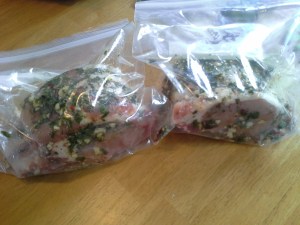
3. Garlic herb Crusted Pork Roast (sub for pork tenderloin)

20150330_111133

4. Almond butter chicken

20150330_114008

5. Jalapeno Chicken Burgers

20150330_120704

6. Pumpkin walnut protein muffins (my recipe that I added on)

20150330_124132

Grocery shopping took me an hour and a half and cooking took me 4 hours (10am-2pm). We had chili for supper (it was awesome!) and now I have a freezer full of yummy meals to help me through this busy month of marking and writing publications 🙂  You can have better work life balance and Once a Month Meals can help. Check it out!

Relationship-building in a Task-Focused World

Increasingly, employees are asked to do more with less.  Arguably, this is the goal of Capitalism: to squeeze out as much work as possible for the least amount of money in order to maximize economic growth. I don’t think that this is a particularly helpful way to approach healthcare, as I believe that it is a basic human right, not a privilege, and that relationships with other people are fundamentally inefficient but extremely important.

In nursing the pressure to perform and maximize efficiency can be particularly difficult to cope with, as increased workloads leave less time to spend with patients and their families which is an important part of our job.  It may not seem like having a conversation is “work” but it is through conversations that patients communicate their needs, hopes, fears, and values (among other things).  By getting to know our patients, we are able to ensure that we provide care that meets their needs and treats each individual holistically, rather than as a list of tasks on our daily to-do list.

Building positive relationships with co-workers and leaders are also essential to creating a positive working environment where nurses and other members of the healthcare team can work together to deliver high-quality patient care.  Investing time and energy into these relationships is not efficient in the short term but pays dividends down the road in terms of staff retention, decreased voluntary absenteeism, decreased short-staffing (which leads to more sick time and burnout, etc.), and of course reduced time spent recruiting, interviewing, and training new hires.  It’s not rocket science that people who like their co-workers and their work environment are more likely to stay than those that dread coming in to work every day.  Strong relationships also facilitate good communication and trust among team members and generate shared understandings of work processes, as well as who knows what, and who to ask when you need help.

While we cannot ignore the tasks that need to be accomplished, as these are obviously important, we need to change how we think about relationships in the workplace.  Culturally, we have a tendency to judge relational work as “non-work” when in fact connecting to others in the workplace is very valuable (and sometimes extremely challenging) work.   Unlike patient care tasks that are easy to quantify and check off, it seems artificial and contrived to make a checklist that says “talked to each of my patients about their concerns”, “invested in my relationship with Susan by asking her about her son’s wedding”…etc.  I would also argue that most of us are naturally social and interested in other people so we do a lot of this work anyway and that trying to maximize relational “efficiency” by reducing these things to tasks is ridiculous (and insulting).

I understand that healthcare is expensive and many of the pushes to increase efficiency are driven by our aging population, aging workforce, government austerity, union wage increases, and the economic recession of 2008 (to name a few things).  It is complicated.  However, we need to invest in people and create healthy workplaces that foster a sustainable workforce and allow our healthcare professionals time to invest in relationships with patients. Pushing people harder and harder to produce more with less is not a long-term solution and will cost us more in the long-run – not just in terms of money, but in quality of life, happiness, and patient care.

Maybe the next time you see a nurse, doctor, or healthcare leader talking with a patient or a colleague, you should acknowledge that they are engaging in valuable work.  Just because we’re not doing a task like inserting an IV or giving a medication doesn’t mean that it’s not important.


International New Graduate Nurse Research Colloquium

On June 20th, 2013, my supervisor, Dr. Heather Laschinger, hosted a wonderful research colloquium with invited researchers from around the world who all have a special interest in gaining a better understanding of the challenges facing new grads during their transition from student to professional nurse.

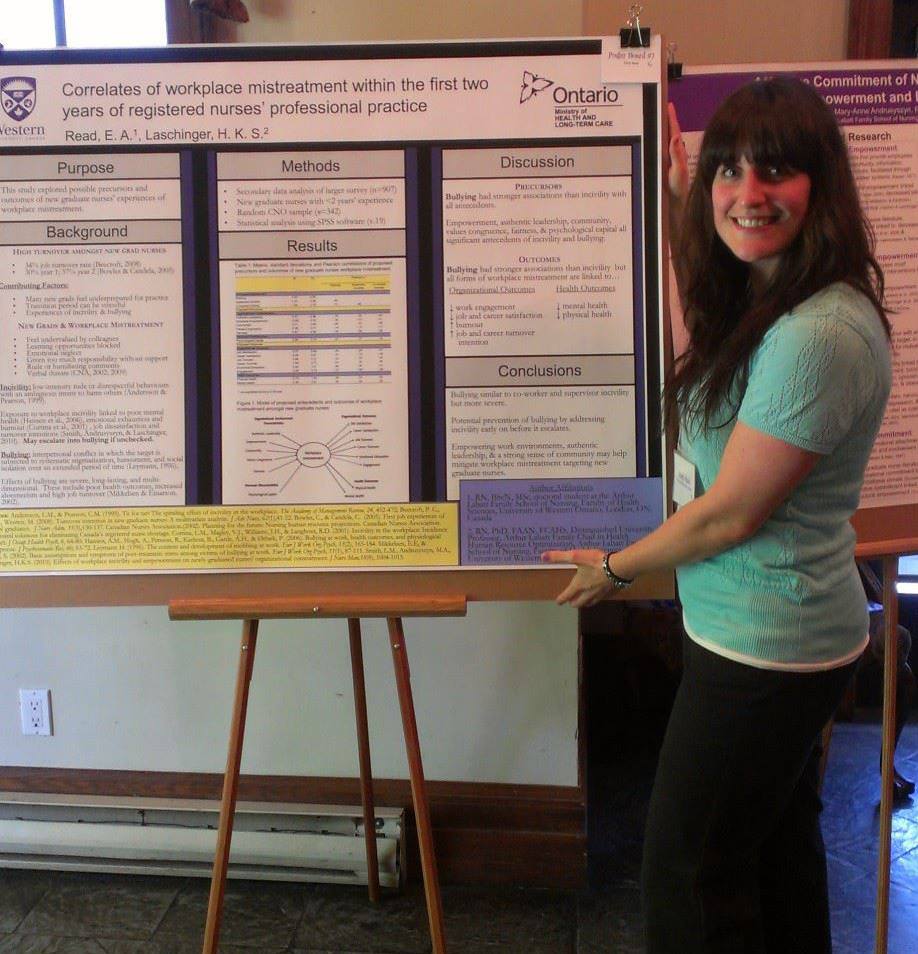
I feel so fortunate to have been invited!  It was a fantastic day of sharing ideas and research results, as well as thinking about what we can do moving forward to help nurses transition into their new roles.  I also had a chance to share a poster of my recent work about correlates of workplace mistreatment (i.e. incivility and bullying) directed towards new nurses in Ontario.   I wish that kind of research wasn’t needed to begin with but I think a lot of it has to do with structural factors of the work environment (e.g. leadership, workload, resources, support, etc. available to do your job) and personal factors that individuals bring with them to their job.  It is challenging to be kind and happy when you’re working overtime, have a heavy patient load, and are exhausted!    Nurses are valuable health human resources and we definitely have some work to do in supporting them/us and in particular, during transitions to new career roles (new grads or otherwise!).

Overall it was an inspiring day and I am so thankful that so many knowledgeable and fabulous guests were able to attend!    Christine also did a terrific job putting the event together and making the day run seamlessly 🙂  Nicely done everyone!

emily poster 2013

How to Choose a Supervisor

Choosing your supervisor is one of the most important decisions that you will make as a graduate student.  Personally, I have been very fortunate with regards to supervisors.   I have worked with excellent scholars who have been supportive and kind, yet pushed and challenged me to learn and improve.

As a graduate student, the importance of having a good relationship with your supervisor cannot be under-emphasized.   I started looking for my doctoral supervisor two years before I applied for the PhD program and was fortunate to be able to work with my prospective supervisor as a research assistant during that time.  This gave me direct experience working with her and helped us develop a positive working relationship.  I knew going into my program that she was someone who I wanted to continue working with and vice-versa.  I primarily choose Western because she is an expert in her field and I enjoy working with her.  I lucked out because Western is also an amazing university with one of the best nursing programs in Canada.

I’m not sure that there are any truly bad supervisors out there but I have heard horror stories from friends in other disciplines.  I think it’s also important to consider that two people may be fantastic but have difficulty working together if it’s not the right fit.   If you are in the process of trying to choose a supervisor, here are some suggestions to help you get started.

1. First and foremost, do your research interests align?

You may really like someone but if they are an expert in something that doesn’t really interest you, it is probably best that you don’t work with them.  Investing your time and energy into something that you don’t enjoy is only going to make you miserable and potentially put strain on your relationship.

2. Clarify expectations on both sides. 

What do you expect from your supervisor and what do they expect of you?  Sounds pretty basic but you’d be surprised how many people don’t know what they should expect or look for in a supervisor, or on the flip side are unclear about what they are expected to do as a graduate student.

Start by thinking about what you want to learn through your graduate studies.  What skills and expertise are you aiming to acquire?  Graduate school should be about more than just getting a piece of paper!  This is an exciting opportunity to learn so take advantage of it.  (If you don’t feel this way, perhaps you should reconsider your decision or engage in some personal reflection about your approach to learning).  What do you need from your supervisor to help you be successful in achieving your goals?   Regular meetings?  Constructive feedback?   Opportunities to work on research projects?  High fives?

Ask potential supervisors what they expect of their students.  What GPA do they expect you to maintain?  Which courses do they expect you to take?   How long does it generally take their students to complete their degrees?   What is the expected timeline?   Do they want you to attend certain conferences or work for them as a research assistant?

Being up front about expectations can help you both decide if this will be a mutually beneficial relationship and eliminate a lot of frustration and misunderstanding down the line.

3. Talk to a current or former student.  

Having a coffee with someone who has worked with your prospective supervisor is a great way to get a sense of what they are like to work with.  It can also give you some insight into other aspects of the program such as coursework, other faculty members, and most importantly, its culture.  Is it competitive or cooperative?  Are most students working full-time as nurses, managers, and educators or are they full-time students who spend time together regularly?   Try to get a feel for what the experience has to offer and how that aligns with what you are looking to learn and accomplish as a grad student.

Final Thoughts:

I’m sure there are other questions that you will come up with, but I hope this is helpful in getting the gears going!  I am a strong advocate of nursing graduate education and I think that we need to do a better job of encouraging and supporting nurses who are interested in furthering their knowledge and expertise in this way.   Positive relationships within the academic environment are just as important as those in the health care setting so I encourage you to seek out a supervisor who will offer you their best and who will bring out the best in you.

Have a great day!

-Emily

STTI Conference Reflections

I just arrived home from the Sigma Theta Tau International (STTI) conference in Indianapolis about creating healthy work environments.  It was a full day of driving there and back from Ontario but well worth the journey!   Everyone I met was so positive and inspiring – I wish we could spread this positive energy to the four corners of the earth and remind our colleagues that healthy workplaces are possible.  Are there barriers?  For sure.  But without a vision and passion for change, we are going to stay where we are, which unfortunately isn’t always  ideal.

Some of the highlights of the conference for me were listening to the panel discussion that kickstarted the conference on Friday morning, hearing Dr. Cindy Clarke speak later that day, and having a discussion about some of the challenges of having an academic career in nursing.

I had a real “light bulb” moment on Saturday when we were discussing the importance of recruiting and retaining doctoral-prepared nurses in academic positions and the value of  staying current in our clinical practice in addition to balancing the demands of teaching, research, and service while pursing tenure.

It dawned on me that the academy was not built with practice disciplines in mind, therefore clinical practice is not valued at many institutions in the same way as the traditional tripod of responsibilities (i.e. teaching, research, and service).   How can we be expected to prepare undergraduate students to become professional nurses if we are not up to date on our nursing skills and current best practices?  On the other hand, how can we possibly become and remain experts in all domains and still have a life?!    I’ll be the first to admit that I work 50-60 hours/week on research and schoolwork and the remainder of my time is spent with my son, working out, squeezing in other activities (like writing and grocery shopping) and sleeping.

Although I love my job as a staff nurse I am dreading going back to work in September when my maternity leave ends.   I know from experience that spreading yourself too thin takes a toll on my body and my mental health.  Not to mention that when quantity of activities increases past a manageable level, quality often suffers.   Having to choose between spending time with my son (which I will never get back) and running around like a crazy person trying to build my CV and establish my career is not easy.   I care deeply about nursing and I want to contribute to our profession in a meaningful way.  I also love my son and cherish all the time we have together.

Women already face enough challenges pursuing academic careers without the added obstacles of pursing one in nursing.  How can we expect nurses to give up their high-paying (and often unionized) staff nursing jobs to go back to school and still support their families?  Moreover, how can we expect nurses to complete their doctoral work while teaching or working full-time and often working the second shift at home as a mom and house manager?   Yet, so many do.   If we are going to successfully recruit and retain nursing faculty, we need to be more supportive of talented nurses who want to become educators and researchers.  We need to recognize and appreciate that as individuals we cannot and need not be experts in everything.  Every nurse has different gifts and strengths to offer that bring a wealth of knowledge and ways of being that enrich our profession.

For me, valuing, respecting, and embracing diversity is fundamental to creating a healthy profession and a healthy work environment.  Just because I have a passion for research and teaching and a few extra letters next to my name doesn’t mean I don’t admire and value the experience and expertise of seasoned staff nurses.  It would be completely ignorant of me to think that I know more or better than others; I simply know differently.  I would be gravely mistaken if I thought that what others have to offer makes me “less than”.  I can only hope that my colleagues in practice embrace the same attitude: I might be pursing an academic career but I am still a “real” nurse.

Thankfully, my nurse colleagues in academia have been so supportive and encouraging!   I have so much to learn and a long way to go but I am inspired by the courage, wisdom, and strength of the nurses who have led the way before me.   I am so fortunate to be surrounded by such wonderful scholars and nursing leaders.   Together we are all going to accomplish so much!