Professor’s Notebook: Wrapping Up your Semester of Teaching

The end of term is a busy time that often involves a lot of final assessment activities for the courses you are teaching. It can be challenging to go the extra distance to make sure that you stay organized during the transition from one semester to the next. Today I’m going to share with you what I consider the “must-dos” to close out your semester, stay organized, and learn and grow as a teacher.

1. Submit your final grades on time

This should be low-hanging fruit but you’d be surprised how many faculty members either do not keep track of the deadlines for grade submission or struggle to get all of their grading done on time (especially with final papers/essays). You need to know your institution’s policy and dates for submitting final grades. It is very helpful to add the relevant dates for each course you teach to your calendar and plan your assignments and exams in a way that gives you enough time to grade them and submit the final grades on time.

As an aside, we usually underestimate how much time it takes to grade assignments so it can also be helpful to do some time tracking when you grade so that you have a more realistic estimate of the time you will need to block off in your calendar for this. Time tracking is simply keeping track of the amount of time you spend doing things and can be as basic as writing it on a piece of paper or in a Word document. Even timing grading a random sample of papers can give you a decent estimate of your average grading time for that assignment.

Obviously, it will vary by course, level, quality of writing, etc. but moving forward, this information can help you make informed decisions about the assignments you develop for your courses. There is also the whole AI thing which means we could be (some are) moving away from more traditional scholarly papers or essays or that we need to allocate more time to grading smaller scaffolded assignments throughout the term. We may (probably) also need more time to deal with AI cheating issues for some types of assignments. Even so, you need to get your grades in on time and make a plan that allows you to do that.

2. Clean up and organize your teaching files

You should have a personal filing system that makes it easy for you to find information. Personally, I have a main folder called TEACHING with a subfolder for each of the different courses I’ve taught and another level of subfolders by year for the courses that I have taught multiple times. You might prefer to organize by year. There isn’t one best way to organize your files but you do need a system that is consistent and works for you.

When it comes to teaching, there are basically three types of files: 1) content that you’ve created for teaching and learning, 2) content that others have created that you are using for teaching and learning while minding copyright laws (e.g., book chapters, journal articles, etc.), and 3) content that your students have created during the course (e.g., assignments, discussion posts, exams, etc.).

In my view, the student-created content and your evaluations of it require the most consideration due to privacy concerns and the potential for grade appeals. As a general rule, I would recommend finding out how long you are required to keep student work at your institution and then deleting the student work once that time has passed. For example, if you need to keep it for 1 year, then at the end of this term you would delete/electronically shred all student work from the Winter 2023 term. This includes discussion posts in your LMS.

The exception to this would be excellent work that you would like to use for accreditation/program review purposes or as examples to share with future classes. If you would like to save specific pieces of work from students for these purposes, you should ask them for permission to save and share their work in those ways now and file it in a special folder. The best time to ask students is now after you’ve just taught them (and after submitting final grades). Generally, I would ask for this permission via email and then if the student replies giving their written permission, I save the email thread as a PDF in the folder with their assignment.

The other types of files that you have (created by you and resources created by others) can be kept indefinitely in your personal filing system. I like to have folders organized by class or by week of the course and then a separate folder for assignments. I also create a brand new folder for each time I teach the same course. While this does create some duplication, it means that I have an archived version of the course for each time I taught it. Note that I always update and revise my courses to improve them so no two offerings are identical.

3. Read your student teaching evaluations

It might not be your favourite thing to do, but you really do need to read your student evaluations. Yes, there are known problems with student teaching evaluations – most students are not experts in teaching and learning, people have personal biases that negatively affect their ratings of women and members of minority groups who are professors, hard classes/subjects are viewed less favourably than others, and students with strong extreme opinions are most likely to complete the evaluation – however, there can still be helpful nuggets that can help you improve as a teacher so I wouldn’t advise ignoring them or sticking your head in the sand.

I would advise you not to take the feedback personally and to approach your teaching evaluations like a researcher instead. This is data after all. Print out your evaluations and go through them with different coloured highlighters. First, highlight all of the positive feedback in one colour. Then, highlight the negative feedback in another colour. I would ignore comments that are irrelevant to teaching (for example, comments about your appearance which yes, does happen when you are a woman). Look for common themes in each category. Are students consistently saying they didn’t like the textbook? Is there a 50:50 split on loving and hating an active learning strategy that you used? What is the data telling you overall? Write a brief summary of the overall feedback and consider what you might do differently next time to improve your teaching and students’ learning. You might also want to talk to your teaching support center or colleagues, do some research about the scholarship of teaching, or attend a teaching professor conference. Excellence does not require perfection, but it does require effort and there is always more to learn.

4. Take a day off (at least)

Lastly, it’s important to take at least a day off and decompress after a busy few weeks. Go do things that you enjoy and let go of the stresses of the semester. If you can take a vacation (at least a full week) I would highly encourage you to. Sometimes it feels like there is never a good time to take one but it is super important for your health and wellbeing, and, perhaps counterintuitively, taking vacation benefits your productivity at work long-term. Burnt-out people are not productive people so let’s avoid going down the burnout path 😉

And that’s it for today. Go wrap up your teaching semester and enjoy a well-deserved break~!

On Liberal Arts Education

Worker shortages across industries are creating intense pressures to create shortcuts to educate people to fill in the holes in the roster as fast as possible. We need tradespeople, we need nurses, teachers, doctors, and the list goes on… Yes, we definitely need more people in the workforce. But, we need the right people and we need them to know what they are doing (and also, to have the insight to know what they do not know and need to learn).

The trend to shorten education programs and view them as a type of factory that produces workers for the system leads to devaluing learning that is not directly linked to on-the-job tasks and skills that are visible and obvious to non-experts outside the field. For example, as a nurse, it is absolutely essential to understand ideas beyond the knowledge and skills necessary to do medical procedures like giving medications, inserting IVs, and so forth. Understanding the human condition, the determinants of health, the structure, history, and politics of the health care system, and the ethical aspects of care are also very important.

Teachers also need to have a broad understanding of the world, civic engagement, human development, social and political issues, science, arts, history, technology, and more, along with developing their skills and knowledge specific to teaching including curriculum and lesson planning, teaching, evaluation, and classroom management. It takes time to learn all of that.

Arguably, the purpose of education is not just to provide graduates with a career (though, yes, this is important too), but also to develop their critical thinking abilities, introduce them to new ideas, inspire them to think differently, and learn more about themselves and the broader world. Liberal arts education especially provides students with the opportunity to do this because it requires students to take a variety of courses across different disciplines and prepares them to be engaged and thoughtful citizens.

As a student, I didn’t really understand what liberal arts education was or why it was important, but in retrospect, I think it has been instrumental in my personal and professional development. For example, the English courses I took early on were challenging and required me to become a critical reader and thinker, as well as further develop my writing skills. These skills were incredible assets as a kinesiology and nursing student, as well as in my career as a professor. I also learned about different ways to think about and understand the world that I had not been exposed to growing up in smalltown rural Nova Scotia.

Even as a PhD student, my supervisor required me to take graduate courses outside of nursing. Instead of the minimum four courses, I took 10, including courses in instrument development in the Department of Psychology and courses in advanced statistics and teamwork at the Ivey School of Business. These courses introduced me to valuable new perspectives and new ideas outside of my home discipline which are still highly relevant to the work that I do now.

The benefits of liberal arts education and the perils of not exposing students to broader ideas and knowledge seem even more relevant today, with the pace of social and technological change. For example, it is readily apparent that we are not well-equipped to deal with the wide-ranging negative consequences of AI, many of which involve ethical and moral dilemmas. We are also living in a society that is increasingly influenced and polarized by the echo chambers of the internet and social media. Unfathomably, science (and education) is under attack and many people lack the knowledge and skills to critically appraise information and sources. Now, more than ever, we need to foster intellectual curiosity, critical thinking, and philosophical conversations and debates about social and ethical issues. We need liberal arts education.

On Writing a Pandemic Impact Statement

Writing a pandemic impact statement can also be a valuable opportunity for you to reflect on how the pandemic has affected you and may be used as a tool to manage your expectations and priorities.

A major (and perhaps low fun) part of the tenure process is documenting all the wonderful, impactful things that you are doing.

Whether you are a new faculty member or have some experience under your belts, the pandemic has had an impact on both your career and your personal life – and you should document it, even if it’s just for your own personal records.

The purpose of a pandemic impact statement is to document, in a professional manner, the challenges and barriers caused by COVID-19 that have affected your work and productivity. In addition, it is an opportunity to document your resiliency and resourcefulness by highlighting what you were able to accomplish during this difficult time.

Writing a pandemic impact statement can also be a valuable opportunity for you to reflect on how the pandemic has affected you and may be used as a tool to manage your expectations and priorities. Lastly, you may be asked to submit a pandemic impact statement when you apply for grants or for tenure so having something ready to go will give you one less thing to do later!

Best Practices

I scoured the internet so you didn’t have to, searching for university resources and guidelines to help faculty write a pandemic impact statement. Most of these documents are very similar (reference list is provided at the end). They start out with a paragraph about the pandemic and that it happened (yes, we know), explains why you need to document the impact of it, recommends keeping it between 1-2 pages long, and provides lists of probing questions by category (teaching, research, etc.) that can help you remember and document all the ways in which the pandemic has impacted you as a faculty member. Since I am a nursing professor, I also noticed that most resources did not include anything about the impact on clinical teaching which has been a major challenge for faculty teaching in health professional programs.

Two resources stood out as being particularly helpful. They were from the ADVANCE program at UMass Amherst (1) which provides a template to get you started and the Susan Bulkeley Butler Center for Leadership Excellence at Purdue University (2) which includes a wide range of short exemplars that may or may not be relevant to you. Of note, it is not at all surprising to me that the most useful information came from academic leaders (who both happen to be women) working to advance equity, diversity, and inclusion for women and minority groups in academe.

(What) Should I share in my statement?

After reading all of these documents I still had a lot of questions about how to write my statement and I found myself carefully considering how much is actually necessary and safe to share with people who are evaluating me and my work.

This isn’t the first time I have wrestled with deciding how much is okay to share in formal assessment documents. My life hasn’t been easy. I worked multiple part-time jobs throughout university to pay for school and worked my butt off to earn scholarships. I started my PhD nine months pregnant with my son and have been a single parent throughout my doctoral and tenure track journey. My PhD supervisor died right after my graduation. I said goodbye to her in palliative care the night before I walked across the stage. How’s that for a way to start your tenure-track job? I cried a lot my first year as an Assistant Professor. Sometimes life is just hard.

I have been very open about all this but I have never felt that my personal life and the extra challenges I’ve faced were particularly relevant to my assessment documents or my ability to get tenure and be promoted. I guess I always thought that if I met the criteria anyway what does it matter if it was harder?

It seemed more risky to overshare, especially as a millenial (even though I have been working since I was 13 and am almost 40 now). I was afraid that my colleagues (who are mostly older than me) would think that I think I am a “special snowflake” that deserves or is asking for special treatment. Or worse, that I wouldn’t actually earn tenure on merit, but out of pity. In the end, I didn’t mention any of the things above when I submitted my file for probationary assessment. I got tenure early as an exceptional case and I know with my whole heart that I earned it. Perhaps if that hadn’t been the case I would regret not providing context about some of the extra challenges I’ve had to deal with. I will never know.

The pandemic has changed my view on this issue of sharing somewhat because it has forced some of the inequities in society and in academe to become more visible. The fact that many universities are requesting or inviting faculty to include a pandemic impact statement in the first place is an important signal that there is at least some awareness that the pandemic has affected people differently and should be taken in account when assessing employee job performance. However, let’s not lose sight of the fact that the tenure and promotion committee is still focused on assessing your performance, in your job, that they pay you to do.

I think the following statement from Harvard is particularly telling (bold emphasis mine):

In summary, this supplemental statement should describe any significant effects the pandemic had on your regular activities and plans, indicating ways that your focus or priorities may have necessarily shifted and articulating any deliberate choices you made to concentrate on specifically accessible opportunities and goals, given the constraints. It will not be necessary to explain why your work has been impacted (by describing specific childcare or health issues, e.g.), only to explain how (e.g., critical reduction in available working hours, inaccessible field site, loss of funding or unexpected new research expenses, etc.).

You’ll also be invited to highlight examples of innovation, training, additional mentoring or other service activities (e.g., clinical or first-responder service), new directions in research, or other unplanned but concrete accomplishments that came out of this period. A list of related resources is provided to assist you in reflecting on potential categories of impact and assessing extent (Harvard Office of Faculty Affairs, 2021).

While it may not be possible to completely separate the why and the how of the impact of COVID-19 on your work, I think it is best to keep things short and simple and focus on the how. I also really like the second point about highighting the good/new things that happened in response to the pandemic.

As an example, here is what I included in my pandemic impact statement about how my personal circumstances affected my work during the pandemic:

I am a long-time single parent of an elementary school-aged child with no caregiving support from family. School and daycare closures in March/April 2020 and Fall 2021 due to COVID-19 required me to work from home while parenting and supporting at-home learning for my son.

Out of two pages, this is the only part that mentions my personal circumstances and it is still focused on the how. The main point I am trying to get across here is that when it comes to caregiving for my son, I am it; I don’t have backup like so many of my colleagues. Point made. Aside from the infrequent times we’ve been trapped in the house, it hasn’t been all that different from pre-pandemic times. I still have to do all the housework, shopping, and caregiving. I am still the sole breadwinner. It’s impossible to find babysitters. Online conferences are more accessible but I miss in-person conferences which were often my only break from being a parent. Does the univeristy really care about that stuff? I’m not sure.

The rest of my pandemic impact statement is focused on how the pandemic has impacted each of my key roles: Research, Research Supervision, Teaching, Service, and Administration. That’s it.

So now what?

Go write your statement! Easy right?

If you want some help with this I made a workbook for you that can make it less painful and get it done in a single afternoon. As I mentioned earlier, I read pretty much every guide and resource I could find for faculty on how to write a pandemic/Covid-19 impact statement. None of them were quite what I needed so I made my own tool and I think you may find it helpful too.

Inside this workbook, I show you how to organize your statement, provide comprehensive checklists of possible impacts for teaching both classroom and experiential learning courses (like clinical, labs, practicums, etc.), research, and service so that you don’t forget anything (it’s been a long pandemic!), and provide examples of what to write in each part of your statement. I used this workbook myself so I know that it works and the checklists alone will save you loads of time!

If this sounds like something you’d find helpful, click here to check it out.

And that’s it for this week!

See you next Sunday (hopefully with your pandemic impact statement crossed off your to-do list!)

Emily

References:

(not formatted properly but here are the links; #sorrynotsorry)

Harvard Office of Faculty Affairs (2021). COVID-related resources for faculty. https://www.hsph.harvard.edu/faculty-affairs/faculty/covid-related-resources-for-faculty/

California State University (Long Beach): https://www.csulb.edu/academic-affairs/faculty-affairs/covid-19-professional-impact-statement

Clemson University: https://www.clemson.edu/provost/faculty-affairs/Documents/tpr_documents/facultycovidimpactstatement_document.pdf

Cleveland State University:  https://www.csuohio.edu/sites/default/files/CSU%20Faculty%20COVID%20Impact%20Statement%20Guidelines%202021_0.pdf

Georgia State: https://faculty.gsu.edu/files/2021/02/COVID-Impact-StatementsV2.pdf

Michigan State University: https://hr.msu.edu/ua/promotion/faculty-academic-staff/documents/Memo-Guidelines-COVID-19-Impact-Statement-12-2-20.pdf

Michigan Tech: https://www.mtu.edu/advance/resources/covidimpact/

NC State University: https://provost.ncsu.edu/faculty-resources/faculty-evaluation-and-covid-19/

Purdue University: Best Practices Tools – Susan Bulkeley Butler Center for Leadership Excellence – Purdue University

University of California (Santa Barbara): https://ap.ucsb.edu/news.and.announcements/covid-19/2021-01-25_Guidance_for_COVID_Impact_Statement.pdf

University of Central Florida: https://facultyexcellence.ucf.edu/document/optional-covid-19-impact-statement/

University of Connecticut: https://provost.uconn.edu/covid-19/covid-impact-statements-guidance/

University of Florida: http://aa.ufl.edu/media/aaufledu/tenure-and-promotion/Guidance-for-faculty-impact-statement-final.pdf

University of Massachusetts: https://www.umass.edu/advance/documenting-pandemic-impacts-best-practices

University of Nebraska: https://journalism.unl.edu/pdf/COVID%20Impact%20Statements.pdf University of Nevada, Las Vegas: https://www.unlv.edu/hr/employee-info/covid-statement

University of Texas: https://cns.utexas.edu/faculty-affairs/faculty-evaluations/covid-impacts/covid-impact-statement

Nursing workforce planning when everyone has a nursing shortage…

For quite some time academics have been predicting a severe nursing shortage in Canada and around the world. This was delayed because of the economic crisis of 2008 which caused many nurses to delay retirement and keep working. Unfortunately, our population has continued to get sicker and older and efforts to address the predicted shortage have fallen short. As a result we are now in the midst of the exact circumstances we were warned about: We don’t have enough registered nurses and those we do have are often working short-staffed and overtime. In some places it’s even become a challenge to schedule vacations because there just isn’t anyone to cover.

So how to solve the problem?

Option 1: Train more nurses. Considerations: nurses need full-time jobs when they graduate and governments and universities need to invest in nursing education (including hiring more educators for more students).

Option 2: Recruit nurses from other places. Considerations: Taking nurses away from places that also have a nursing shortage is unethical, not all nursing education is equal, and the process to get registered and licensed in Canada can take a couple years. In addition, bringing over foreign nurses to work below their scope of practice as personal care workers until they complete the process (if they can) is completely unethical.

Option 3: Let all nurses work to their full scope of practice (optimize use of health human resources). Considerations: In Northern and remote areas of Canada RNs are able to work to their full scope but in many hospitals and other health care organizations they work below their scope. For example, nurses have the expertise to assess wounds and make decisions about dressing changes but in some hospitals they need an order from a physician to make any changes. We are seeing LPNs (and RPNs in Ontario) starting to work more up to their full scope of practice which is great but all nurses should work to their full scope of practice. Appropriate staff mix is also essential (example: the ratio of RNs and LPNs should be different on different units).

Option 4: Health promotion and prevention (invest in public health and address social determinants of health). Heaven forbid we actually slow the flow of patients that need nursing care in the first place…but addressing the root causes of illness and disease would go a long way to decreasing use of the health care system in the long term.

On Legacy and Goodbyes

I have many thoughts about my first year at UNB and as a nursing professor. Not unexpectedly, it has been a year of intense change, growth, and learning, but also of deep personal loss. In October 2016, just months after starting my career as an Assistant Professor, I said goodbye to my PhD supervisor the night before I walked across the stage in my beautiful purple robes to be hooded as Dr. Read and get my diploma. After leaving the hospital I broke down in tears and sobbed.  I still don’t know how to deal with this loss. The juxtaposition of experiencing one of the happiest and saddest events in my life at the same time was (and is still at times) overwhelming.

This experience has definitely influenced my perspective on my work as I begin my career. Heather was a nursing graduate of UNB where, serendipitously, I now work.  She influenced nursing research, practice, and policy nationally and internationally through her work on structural empowerment and healthy work environments, but arguably her biggest, broadest impact has been through her influence on her students and colleagues. Working with her was a one-of-a-kind experience and I feel so blessed to have had the time with her that I did.  Being a supportive supervisor and mentor for graduate students has become a really important priority for me because I know it matters, deeply.

In retrospect, I think I was in denial about the fact that she wouldn’t always be around.  As her illness progressed, she worked from home more frequently and we (her research staff) would run down to the dental circle to exchange documents and edited drafts with her when she pulled up in her car. It became the new normal and for better or worse she was able to keep working.  The best days were when she would come sit in the RA office with us, pull up a chair, and chat about research and life (and Roger Federer of course!). Despite her busy schedule and everything else, Heather was extremely generous with her time and energy.  Her high expectations and drive weren’t always easy to handle but she pulled out the best in me for sure and always said thank you for the work that I did for her.

God, this is so hard to write about.  What are you supposed to do when your supervisor dies and leaves you her laptop, a book chapter to write, an unfinished research study…? When you help clean out her office and see what’s left behind? The awards, degrees, books, and articles…. the artifacts of hours upon hours of work and intellectual capital.  When you witness her son saying goodbye to her and think about your own mortality and having to say goodbye to your own son down the road?  I’m not sure what the answer is but I see things a bit differently now.

Not that I was ever interested in doing things just because they look good on my CV, but I really do think about my work differently now.  Not to be morbid, but I am acutely aware that the impact of my own research and teaching is important and will live on after me.  Much of Heather’s ideas and knowledge have been passed on to her students and I am honoured to be part of that group of people.

My perspective on how I use my time has also changed and I cherish the time I have with my friends and family in this life even more, though admittedly I don’t spend nearly as much time with them as I would like. I don’t want to sacrifice relationships for my career and I have realized that I don’t have to. In fact, I am more convinced than ever that the relationships we have through our work are (or can be) an important part of our life.

Thanks for listening.


On Being an Academic Nurse

When I began my PhD I felt the need to be cautious about telling people that I was doing it. Luckily I worked with super supportive colleagues and they never made me feel like I was weird or not a “real” nurse because of my interest in research. In fact, many of them were more than willing to share their experience, wisdom, and insights with me when we worked together. I may not have 20 years of nursing experience but I am a hard worker and a caring nurse who is willing to help others and pull my share. I absolutely loved my time working in geriatric rehab as a staff nurse. There were times when I considered quitting the PhD and staying on there instead. I didn’t leave direct care nursing because I didn’t like it. I didn’t leave because I’m afraid of hard work. Or shift work. Or working holidays.

I’m not quite sure what people think academic nurses do but I honestly cannot remember the last time I took an entire 24 hours off from work. I think it was in May? In addition to teaching, research, and service requirements of most faculty, nursing faculty at many schools (mine included) also teach clinical nursing courses. This term I’m teaching second year students in the hospital which means not only 2-3 full shifts in the hospital every week but tons and tons of prep, organizing, evaluation, and follow-up with students. This is not like a lab where they are practicing on mannequins; they are working with real-life patients who are sick. They are interacting with nurses and physicians. Expectations and anxiety are high. I feel like a mother hen trying to protect them while at the same time give them learning opportunities and reasonable autonomy. Teaching clinical is rewarding in many ways but it is one of the most stressful things I have ever done.

I am also a course assistant for the nursing research course and need to prepare to teach a new-to-me course next semester. On top of this I have also been trying to establish my program of research, attend the meetings I need to go to, and get to a stack of article revisions and new submissions. I took a day trip to Ottawa for a conference between clinical days and it was awesome but also exhausting. Somehow I have managed to still spend quality time with my son, work out at least 3 times/week (although Thursday’s “workout” mostly involved staring blankly at the barbell trying to convince myself that it was workout time), and always have some (mostly) healthy food and clean laundry. It’s the small wins, right?

This is not the life I envisioned 11 months ago when I accepted this job. After working and going to school for a million years I thought it would finally be different. I thought I’d have time to have a life but the reality is that I am working constantly. I thought I’d love being closer to home but it’s not really close enough that I can see my family and friends very often. It’s not super helpful when I want to go do something either (“Hey, dad, can you drive 5 hours and babysit while I go to a movie?”).

It’s not all bad of course; I really love a lot of things about my job. I’m just not sure that I want my life to be my job. I realize that the transition to new job in a new province and a new city is a huge adjustment and that it will get easier as time goes on. My first term has been full of many wonderful things and a couple of not-so-awesome things. Highlights include the joy of seeing nursing students grow and learn, interacting with patients and their families and the staff on the unit, and being part of some inspiring research projects. The best thing of all has been looking at the stars with my son on those early mornings before clinical. In the quiet darkness before sunrise we get to share the awe and peace of the night sky together before the busyness of the day begins. These are the moments I cherish most.


Working Out is Non-negotiable

We hear it all the time now that work-life balance is a struggle for pretty much everyone.  My new job is awesome but I am also starting to realize that there is absolutely just not enough time to do everything that I want to do…at least not all at once.

I am excited for everything ahead but also trying to pace myself!  This fall I am teaching a clinical course in chronic care for the second year nursing students which involves 2-3 8-hour shifts every week plus individual student meetings, feedback, prep, and evaluation. I’m also helping with the third-year nursing research course (no sweat).  I am also submitting a couple of grant applications, working on ongoing studies, and getting acquainted with fellow researchers at UNB who have shared interests.  Of course, this is all awesome and I don’t think I could have asked for a better person-job fit!

I am also mindful of taking care of myself and making sure that I get enough sleep and prioritize my workouts. For me that means getting up at 5am to workout in the basement and going to bed by 9 or 10pm at the latest.  Although I’ve decided not to compete in powerlifting until next Spring or Summer when my workload calms down, working out is non-negotiable for my physical and mental health.

I may not be breaking any records lately or “show-ready” for a fitness competition but lifting is an awesome stress-reliever and it’s one of the few things that I do just for me.  I aim to get in 4 days/week (shoulders; bench; squat; and deadlift focused days) and have also been working more on my mobility because sitting at a desk most of the time isn’t exactly good for that. I also bought a treadmill which has made a world of difference since I can’t exactly leave my 3-year old at home to go for a run (one-arm stroller running is hateful and I refuse to do it).

It is difficult to make fitness a priority when you have other things going on, when you’re tired all the time, and your budget is tight (groceries in NB are crazy expensive!), I of all people totally get it. However, if you don’t take care of yourself first, you can be limited in your ability to be there for those you love and be effective at work. These are the things I think about at 5am when I don’t want to get out of bed…and then I get up and get ‘er done (most of the time).

The Defense

On Monday morning I had my PhD Defense and it was completely wonderful!

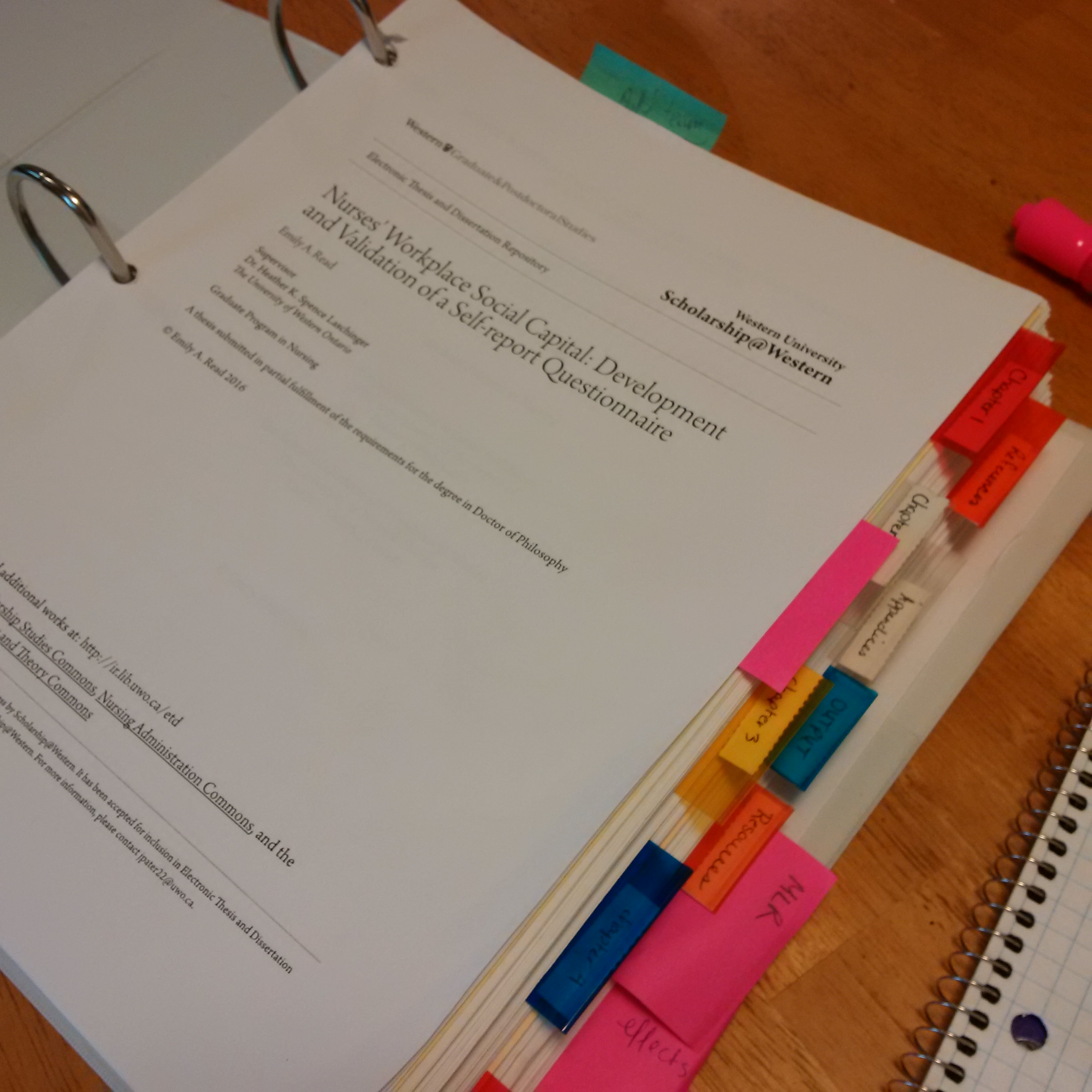
For weeks beforehand I prepared diligently, trying to anticipate difficult questions my examiners might ask. I made an exam binder with my whole dissertation in it, Mplus output, copies of my survey booklet, key references, detailed notes that I made as I re-read my work, etc. What can I say, I like to be prepared.

IMG_20160521_085203 (1)
My super organized exam binder 🙂 

I finally chopped my presentation down to 30 minutes on Friday. I rehearsed it twice on Saturday, one last time on Sunday night (after an epic game of water gun capture the flag with my son). I went to bed on time and slept like a rock.

On Monday morning I was just the right amount of nervous and excited. My game plan was to enjoy the day; the day of my once-in-a-lifetime PhD defense. The hard work had already been done – the hours of endless reading and thinking, writing and rewriting…rewriting again…the data collection and many hours of data analysis….it was all done!  I was as ready as I could be.

The public presentation went well. I felt comfortable and confident and enjoyed sharing my work with everyone who came. About five minutes in, the computer shut down for updates but it broke the ice a bit and helped me relax. It also helped that the audience was full of friendly faces 🙂  After the presentation was over there were a few questions and some discussion.

Then I went to the exam room with the examiners for the “grilling session”. Needless to say, I was pleasantly surprised when the first examiner opened with praise and compliments about my study, writing, and attention to conceptualizing social capital at different levels of analysis, etc. The whole exam is rather a blur but at that point, I knew I was going to be fine. Of course they asked me some challenging questions but overall it was an enjoyable discussion. I am also very hard on myself so it was really nice to hear such positive feedback about my work.

The defense made me realize that everything my committee had done to guide me and challenge me over the past few years had resulted in a solid dissertation study. More importantly, I have developed the knowledge and skills required to be an independent researcher and hold my own as I move on to my new role as an Assistant Professor.

I passed and had minor revisions to complete but the most difficult part was finalizing my acknowledgements section. How do you adequately say thank you to every single amazing person who’s been part of your journey?  The whole reason I became interested in workplace social capital (the topic of my dissertation) in the first place was because I found myself surrounded by caring, supportive colleagues, friends, and family as a single parent working on my PhD. Initially I wanted to look at something completely different – the link between leadership and the work environment and nurses’ physiological health outcomes (something I may do in the future).

My biggest lesson over the last few years, both first-hand, and through my research, is that social capital is tremendously valuable.  Not confined to the workplace, I know I could not have accomplished all that I have without the awesome people in my life. More importantly, social relationships make life meaningful and way more fun!  I am ever thankful for the special people who have been part of my life adventure thus far. Now that my PhD is complete, it feels like 10 million billion elephants are off my back and I am super excited for the new adventures ahead!


Sitting is the New Smoking…

sitting-is-killing-you

So apparently, sitting is the new smoking…and therefore, I am probably going to die.  Not really (I hope), but there has been a whole lot of attention to the “sitting epidemic” recently, highlighting how much time most of us spend sitting during a regular work day.  (Clearly, they have not spent any time with a staff nurse lately!).  The solution? A standing desk, of course.  Or a treadmill desk. Or taking frequent breaks. Making sure that you have an ergonomically designed work station….

On perhaps, we need to start asking different questions about how our work is designed. For example, in academe, we do spend a lot of time sitting at our computer working on all kinds of things from research grants to articles, powerpoints, data analysis, etc.  Some of this work is unavoidable I think but I also wonder if some of this time could be used more effectively. For example, do we really need to write 20 research articles using one dataset?  Do we really need another book chapter on such and such that a handful of people will read?  What if we publish one really strong paper and then talk to people about our ideas instead?  How much more fun (and time effective) is it to interview people, record a podcast, or share a conference presentation on YouTube?  Obviously, none of these things completely eliminates computer time but I am guessing that the impact of one really great Ted Talk is much broader and valuable than a research article buried in an academic journal that mostly only other researchers are going to read.  Unless of course, more research articles = more tenure points.

Sometimes collecting tenure points feels a bit like being Mario trying to get all the gold coins within reach (and apparently research activities that require copious sitting are as likely to kill you as sitting on your butt playing too many video games).

mario coins.jpg

So let’s assume that you just have to accept that your job requires some sitting.  What can you do to make it less bad?

  1. Take care of your body. Exercise. Eat nutrition food. Go easy-ish on the coffee (mostly). Get enough sleep.
  2. Plan ahead for the ebbs and flows of the school year. Midterms? Exam period? Research grant deadlines?  These are busy times, but they are not unexpected!  Get a calendar and plan ahead. I like to make extra healthy meals and stick them in the freezer to reduce cooking time. Having some exercise equipment in the basement is also really awesome for saving time when I am busy.  There have also been times when I have had to hire my babysitter to give me an extra morning or afternoon to do work on the weekend. (Fingers crossed that being a professor is more awesome than being a grad student working full time!).  Do I always get to do a full workout? No. But sometimes 10 minutes of exercise is better than nothing 😉
  3. Be super organized. You can waste a lot of time trying to simply locate documents, references, and sort through different versions of things.  Having a logical way to organize files and name documents will save you a ton of time. I even get my students to name their documents in specific ways so that I don’t end up with 25 versions of “Assignment 1”.  Using a reference management software program is also a really great way to save time with citing and reference lists, especially when you need to use different referencing styles for different journals. No more wasted time seeking and downloading the same reference articles over and over!  Lastly, using tags and folders in your email inbox is another strategy that saves oodles of time. If you can use the same main categories as your main files on your computer, that is even better!  I like to use gmail and get all of my other emails forwarded to that one account.
  4. Be reasonable. Sometimes I struggle with this. (e.g. “Of course I can have a baby and do my PhD and publish and compete in powerlifting and work at the hospital and teach, etc. at the same time…).  I like to set big goals and have a tendency to say yes to everything but I have learned that this usually leads to burnout. A better strategy is to take on a few things that you can really focus on. Reading (and re-reading) the Power of Less  is a helpful place to start.  Academia seems to reward people who work hard and do a lot but I think another point to consider is that learning and teaching is exciting!  Research and teaching are (should be) both about learning new things and understanding more about the world around us, as well as sharing that knowledge and excitement about learning.  It is hard to say no when you are excited about learning and sharing ideas!   Is it reasonable to spend 20 hours a week preparing for a class you are teaching for the first time?  Maybe not if you are teaching 3 courses and have other things on your plate.
  5. Aim for excellence, rather than perfection. I don’t think there is such a thing as “perfect”. The pareto principle, or 80:20 rule comes in handy here too. It states that 80% of your outcomes/effects will come from 20% of your work. Do you really need to make 50 slides for a 10 minute presentation?  Or, would 10-12 slides, well-designed, be more captivating and effective in getting your point across?  How much time are you spending sitting, working on things that have little to no impact?  After all, sitting is the new smoking….

Grant Writing Success

In late November I was offered my dream job as an Assistant Professor at the University of New Brunswick in the Faculty of Nursing (I enthusiastically accepted!).  I am getting ready to board the train on the tenure track and plunged right into writing my first CIHR grant as a PI. Not for the reasons you might think either. While I do understand that obtaining funding is valued as a performance outcome for faculty members, having money to do your research allows you to – wait for it – do your research 🙂  That being said, being awarded the money which allows you to accomplish valuable work is not the only reason to write a grant proposal and it is not the only measure of success (although, again, it is super helpful and makes it easier to do what you are trying to do).

So what else defines a successful grant application?  For me, success includes learning more about the research problems that I am interested in examining, learning more about what other researchers have done, and thinking about what we need to know and/or do to solve these problems (ultimately contributing to a healthier health care system and society I hope!). Building connections with other researchers, health care providers, and policy makers can also be a lot of fun!  Over the last few months I have been able to connect with others who share common interests and also have unique expertise and experience to bring to the project that I initiated. Regardless of whether or not we get funded for the project, we now have developed a plan, a budget, and have a good handle on what we want to accomplish through our research.

As a new kid on the block in New Brunswick it has also been really helpful for me to start meeting people and getting a better understanding of my new province. I grew up in Nova Scotia but each province has a different approach to health care delivery and my training and experience in nursing has been in Ontario in an urban centre which is quite different than Fredericton.  Making connections now will make it easier to fit in when I get there and I feel like it is a very welcoming place.

I do think our project is important and worth funding but I also recognize that there are limited funds and lots of great ideas worth funding.  It also depends on who ends up reviewing our application and the other projects that are being submitted.  At this point I’m not sure if you get “tenure points” for submitting applications that don’t get funded but it’s not like a straight-forward sport like track and field where there is a clear winner. Train hard, eat right, be the best, win, right?  Research grant competitions are more like artistic sports like figure skating and gymnastics where judges (reviewers) assess the relative value of competitors/applications and assess whether or not you will be able to successfully do the proposed research. Comparing research projects and teams that are qualitatively diverse makes it harder to decide which projects should be funded.approved

For these reasons, I think it is important to define success not just in terms of getting funded or not. As a novice PI, I am uncertain whether that will go in my favour or not.  After 4 degrees, 3 theses, and being able to balance all the demands of school, work, residence life, teaching, research, and being a single parent while also staying fit, I am 110% confident that I will be a good team leader and that we will be able to carry out the project as a team.  Of course, when you submit a research grant application you can’t put “single mom/time management ninja” or “worked 10 part-time jobs including running a residence hall while completing my undergrad” as part of your accomplishments/skills (and if you did, it would probably count against you).  Again, another reason why I think it is important to always do your best and see the process and the development of the proposal as an accomplishment and an opportunity to learn and grow as a writer and researcher.

Of course, if we do get the grant, it will be icing on the cake and I will be literally jumping for joy because we can start putting our research plan into action.  There is absolutely no denying that actually getting the grant is a successful outcome too!  And a very sweet one at that! However, if it is the only outcome that you focus on, I think that you miss out on a lot of other great things about writing research grants.