Professor’s Notebook: Wrapping Up your Semester of Teaching

The end of term is a busy time that often involves a lot of final assessment activities for the courses you are teaching. It can be challenging to go the extra distance to make sure that you stay organized during the transition from one semester to the next. Today I’m going to share with you what I consider the “must-dos” to close out your semester, stay organized, and learn and grow as a teacher.

1. Submit your final grades on time

This should be low-hanging fruit but you’d be surprised how many faculty members either do not keep track of the deadlines for grade submission or struggle to get all of their grading done on time (especially with final papers/essays). You need to know your institution’s policy and dates for submitting final grades. It is very helpful to add the relevant dates for each course you teach to your calendar and plan your assignments and exams in a way that gives you enough time to grade them and submit the final grades on time.

As an aside, we usually underestimate how much time it takes to grade assignments so it can also be helpful to do some time tracking when you grade so that you have a more realistic estimate of the time you will need to block off in your calendar for this. Time tracking is simply keeping track of the amount of time you spend doing things and can be as basic as writing it on a piece of paper or in a Word document. Even timing grading a random sample of papers can give you a decent estimate of your average grading time for that assignment.

Obviously, it will vary by course, level, quality of writing, etc. but moving forward, this information can help you make informed decisions about the assignments you develop for your courses. There is also the whole AI thing which means we could be (some are) moving away from more traditional scholarly papers or essays or that we need to allocate more time to grading smaller scaffolded assignments throughout the term. We may (probably) also need more time to deal with AI cheating issues for some types of assignments. Even so, you need to get your grades in on time and make a plan that allows you to do that.

2. Clean up and organize your teaching files

You should have a personal filing system that makes it easy for you to find information. Personally, I have a main folder called TEACHING with a subfolder for each of the different courses I’ve taught and another level of subfolders by year for the courses that I have taught multiple times. You might prefer to organize by year. There isn’t one best way to organize your files but you do need a system that is consistent and works for you.

When it comes to teaching, there are basically three types of files: 1) content that you’ve created for teaching and learning, 2) content that others have created that you are using for teaching and learning while minding copyright laws (e.g., book chapters, journal articles, etc.), and 3) content that your students have created during the course (e.g., assignments, discussion posts, exams, etc.).

In my view, the student-created content and your evaluations of it require the most consideration due to privacy concerns and the potential for grade appeals. As a general rule, I would recommend finding out how long you are required to keep student work at your institution and then deleting the student work once that time has passed. For example, if you need to keep it for 1 year, then at the end of this term you would delete/electronically shred all student work from the Winter 2023 term. This includes discussion posts in your LMS.

The exception to this would be excellent work that you would like to use for accreditation/program review purposes or as examples to share with future classes. If you would like to save specific pieces of work from students for these purposes, you should ask them for permission to save and share their work in those ways now and file it in a special folder. The best time to ask students is now after you’ve just taught them (and after submitting final grades). Generally, I would ask for this permission via email and then if the student replies giving their written permission, I save the email thread as a PDF in the folder with their assignment.

The other types of files that you have (created by you and resources created by others) can be kept indefinitely in your personal filing system. I like to have folders organized by class or by week of the course and then a separate folder for assignments. I also create a brand new folder for each time I teach the same course. While this does create some duplication, it means that I have an archived version of the course for each time I taught it. Note that I always update and revise my courses to improve them so no two offerings are identical.

3. Read your student teaching evaluations

It might not be your favourite thing to do, but you really do need to read your student evaluations. Yes, there are known problems with student teaching evaluations – most students are not experts in teaching and learning, people have personal biases that negatively affect their ratings of women and members of minority groups who are professors, hard classes/subjects are viewed less favourably than others, and students with strong extreme opinions are most likely to complete the evaluation – however, there can still be helpful nuggets that can help you improve as a teacher so I wouldn’t advise ignoring them or sticking your head in the sand.

I would advise you not to take the feedback personally and to approach your teaching evaluations like a researcher instead. This is data after all. Print out your evaluations and go through them with different coloured highlighters. First, highlight all of the positive feedback in one colour. Then, highlight the negative feedback in another colour. I would ignore comments that are irrelevant to teaching (for example, comments about your appearance which yes, does happen when you are a woman). Look for common themes in each category. Are students consistently saying they didn’t like the textbook? Is there a 50:50 split on loving and hating an active learning strategy that you used? What is the data telling you overall? Write a brief summary of the overall feedback and consider what you might do differently next time to improve your teaching and students’ learning. You might also want to talk to your teaching support center or colleagues, do some research about the scholarship of teaching, or attend a teaching professor conference. Excellence does not require perfection, but it does require effort and there is always more to learn.

4. Take a day off (at least)

Lastly, it’s important to take at least a day off and decompress after a busy few weeks. Go do things that you enjoy and let go of the stresses of the semester. If you can take a vacation (at least a full week) I would highly encourage you to. Sometimes it feels like there is never a good time to take one but it is super important for your health and wellbeing, and, perhaps counterintuitively, taking vacation benefits your productivity at work long-term. Burnt-out people are not productive people so let’s avoid going down the burnout path 😉

And that’s it for today. Go wrap up your teaching semester and enjoy a well-deserved break~!

Simple Stress Busters to Cope with Mid-Semester Overwhelm

It’s that time of the semester again! The end is in sight but the work is piling up! You have a lot to do before the holiday break including finishing everything for your current classes and preparing for next term so that you can actually relax for a bit.

Research suggests that a wide range of stress coping strategies can be effective. These include social support, emotion-focused coping strategies (aimed at making you feel better), problem-focused coping strategies (aimed at improving or solving the problems/situations that are the source of your stress), and cognitive reappraisal (reframing the stressor and your interpretation of it).

Here are some Simple Stress Busters to Cope with Mid-Semester Overwhelm:

  1. Do a short guided relaxation or meditation. Apps like Calm and Headspace are particularly helpful for this. Schedule 10 min in your day to do this so that it becoms a habit. I like to do it in the car at the end of the work day before I go pick up my son and dog from daycare. It puts me in a much calmer, more mindful state of mind and provides a transition from work to non-work that I find helpful.
  2. Have a mini dance party! Listen to 2-3 of your favourite songs and rock out. This is such an awesome way to release pent up stress energy and add a bit of fun/play to your day 🙂 Often the songs we love also remind us of fun times with friends.
  3. Speaking of which… Connecting with a good friend can also be a great mood booster. Taking 10 min to message a friend or family member and let them know you’re thinking of them is never a bad idea. Making use of commute time to have a longer conversation is also an excellent way to build in meaningful connections during your busy life.
  4. Do something physical. There is a lot of research showing that physical activity and exercise have positive effects on your mental and physical health. You probably already know this! If you’re finding it challenging to get motivated, just commit to doing 10 min/day to start. You will probably feel better once you get going and even a 10 min walk/workout can help break up your grading marathons and give you some fresh air.
  5. Go the F to sleep! I mean that as nicely as possible. If you are not getting enough sleep you are living life on hard mode. Getting a good night sleep when you are stressed out can be challenging, I totally get it! However, there are many things you can do to set yourself up for the best opportunity to have a good night sleep. These include creating a dark, quiet, cool sleeping space, turning off electronics an hour before bedtime (also you should absolutely have a consistent bedtime), having a caffeine cutoff time in the early afternoon, and doing a brain dump so that you can put your mind to rest.
  6. Stop checking your email first thing in the morning. You have more important things to do most of the time. I like to plan my most important work for early in the work day because it ensures that it actually gets done. Your inbox is a black hole of other people’s priorities. It is a bit different for me now in my current role as an Associate Dean because I do need to be available for my team and there can be urgent things that need to be responded to. Our students are in clinical so serious things can happen (knock on wood they don’t). But if you are in a regular faculty position, you may want to consider scheduling certain times each day for email management and communication.
  7. Book a massage or spa treatment. Find a local day spa or massage therapist that specializes in relaxation. Book an appointment. Go. Enjoy. Forget all the things. It’s that easy.
  8. Stop comparing yourself to others. You might feel like you are “behind” or that you don’t measure up to the amazing superstar researcher that you look up to. Stop wasting your energy on that! Instead, focus on the unique value and expertise that you have to share. You are awesome and one of a kind! Take 5 min to write down what makes your teaching and/or research unique. Pin that on your bulletin board so you can look at it and remind yourself.

You certainly don’t need to do all of these but consider trying one out today and see how you feel afterward – maybe you will want to keep doing it 🙂

Have a great week and hang in there!

Emily

Need some more time for self-care? Download this awesome freebie I made just for you. Click here to subscribe to my weekly newsletter and get your free PDF of “How to Find Time for Self-Care”.

On Being an Academic Nurse

When I began my PhD I felt the need to be cautious about telling people that I was doing it. Luckily I worked with super supportive colleagues and they never made me feel like I was weird or not a “real” nurse because of my interest in research. In fact, many of them were more than willing to share their experience, wisdom, and insights with me when we worked together. I may not have 20 years of nursing experience but I am a hard worker and a caring nurse who is willing to help others and pull my share. I absolutely loved my time working in geriatric rehab as a staff nurse. There were times when I considered quitting the PhD and staying on there instead. I didn’t leave direct care nursing because I didn’t like it. I didn’t leave because I’m afraid of hard work. Or shift work. Or working holidays.

I’m not quite sure what people think academic nurses do but I honestly cannot remember the last time I took an entire 24 hours off from work. I think it was in May? In addition to teaching, research, and service requirements of most faculty, nursing faculty at many schools (mine included) also teach clinical nursing courses. This term I’m teaching second year students in the hospital which means not only 2-3 full shifts in the hospital every week but tons and tons of prep, organizing, evaluation, and follow-up with students. This is not like a lab where they are practicing on mannequins; they are working with real-life patients who are sick. They are interacting with nurses and physicians. Expectations and anxiety are high. I feel like a mother hen trying to protect them while at the same time give them learning opportunities and reasonable autonomy. Teaching clinical is rewarding in many ways but it is one of the most stressful things I have ever done.

I am also a course assistant for the nursing research course and need to prepare to teach a new-to-me course next semester. On top of this I have also been trying to establish my program of research, attend the meetings I need to go to, and get to a stack of article revisions and new submissions. I took a day trip to Ottawa for a conference between clinical days and it was awesome but also exhausting. Somehow I have managed to still spend quality time with my son, work out at least 3 times/week (although Thursday’s “workout” mostly involved staring blankly at the barbell trying to convince myself that it was workout time), and always have some (mostly) healthy food and clean laundry. It’s the small wins, right?

This is not the life I envisioned 11 months ago when I accepted this job. After working and going to school for a million years I thought it would finally be different. I thought I’d have time to have a life but the reality is that I am working constantly. I thought I’d love being closer to home but it’s not really close enough that I can see my family and friends very often. It’s not super helpful when I want to go do something either (“Hey, dad, can you drive 5 hours and babysit while I go to a movie?”).

It’s not all bad of course; I really love a lot of things about my job. I’m just not sure that I want my life to be my job. I realize that the transition to new job in a new province and a new city is a huge adjustment and that it will get easier as time goes on. My first term has been full of many wonderful things and a couple of not-so-awesome things. Highlights include the joy of seeing nursing students grow and learn, interacting with patients and their families and the staff on the unit, and being part of some inspiring research projects. The best thing of all has been looking at the stars with my son on those early mornings before clinical. In the quiet darkness before sunrise we get to share the awe and peace of the night sky together before the busyness of the day begins. These are the moments I cherish most.


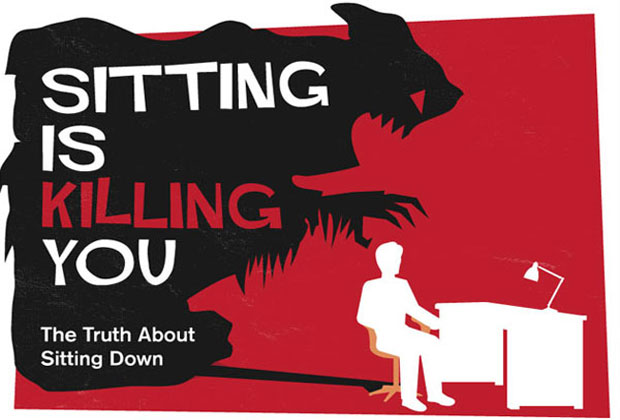
Sitting is the New Smoking…

sitting-is-killing-you

So apparently, sitting is the new smoking…and therefore, I am probably going to die.  Not really (I hope), but there has been a whole lot of attention to the “sitting epidemic” recently, highlighting how much time most of us spend sitting during a regular work day.  (Clearly, they have not spent any time with a staff nurse lately!).  The solution? A standing desk, of course.  Or a treadmill desk. Or taking frequent breaks. Making sure that you have an ergonomically designed work station….

On perhaps, we need to start asking different questions about how our work is designed. For example, in academe, we do spend a lot of time sitting at our computer working on all kinds of things from research grants to articles, powerpoints, data analysis, etc.  Some of this work is unavoidable I think but I also wonder if some of this time could be used more effectively. For example, do we really need to write 20 research articles using one dataset?  Do we really need another book chapter on such and such that a handful of people will read?  What if we publish one really strong paper and then talk to people about our ideas instead?  How much more fun (and time effective) is it to interview people, record a podcast, or share a conference presentation on YouTube?  Obviously, none of these things completely eliminates computer time but I am guessing that the impact of one really great Ted Talk is much broader and valuable than a research article buried in an academic journal that mostly only other researchers are going to read.  Unless of course, more research articles = more tenure points.

Sometimes collecting tenure points feels a bit like being Mario trying to get all the gold coins within reach (and apparently research activities that require copious sitting are as likely to kill you as sitting on your butt playing too many video games).

mario coins.jpg

So let’s assume that you just have to accept that your job requires some sitting.  What can you do to make it less bad?

  1. Take care of your body. Exercise. Eat nutrition food. Go easy-ish on the coffee (mostly). Get enough sleep.
  2. Plan ahead for the ebbs and flows of the school year. Midterms? Exam period? Research grant deadlines?  These are busy times, but they are not unexpected!  Get a calendar and plan ahead. I like to make extra healthy meals and stick them in the freezer to reduce cooking time. Having some exercise equipment in the basement is also really awesome for saving time when I am busy.  There have also been times when I have had to hire my babysitter to give me an extra morning or afternoon to do work on the weekend. (Fingers crossed that being a professor is more awesome than being a grad student working full time!).  Do I always get to do a full workout? No. But sometimes 10 minutes of exercise is better than nothing 😉
  3. Be super organized. You can waste a lot of time trying to simply locate documents, references, and sort through different versions of things.  Having a logical way to organize files and name documents will save you a ton of time. I even get my students to name their documents in specific ways so that I don’t end up with 25 versions of “Assignment 1”.  Using a reference management software program is also a really great way to save time with citing and reference lists, especially when you need to use different referencing styles for different journals. No more wasted time seeking and downloading the same reference articles over and over!  Lastly, using tags and folders in your email inbox is another strategy that saves oodles of time. If you can use the same main categories as your main files on your computer, that is even better!  I like to use gmail and get all of my other emails forwarded to that one account.
  4. Be reasonable. Sometimes I struggle with this. (e.g. “Of course I can have a baby and do my PhD and publish and compete in powerlifting and work at the hospital and teach, etc. at the same time…).  I like to set big goals and have a tendency to say yes to everything but I have learned that this usually leads to burnout. A better strategy is to take on a few things that you can really focus on. Reading (and re-reading) the Power of Less  is a helpful place to start.  Academia seems to reward people who work hard and do a lot but I think another point to consider is that learning and teaching is exciting!  Research and teaching are (should be) both about learning new things and understanding more about the world around us, as well as sharing that knowledge and excitement about learning.  It is hard to say no when you are excited about learning and sharing ideas!   Is it reasonable to spend 20 hours a week preparing for a class you are teaching for the first time?  Maybe not if you are teaching 3 courses and have other things on your plate.
  5. Aim for excellence, rather than perfection. I don’t think there is such a thing as “perfect”. The pareto principle, or 80:20 rule comes in handy here too. It states that 80% of your outcomes/effects will come from 20% of your work. Do you really need to make 50 slides for a 10 minute presentation?  Or, would 10-12 slides, well-designed, be more captivating and effective in getting your point across?  How much time are you spending sitting, working on things that have little to no impact?  After all, sitting is the new smoking….

I want an academic career. When’s the BEST time to have a baby?

The short answer is that there is no best time and that really, anytime is the best time. Nothing can ever prepare you for the challenges and joys of parenting – regardless of whether or not you are a grad student, a practising nurse, or a stay-at-home mom.

That being said, it helps if you have a committed partner and some sort of plan.  Personally, I did not have that experience. Let’s just say that the pill is not 100% effective.  I stuck with my life plan (sort of) and worked at the hospital as an RN until September and started my PhD 9 months pregnant (against all good sense I think) and took one week off from classes (because my supervisor made me). The “birth plan” involved my wonderful friend driving me and my roommate to the hospital where we streamed episodes of New Girl while I waited for my son to decide to make his grand entrance. My sister and her boyfriend flew in and met us there (he stayed outside).

Lucky for me, in Canada we get a year of paid maternity leave and you can be in school during that time – I didn’t plan this out at all but it definitely made life a lot less stressful. For the first semester we didn’t have a car so we got up early to catch the bus so I could take him to the wonderful home daycare we found, then back on the bus to school. After school I would go back on the bus to get him, and again on the bus to go home or sometimes to the Y and then home.  It was exhausting!  On the plus side, it really made me appreciate the amount of time and energy it takes to coordinate life when you don’t have a car.  Before my son was born I rode my bike a lot and it was hard to not be able to do that anymore.

One of the best things about being a single parent and a nurse was how much support I received from others. The nurses at work threw me a baby shower, offered support and advice, and even offered me lifts to and from work when they could.  My former roommate lived with us for a year until she finished her nursing degree (God bless her) and friends have helped take care of my son so that I could go to work, school, and conferences (one even road-tripped with us to Indianapolis!).  Their love and support made me realize how important relationships are in life and sparked my interest in workplace social capital (my dissertation topic).  In many ways, our lives have been richer because it was obvious to others that we needed them.  I’m not sure that it is always the same when people are married and it is assumed that they have all the support and help they need (I’m sure that it is different for everyone).

I think you can balance a demanding PhD program with being a parent but it requires focus, discipline, and support. The balance is always changing too! The time you get to do homework when you have a baby who sleeps a lot is different from the time you get when you have a busy 3 year old who wants to play all the time.  You have to learn to be more flexible and adapt to what your child (or children) need as they grow up.  My son has helped me slow down and reminds me daily to play and enjoy life.  Not that I didn’t before but children have such an awesome way of looking at the world.

At times I have had to make tough choices about work because of being the only parent – for example, this past fall I chose a day job as a research coordinator (which I find rather stressful) because it had regular hours – but because of that I had to give up my part-time staff nurse position at the hospital (which I love) and go casual. It’s straight-up difficult to find daycare for shift work – especially when you are part-time and don’t have a consistent schedule.  I miss seeing my co-workers and my patients. Research is rewarding and I have learned a lot this year but it’s different.

Ultimately, I think being a parent has made me a better person and has made me more efficient with my time. When I am home, I don’t want to be thinking about work so I work hard at work to be organized and focus on things that are important. I have one dedicated day a week to work on my thesis and try to keep it contained in that time frame. I think one of the big problems with academic culture is this idea that working longer hours makes you a better, more productive member of the academy.  Numerous studies show that overworking people actually makes people less effective, less happy, and has very damaging effects on their health.  That, however, is a topic for another post I think…

Relationship-building in a Task-Focused World

Increasingly, employees are asked to do more with less.  Arguably, this is the goal of Capitalism: to squeeze out as much work as possible for the least amount of money in order to maximize economic growth. I don’t think that this is a particularly helpful way to approach healthcare, as I believe that it is a basic human right, not a privilege, and that relationships with other people are fundamentally inefficient but extremely important.

In nursing the pressure to perform and maximize efficiency can be particularly difficult to cope with, as increased workloads leave less time to spend with patients and their families which is an important part of our job.  It may not seem like having a conversation is “work” but it is through conversations that patients communicate their needs, hopes, fears, and values (among other things).  By getting to know our patients, we are able to ensure that we provide care that meets their needs and treats each individual holistically, rather than as a list of tasks on our daily to-do list.

Building positive relationships with co-workers and leaders are also essential to creating a positive working environment where nurses and other members of the healthcare team can work together to deliver high-quality patient care.  Investing time and energy into these relationships is not efficient in the short term but pays dividends down the road in terms of staff retention, decreased voluntary absenteeism, decreased short-staffing (which leads to more sick time and burnout, etc.), and of course reduced time spent recruiting, interviewing, and training new hires.  It’s not rocket science that people who like their co-workers and their work environment are more likely to stay than those that dread coming in to work every day.  Strong relationships also facilitate good communication and trust among team members and generate shared understandings of work processes, as well as who knows what, and who to ask when you need help.

While we cannot ignore the tasks that need to be accomplished, as these are obviously important, we need to change how we think about relationships in the workplace.  Culturally, we have a tendency to judge relational work as “non-work” when in fact connecting to others in the workplace is very valuable (and sometimes extremely challenging) work.   Unlike patient care tasks that are easy to quantify and check off, it seems artificial and contrived to make a checklist that says “talked to each of my patients about their concerns”, “invested in my relationship with Susan by asking her about her son’s wedding”…etc.  I would also argue that most of us are naturally social and interested in other people so we do a lot of this work anyway and that trying to maximize relational “efficiency” by reducing these things to tasks is ridiculous (and insulting).

I understand that healthcare is expensive and many of the pushes to increase efficiency are driven by our aging population, aging workforce, government austerity, union wage increases, and the economic recession of 2008 (to name a few things).  It is complicated.  However, we need to invest in people and create healthy workplaces that foster a sustainable workforce and allow our healthcare professionals time to invest in relationships with patients. Pushing people harder and harder to produce more with less is not a long-term solution and will cost us more in the long-run – not just in terms of money, but in quality of life, happiness, and patient care.

Maybe the next time you see a nurse, doctor, or healthcare leader talking with a patient or a colleague, you should acknowledge that they are engaging in valuable work.  Just because we’re not doing a task like inserting an IV or giving a medication doesn’t mean that it’s not important.


Being a Mom Changes the Game

It’s taken me quite a while to understand how having children really changes your life and forces you to make choices about your priorities. Since today is Mother’s Day, I thought it would be a good time to share some of the ways I have found some sort of work-life balance.

1. I have mastered the art of the 10 minute cleanup. At the end of the day I set the stove timer for 10 minutes and clean as much as I can. Sometimes this motivates me to keep going and other times I get half the toys in a basket and the dishes washed.

2. I continue to negotiate balance. Some weeks I have a lot of work commitments and some weeks it’s a little slower. Learning to anticipate the ebb and flow and accept it has been really key for me. For example, last week I had a presentation to prepare for, a teaching job application to submit, a training session at the hospital, and work to do for my supervisor. It was a busy week and I ended up taking a few days off from the gym. Big deal. Got back to it the next day and life goes on. This doesn’t mean I’m always happy. Sometimes it is very frustrating when you can’t do everything that you wanted to do. For me, acceptance is a helpful way forward.

3. Unless I am going to be teaching, presenting, or meeting someone important, I don’t wear fancy clothes or do my hair. Maybe this sounds silly but getting ready in the morning takes time and effort and I would rather have my hair in a bun and spend some quality time with my son in the morning than fuss with a hair straightener and panty hose. If you spend thirty minutes a day getting ready that adds up to 2 ½ hours per week! This doesn’t mean I’m a total slob. I draw the line at tank tops and yoga pants (unless I am writing at home, in which case it’s pretty much guaranteed that I am wearing workout clothes). I also don’t own a lot of clothes which means fewer choices but that’s sometimes a good thing.

4. I prioritize fitness and health. Recreation and leisure time is really important to me so our entertainment is playing at the park, going swimming, etc. I also plan healthy meals and cook at home. We have a lot of fun together, spend time outside, and I find myself refreshed for the week ahead.

5. I have amazing support. It’s not easy to be a single parent while working on a doctorate and building an academic career. If I want to go to a conference or attend a workshop I need to find someone to look after my son while I go. I can’t just go to Toronto for the day or stay late on campus. Thankfully, I have found an amazing daycare and many friends and family members have helped me out when I need some help. I have also learned that I need to be more selective about my commitments. While I would love to go to everything and be part of many more committees and professional groups, I can’t do it all.

6. I remember why I am doing this. The reason I am pursing an academic career in nursing is to help create positive changes in health care and ultimately in people’s lives. I envision a health care system where quality of life and preventative health care is valued. I could go on about this but my point is that I am very fortunate to be doing my PhD with world-renown scholars in my discipline. Sure, I want to keep publishing and yes, I will literally jump for joy if I ever do receive an elusive CIHR grant, but at the end of the day, the impact that I have through the students that I teach and the research work that I do is the end goal. Publications, presentations, and grants are all helpful, but the way I see it, if you focus on doing work that matters and doing it well, those other things will come.


There is time to write and play trains, but the time to play trains is rather short, whereas there will always be another paper to write.  Happy Mother’s Day everyone!

Why Tenure isn’t Everything

Many doctoral students think that getting published in a top journal and getting tenure are the only things that matter in their career.  While I think those things are valuable achievements, I believe that this task-focused approach to doctoral education is dead wrong.  Here’s why.

1. Relationship-building is more important than you think.  Are outcome-focused type A overachievers who leave little time for “unproductive” things like spending time with other people or having fun really more likely to be successful in life?   Admittedly, the academic pursuit of tenure and endless productivity can make you feel guilty for spending time doing something unrelated to your work.  Relationships are inherently inefficient but they certainly aren’t useless, even if they don’t have an immediate outcome or “accomplish” anything.   Co-students and supervisors, other faculty members, and colleagues you meet at conferences make your career more rewarding and more fun.  They also provide you with support, constructive feedback, a sounding board for new ideas (which often sound better in your head than they do out loud), and occasionally, a shoulder to cry on.   On the flip side, you will also be able to contribute to others’ projects and provide feedback to help others.  My experience as a nurse has made it pretty obvious that relationships are one of the most valuable aspects of our lives and that we need to value them more.  Building positive relationships takes time and energy but at the end of your life, are you really going to regret the time you spent with other people?  Not likely.

2.  Burnout prevention

Sometimes we are overambitious and take on too much.  I have done this more times than I would like to admit.  During my first undergraduate degree I refused to take a student loan so I worked 10 part-time jobs while taking a full course load and having an active social life.  My schedule was crazy! After final exam period I slept for almost a week straight to recover from the burnout.  Don’t do this to yourself!  I have learned that a much more sustainable method is to limit the number of projects and commitments you take on and do them well.  If you take on too many things at once you are probably going to do a mediocre job and end up exhausted.  I also don’t advise doing things just because they look good on your CV.  If you invest your time and energy into things that help you learn and grow and that you are interested in, you are going to excel at them and have a lot more fun.  I truly believe that if you are engaged in the learning process and doing work that gets you excited the publications and tenure-track position will follow.  Enjoy the process and pace yourself – this is a marathon, not a sprint.

3.  Today is the only day.

As much as we plan and dream, the only day we ever have is this one.  Take advantage of it.  Sure, there may be times when you have to stay inside on a sunny day to meet an urgent deadline and you will spend many many many hours sitting in front of a computer screen working with data, writing, and picking at powerpoint slides.  Take breaks. Spend time outside.  Take care of yourself physically and mentally.  Most importantly, make time for the people you care about.  You really never know when your time will be up.

Tenure is a good goal for many of us and it is something that I am working towards but right now being a doctoral student is pretty darn amazing.  Every day is a learning adventure and I am building my research toolkit.  I get to work with smart people who have a lot of knowledge and ideas to share and who are passionate about nursing and health care.   I get to ask questions and think about ideas.  I am also working with the best supervisor, committee, and research team I could ask for.  Tenure will be nice but it can wait.