Professor’s Notebook: Wrapping Up your Semester of Teaching

The end of term is a busy time that often involves a lot of final assessment activities for the courses you are teaching. It can be challenging to go the extra distance to make sure that you stay organized during the transition from one semester to the next. Today I’m going to share with you what I consider the “must-dos” to close out your semester, stay organized, and learn and grow as a teacher.

1. Submit your final grades on time

This should be low-hanging fruit but you’d be surprised how many faculty members either do not keep track of the deadlines for grade submission or struggle to get all of their grading done on time (especially with final papers/essays). You need to know your institution’s policy and dates for submitting final grades. It is very helpful to add the relevant dates for each course you teach to your calendar and plan your assignments and exams in a way that gives you enough time to grade them and submit the final grades on time.

As an aside, we usually underestimate how much time it takes to grade assignments so it can also be helpful to do some time tracking when you grade so that you have a more realistic estimate of the time you will need to block off in your calendar for this. Time tracking is simply keeping track of the amount of time you spend doing things and can be as basic as writing it on a piece of paper or in a Word document. Even timing grading a random sample of papers can give you a decent estimate of your average grading time for that assignment.

Obviously, it will vary by course, level, quality of writing, etc. but moving forward, this information can help you make informed decisions about the assignments you develop for your courses. There is also the whole AI thing which means we could be (some are) moving away from more traditional scholarly papers or essays or that we need to allocate more time to grading smaller scaffolded assignments throughout the term. We may (probably) also need more time to deal with AI cheating issues for some types of assignments. Even so, you need to get your grades in on time and make a plan that allows you to do that.

2. Clean up and organize your teaching files

You should have a personal filing system that makes it easy for you to find information. Personally, I have a main folder called TEACHING with a subfolder for each of the different courses I’ve taught and another level of subfolders by year for the courses that I have taught multiple times. You might prefer to organize by year. There isn’t one best way to organize your files but you do need a system that is consistent and works for you.

When it comes to teaching, there are basically three types of files: 1) content that you’ve created for teaching and learning, 2) content that others have created that you are using for teaching and learning while minding copyright laws (e.g., book chapters, journal articles, etc.), and 3) content that your students have created during the course (e.g., assignments, discussion posts, exams, etc.).

In my view, the student-created content and your evaluations of it require the most consideration due to privacy concerns and the potential for grade appeals. As a general rule, I would recommend finding out how long you are required to keep student work at your institution and then deleting the student work once that time has passed. For example, if you need to keep it for 1 year, then at the end of this term you would delete/electronically shred all student work from the Winter 2023 term. This includes discussion posts in your LMS.

The exception to this would be excellent work that you would like to use for accreditation/program review purposes or as examples to share with future classes. If you would like to save specific pieces of work from students for these purposes, you should ask them for permission to save and share their work in those ways now and file it in a special folder. The best time to ask students is now after you’ve just taught them (and after submitting final grades). Generally, I would ask for this permission via email and then if the student replies giving their written permission, I save the email thread as a PDF in the folder with their assignment.

The other types of files that you have (created by you and resources created by others) can be kept indefinitely in your personal filing system. I like to have folders organized by class or by week of the course and then a separate folder for assignments. I also create a brand new folder for each time I teach the same course. While this does create some duplication, it means that I have an archived version of the course for each time I taught it. Note that I always update and revise my courses to improve them so no two offerings are identical.

3. Read your student teaching evaluations

It might not be your favourite thing to do, but you really do need to read your student evaluations. Yes, there are known problems with student teaching evaluations – most students are not experts in teaching and learning, people have personal biases that negatively affect their ratings of women and members of minority groups who are professors, hard classes/subjects are viewed less favourably than others, and students with strong extreme opinions are most likely to complete the evaluation – however, there can still be helpful nuggets that can help you improve as a teacher so I wouldn’t advise ignoring them or sticking your head in the sand.

I would advise you not to take the feedback personally and to approach your teaching evaluations like a researcher instead. This is data after all. Print out your evaluations and go through them with different coloured highlighters. First, highlight all of the positive feedback in one colour. Then, highlight the negative feedback in another colour. I would ignore comments that are irrelevant to teaching (for example, comments about your appearance which yes, does happen when you are a woman). Look for common themes in each category. Are students consistently saying they didn’t like the textbook? Is there a 50:50 split on loving and hating an active learning strategy that you used? What is the data telling you overall? Write a brief summary of the overall feedback and consider what you might do differently next time to improve your teaching and students’ learning. You might also want to talk to your teaching support center or colleagues, do some research about the scholarship of teaching, or attend a teaching professor conference. Excellence does not require perfection, but it does require effort and there is always more to learn.

4. Take a day off (at least)

Lastly, it’s important to take at least a day off and decompress after a busy few weeks. Go do things that you enjoy and let go of the stresses of the semester. If you can take a vacation (at least a full week) I would highly encourage you to. Sometimes it feels like there is never a good time to take one but it is super important for your health and wellbeing, and, perhaps counterintuitively, taking vacation benefits your productivity at work long-term. Burnt-out people are not productive people so let’s avoid going down the burnout path 😉

And that’s it for today. Go wrap up your teaching semester and enjoy a well-deserved break~!
Using your syllabus to manage student expectations

If you want to be an effective university teacher and have a manageable teaching (and email) workload throughout the semester, then you must establish clear expectations for your students. In this post I’m going to discuss how to use your syllabus to establish clear expectations for your students and proactively address student concerns and issues as much as possible. Let’s get started!

The Syllabus

As you know, your course syllabus should provide all of the information that your students need to know about your course and what they need to learn and do to be successful in your course. It also is a tool for setting/managing expectations and establishing boundaries. It is important to be up front with students about things such as: when you are available/unavailable, your email response time, consequences of late assignments, requests for extensions, how to submit assignments, and so forth.

Your institution and/or faculty/department likely has a standard syllabus template that you are asked/required to use or can adapt. Although it is tempting to keep recycling and updating old versions of syllabi, always check to make sure that the information is up to date and that all the hyperlinks still work.

What I include in my syllabi:

  • Course information:
    • Course name, number, and calendar description
    • Course objectives
    • Class schedule
  • Professor information:
    • Professor/Instructor name and contact information
    • Office hours and availability
    • Email policy
    • FAQ discussion board
  • Required learning resources (typically books or software programs)
  • Technology requirements (especially for online classes)
  • Assignment information:
    • List of summative assignments/tests/exams, due dates, and their % grade for the course
    • List of formative assignments/tests and due dates
    • Detailed assignment instructions (may choose to make this a separate document)
    • Assignment grading rubrics (as applicable; may choose to make this a separate document as well)
    • Assignment submission instructions
    • Information about late assignments and/or missed tests/exams
    • Information about requesting extensions
  • Information about unversity student resources including learning accommodations, student services, health and counseling services, etc.
  • Information about plagiarism
  • Information about the appeal process
  • Grading scheme for the course
  • Easter egg for students who read the syllabus

Many of these sections are fairly standard but the ones that I find really make a big difference for students and for me are: Professor information and Assignment information.

Professor Information:

In terms of office hours, I only do these by appointment and try to keep it to business hours M-F. However, some of my master’s students are nurses working shifts so I make sure they know that I am willing to be flexible for them. You may want to block off certain days/times for student meetings. I find that student questions/meeting requests happen when there is a test or assignment coming up or after they get an assignment or test back so I don’t really find it helpful to block off consistent time every week.

I have a lot of rules for students about sending me emails. In terms of my email response time, I tend to be really on top of my inbox and generally respond in less than 24h. However, my official policy is within 48h to give me a buffer and set a reasonable expectation for students. I also ask that students type the name of the course in the subject line and if it is a legit emergency to indicate that it is urgent. When I give back assignments, I ask that students read over all of my feedback and reflect on their assignment AND that they wait at least 24h before they email me to request a time to meet with me about it. I am more than willing to discuss assignments with students but I find that they are in a better frame of mind when they have time to reflect on their work and the feedback I have provided. Recently I have held optional live sessions online for students to ask any questions that they have about an upcoming assignment or test. Often more than one student has the same question so it is an effective way of helping the whole class at once.

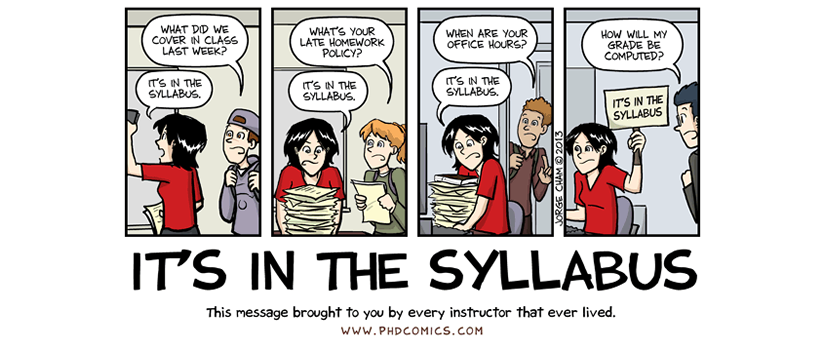
Another tool that I have used within my learning management system (LMS) where the course is housed (we use D2L Brightspace) is to create an FAQ Discussion Board where students can ask questions that they have about the course or assignments. I also encourage students to look in the syllabus and the assignment instructions and grading rubrics to see if they can find the answer to their question before reaching out to me. Nine times out of ten, the information they are looking for has already been provided. This prevents me from getting a lot of repetitive questions via email.

Sometimes a student will email me about something that I hadn’t thought of and that the whole class would benefit from. In these cases, I usually email the entire class or post a news item/announcement in D2L to share the information with everyone.

Assignment Information:

I try my best to provide students with very detailed assignment instructions and marking rubrics (when applicable). I encourage students to mark their due dates in their calendar/planner, start working on their assignments early in the term, and sometimes include smaller low stakes assignments along the way to get them started. When possible I also include example assignments (in the course site, not actually in the syllabus) from previous students (with permission) so that they understand what I am asking them to do. Obviously this isn’t possible for every type of assigment or for tests but it helps clarify expectations tremendously. For tests, I also find it helpful to have a marking key with justification for correct and incorrect answers. Yes, it is time consuming to make this but it is super helpful to have on hand when explaining to students where they went wrong or misunderstood a question/answer. It also helps me check that I didn’t write a wonky question and when I am lucky enough to have TAs, it helps them understand how to mark.

Providing students with information up front about what happens if they submit assignments late (or never) or miss a test or need an extension is also really important. With the current pandemic, many of my students have had additional challenges (many of them are nurses working on the front lines or in management positions and have kids at homes, etc.) so I have tried my best to be supportive and flexible with due dates this year. I usually give students 48 hours of extension time that they can use any time during the term as long as they let me know a few days before the due date. This information is included in the syllabus. Generally, few students use this but it helps reduce their stress because they know they have that buffer if they need it.

The last thing that you may want to include in your syllabus is an easter egg that students will find if they actually read your syllabus. If it is a smaller class and you don’t mind getting a bunch of emails you could ask them to email you a picture of an animal or a car (or whatever). Another approach (which I prefer) is to set up a short survey using Microsoft or Google Forms (depending on what your school uses). Insert the link into your syllabus near the end with brief instructions to the student to click on it.

Example text:

Let me know that you read the syllabus by completing this brief survey: click here.

Sometimes the hyperlinks can be really long so you can shorten the text to display by clicking on the second letter in, typing what you want it to say, and then deleting the first letter and the remaining letters after what you typed. This looks better and also can make the easter egg less obvious to students who aren’t actually reading the syllabus.

So there you have it!

Is there anything I missed?

I would love to hear what you include in your syllabi. Comment on this post if you have something to share.

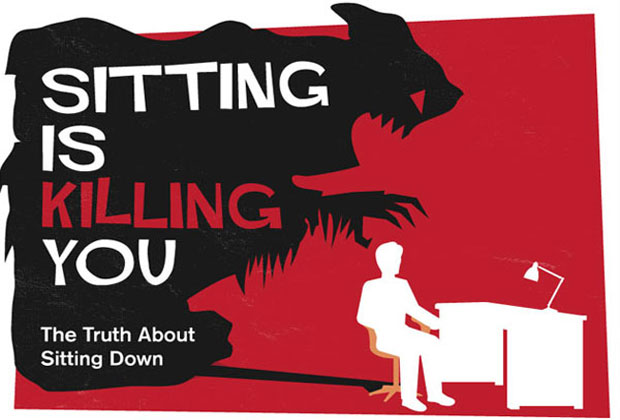
Sitting is the New Smoking…

sitting-is-killing-you

So apparently, sitting is the new smoking…and therefore, I am probably going to die.  Not really (I hope), but there has been a whole lot of attention to the “sitting epidemic” recently, highlighting how much time most of us spend sitting during a regular work day.  (Clearly, they have not spent any time with a staff nurse lately!).  The solution? A standing desk, of course.  Or a treadmill desk. Or taking frequent breaks. Making sure that you have an ergonomically designed work station….

On perhaps, we need to start asking different questions about how our work is designed. For example, in academe, we do spend a lot of time sitting at our computer working on all kinds of things from research grants to articles, powerpoints, data analysis, etc.  Some of this work is unavoidable I think but I also wonder if some of this time could be used more effectively. For example, do we really need to write 20 research articles using one dataset?  Do we really need another book chapter on such and such that a handful of people will read?  What if we publish one really strong paper and then talk to people about our ideas instead?  How much more fun (and time effective) is it to interview people, record a podcast, or share a conference presentation on YouTube?  Obviously, none of these things completely eliminates computer time but I am guessing that the impact of one really great Ted Talk is much broader and valuable than a research article buried in an academic journal that mostly only other researchers are going to read.  Unless of course, more research articles = more tenure points.

Sometimes collecting tenure points feels a bit like being Mario trying to get all the gold coins within reach (and apparently research activities that require copious sitting are as likely to kill you as sitting on your butt playing too many video games).

mario coins.jpg

So let’s assume that you just have to accept that your job requires some sitting.  What can you do to make it less bad?

  1. Take care of your body. Exercise. Eat nutrition food. Go easy-ish on the coffee (mostly). Get enough sleep.
  2. Plan ahead for the ebbs and flows of the school year. Midterms? Exam period? Research grant deadlines?  These are busy times, but they are not unexpected!  Get a calendar and plan ahead. I like to make extra healthy meals and stick them in the freezer to reduce cooking time. Having some exercise equipment in the basement is also really awesome for saving time when I am busy.  There have also been times when I have had to hire my babysitter to give me an extra morning or afternoon to do work on the weekend. (Fingers crossed that being a professor is more awesome than being a grad student working full time!).  Do I always get to do a full workout? No. But sometimes 10 minutes of exercise is better than nothing 😉
  3. Be super organized. You can waste a lot of time trying to simply locate documents, references, and sort through different versions of things.  Having a logical way to organize files and name documents will save you a ton of time. I even get my students to name their documents in specific ways so that I don’t end up with 25 versions of “Assignment 1”.  Using a reference management software program is also a really great way to save time with citing and reference lists, especially when you need to use different referencing styles for different journals. No more wasted time seeking and downloading the same reference articles over and over!  Lastly, using tags and folders in your email inbox is another strategy that saves oodles of time. If you can use the same main categories as your main files on your computer, that is even better!  I like to use gmail and get all of my other emails forwarded to that one account.
  4. Be reasonable. Sometimes I struggle with this. (e.g. “Of course I can have a baby and do my PhD and publish and compete in powerlifting and work at the hospital and teach, etc. at the same time…).  I like to set big goals and have a tendency to say yes to everything but I have learned that this usually leads to burnout. A better strategy is to take on a few things that you can really focus on. Reading (and re-reading) the Power of Less  is a helpful place to start.  Academia seems to reward people who work hard and do a lot but I think another point to consider is that learning and teaching is exciting!  Research and teaching are (should be) both about learning new things and understanding more about the world around us, as well as sharing that knowledge and excitement about learning.  It is hard to say no when you are excited about learning and sharing ideas!   Is it reasonable to spend 20 hours a week preparing for a class you are teaching for the first time?  Maybe not if you are teaching 3 courses and have other things on your plate.
  5. Aim for excellence, rather than perfection. I don’t think there is such a thing as “perfect”. The pareto principle, or 80:20 rule comes in handy here too. It states that 80% of your outcomes/effects will come from 20% of your work. Do you really need to make 50 slides for a 10 minute presentation?  Or, would 10-12 slides, well-designed, be more captivating and effective in getting your point across?  How much time are you spending sitting, working on things that have little to no impact?  After all, sitting is the new smoking….

I want an academic career. When’s the BEST time to have a baby?

The short answer is that there is no best time and that really, anytime is the best time. Nothing can ever prepare you for the challenges and joys of parenting – regardless of whether or not you are a grad student, a practising nurse, or a stay-at-home mom.

That being said, it helps if you have a committed partner and some sort of plan.  Personally, I did not have that experience. Let’s just say that the pill is not 100% effective.  I stuck with my life plan (sort of) and worked at the hospital as an RN until September and started my PhD 9 months pregnant (against all good sense I think) and took one week off from classes (because my supervisor made me). The “birth plan” involved my wonderful friend driving me and my roommate to the hospital where we streamed episodes of New Girl while I waited for my son to decide to make his grand entrance. My sister and her boyfriend flew in and met us there (he stayed outside).

Lucky for me, in Canada we get a year of paid maternity leave and you can be in school during that time – I didn’t plan this out at all but it definitely made life a lot less stressful. For the first semester we didn’t have a car so we got up early to catch the bus so I could take him to the wonderful home daycare we found, then back on the bus to school. After school I would go back on the bus to get him, and again on the bus to go home or sometimes to the Y and then home.  It was exhausting!  On the plus side, it really made me appreciate the amount of time and energy it takes to coordinate life when you don’t have a car.  Before my son was born I rode my bike a lot and it was hard to not be able to do that anymore.

One of the best things about being a single parent and a nurse was how much support I received from others. The nurses at work threw me a baby shower, offered support and advice, and even offered me lifts to and from work when they could.  My former roommate lived with us for a year until she finished her nursing degree (God bless her) and friends have helped take care of my son so that I could go to work, school, and conferences (one even road-tripped with us to Indianapolis!).  Their love and support made me realize how important relationships are in life and sparked my interest in workplace social capital (my dissertation topic).  In many ways, our lives have been richer because it was obvious to others that we needed them.  I’m not sure that it is always the same when people are married and it is assumed that they have all the support and help they need (I’m sure that it is different for everyone).

I think you can balance a demanding PhD program with being a parent but it requires focus, discipline, and support. The balance is always changing too! The time you get to do homework when you have a baby who sleeps a lot is different from the time you get when you have a busy 3 year old who wants to play all the time.  You have to learn to be more flexible and adapt to what your child (or children) need as they grow up.  My son has helped me slow down and reminds me daily to play and enjoy life.  Not that I didn’t before but children have such an awesome way of looking at the world.

At times I have had to make tough choices about work because of being the only parent – for example, this past fall I chose a day job as a research coordinator (which I find rather stressful) because it had regular hours – but because of that I had to give up my part-time staff nurse position at the hospital (which I love) and go casual. It’s straight-up difficult to find daycare for shift work – especially when you are part-time and don’t have a consistent schedule.  I miss seeing my co-workers and my patients. Research is rewarding and I have learned a lot this year but it’s different.

Ultimately, I think being a parent has made me a better person and has made me more efficient with my time. When I am home, I don’t want to be thinking about work so I work hard at work to be organized and focus on things that are important. I have one dedicated day a week to work on my thesis and try to keep it contained in that time frame. I think one of the big problems with academic culture is this idea that working longer hours makes you a better, more productive member of the academy.  Numerous studies show that overworking people actually makes people less effective, less happy, and has very damaging effects on their health.  That, however, is a topic for another post I think…