Blog

On Writing a Pandemic Impact Statement

Writing a pandemic impact statement can also be a valuable opportunity for you to reflect on how the pandemic has affected you and may be used as a tool to manage your expectations and priorities.

A major (and perhaps low fun) part of the tenure process is documenting all the wonderful, impactful things that you are doing.

Whether you are a new faculty member or have some experience under your belts, the pandemic has had an impact on both your career and your personal life – and you should document it, even if it’s just for your own personal records.

The purpose of a pandemic impact statement is to document, in a professional manner, the challenges and barriers caused by COVID-19 that have affected your work and productivity. In addition, it is an opportunity to document your resiliency and resourcefulness by highlighting what you were able to accomplish during this difficult time.

Writing a pandemic impact statement can also be a valuable opportunity for you to reflect on how the pandemic has affected you and may be used as a tool to manage your expectations and priorities. Lastly, you may be asked to submit a pandemic impact statement when you apply for grants or for tenure so having something ready to go will give you one less thing to do later!

Best Practices

I scoured the internet so you didn’t have to, searching for university resources and guidelines to help faculty write a pandemic impact statement. Most of these documents are very similar (reference list is provided at the end). They start out with a paragraph about the pandemic and that it happened (yes, we know), explains why you need to document the impact of it, recommends keeping it between 1-2 pages long, and provides lists of probing questions by category (teaching, research, etc.) that can help you remember and document all the ways in which the pandemic has impacted you as a faculty member. Since I am a nursing professor, I also noticed that most resources did not include anything about the impact on clinical teaching which has been a major challenge for faculty teaching in health professional programs.

Two resources stood out as being particularly helpful. They were from the ADVANCE program at UMass Amherst (1) which provides a template to get you started and the Susan Bulkeley Butler Center for Leadership Excellence at Purdue University (2) which includes a wide range of short exemplars that may or may not be relevant to you. Of note, it is not at all surprising to me that the most useful information came from academic leaders (who both happen to be women) working to advance equity, diversity, and inclusion for women and minority groups in academe.

(What) Should I share in my statement?

After reading all of these documents I still had a lot of questions about how to write my statement and I found myself carefully considering how much is actually necessary and safe to share with people who are evaluating me and my work.

This isn’t the first time I have wrestled with deciding how much is okay to share in formal assessment documents. My life hasn’t been easy. I worked multiple part-time jobs throughout university to pay for school and worked my butt off to earn scholarships. I started my PhD nine months pregnant with my son and have been a single parent throughout my doctoral and tenure track journey. My PhD supervisor died right after my graduation. I said goodbye to her in palliative care the night before I walked across the stage. How’s that for a way to start your tenure-track job? I cried a lot my first year as an Assistant Professor. Sometimes life is just hard.

I have been very open about all this but I have never felt that my personal life and the extra challenges I’ve faced were particularly relevant to my assessment documents or my ability to get tenure and be promoted. I guess I always thought that if I met the criteria anyway what does it matter if it was harder?

It seemed more risky to overshare, especially as a millenial (even though I have been working since I was 13 and am almost 40 now). I was afraid that my colleagues (who are mostly older than me) would think that I think I am a “special snowflake” that deserves or is asking for special treatment. Or worse, that I wouldn’t actually earn tenure on merit, but out of pity. In the end, I didn’t mention any of the things above when I submitted my file for probationary assessment. I got tenure early as an exceptional case and I know with my whole heart that I earned it. Perhaps if that hadn’t been the case I would regret not providing context about some of the extra challenges I’ve had to deal with. I will never know.

The pandemic has changed my view on this issue of sharing somewhat because it has forced some of the inequities in society and in academe to become more visible. The fact that many universities are requesting or inviting faculty to include a pandemic impact statement in the first place is an important signal that there is at least some awareness that the pandemic has affected people differently and should be taken in account when assessing employee job performance. However, let’s not lose sight of the fact that the tenure and promotion committee is still focused on assessing your performance, in your job, that they pay you to do.

I think the following statement from Harvard is particularly telling (bold emphasis mine):

In summary, this supplemental statement should describe any significant effects the pandemic had on your regular activities and plans, indicating ways that your focus or priorities may have necessarily shifted and articulating any deliberate choices you made to concentrate on specifically accessible opportunities and goals, given the constraints. It will not be necessary to explain why your work has been impacted (by describing specific childcare or health issues, e.g.), only to explain how (e.g., critical reduction in available working hours, inaccessible field site, loss of funding or unexpected new research expenses, etc.).

You’ll also be invited to highlight examples of innovation, training, additional mentoring or other service activities (e.g., clinical or first-responder service), new directions in research, or other unplanned but concrete accomplishments that came out of this period. A list of related resources is provided to assist you in reflecting on potential categories of impact and assessing extent (Harvard Office of Faculty Affairs, 2021).

While it may not be possible to completely separate the why and the how of the impact of COVID-19 on your work, I think it is best to keep things short and simple and focus on the how. I also really like the second point about highighting the good/new things that happened in response to the pandemic.

As an example, here is what I included in my pandemic impact statement about how my personal circumstances affected my work during the pandemic:

I am a long-time single parent of an elementary school-aged child with no caregiving support from family. School and daycare closures in March/April 2020 and Fall 2021 due to COVID-19 required me to work from home while parenting and supporting at-home learning for my son.

Out of two pages, this is the only part that mentions my personal circumstances and it is still focused on the how. The main point I am trying to get across here is that when it comes to caregiving for my son, I am it; I don’t have backup like so many of my colleagues. Point made. Aside from the infrequent times we’ve been trapped in the house, it hasn’t been all that different from pre-pandemic times. I still have to do all the housework, shopping, and caregiving. I am still the sole breadwinner. It’s impossible to find babysitters. Online conferences are more accessible but I miss in-person conferences which were often my only break from being a parent. Does the univeristy really care about that stuff? I’m not sure.

The rest of my pandemic impact statement is focused on how the pandemic has impacted each of my key roles: Research, Research Supervision, Teaching, Service, and Administration. That’s it.

So now what?

Go write your statement! Easy right?

If you want some help with this I made a workbook for you that can make it less painful and get it done in a single afternoon. As I mentioned earlier, I read pretty much every guide and resource I could find for faculty on how to write a pandemic/Covid-19 impact statement. None of them were quite what I needed so I made my own tool and I think you may find it helpful too.

Inside this workbook, I show you how to organize your statement, provide comprehensive checklists of possible impacts for teaching both classroom and experiential learning courses (like clinical, labs, practicums, etc.), research, and service so that you don’t forget anything (it’s been a long pandemic!), and provide examples of what to write in each part of your statement. I used this workbook myself so I know that it works and the checklists alone will save you loads of time!

If this sounds like something you’d find helpful, click here to check it out.

And that’s it for this week!

See you next Sunday (hopefully with your pandemic impact statement crossed off your to-do list!)

Emily

References:

(not formatted properly but here are the links; #sorrynotsorry)

Harvard Office of Faculty Affairs (2021). COVID-related resources for faculty. https://www.hsph.harvard.edu/faculty-affairs/faculty/covid-related-resources-for-faculty/

California State University (Long Beach): https://www.csulb.edu/academic-affairs/faculty-affairs/covid-19-professional-impact-statement

Clemson University: https://www.clemson.edu/provost/faculty-affairs/Documents/tpr_documents/facultycovidimpactstatement_document.pdf

Cleveland State University:  https://www.csuohio.edu/sites/default/files/CSU%20Faculty%20COVID%20Impact%20Statement%20Guidelines%202021_0.pdf

Georgia State: https://faculty.gsu.edu/files/2021/02/COVID-Impact-StatementsV2.pdf

Michigan State University: https://hr.msu.edu/ua/promotion/faculty-academic-staff/documents/Memo-Guidelines-COVID-19-Impact-Statement-12-2-20.pdf

Michigan Tech: https://www.mtu.edu/advance/resources/covidimpact/

NC State University: https://provost.ncsu.edu/faculty-resources/faculty-evaluation-and-covid-19/

Purdue University: Best Practices Tools – Susan Bulkeley Butler Center for Leadership Excellence – Purdue University

University of California (Santa Barbara): https://ap.ucsb.edu/news.and.announcements/covid-19/2021-01-25_Guidance_for_COVID_Impact_Statement.pdf

University of Central Florida: https://facultyexcellence.ucf.edu/document/optional-covid-19-impact-statement/

University of Connecticut: https://provost.uconn.edu/covid-19/covid-impact-statements-guidance/

University of Florida: http://aa.ufl.edu/media/aaufledu/tenure-and-promotion/Guidance-for-faculty-impact-statement-final.pdf

University of Massachusetts: https://www.umass.edu/advance/documenting-pandemic-impacts-best-practices

University of Nebraska: https://journalism.unl.edu/pdf/COVID%20Impact%20Statements.pdf University of Nevada, Las Vegas: https://www.unlv.edu/hr/employee-info/covid-statement

University of Texas: https://cns.utexas.edu/faculty-affairs/faculty-evaluations/covid-impacts/covid-impact-statement

Creating a weekly research writing practice

Creating a consistent writing practice is an essential habit that will help you be more productive and impactful as a researcher. If you don’t prioritize your research writing in your calendar other activities (often meetings and teaching-related work) will take over that time, leaving you feeling like you just don’t have enough hours in the day to get everything done. (Pro tip: you don’t and never will have enough time to do ALL the things so you must prioritize and choose what matters most).

Why weekly instead of daily? 

A lot of people recommend daily writing but I find that a week is a better unit of time for planning and time management, especially as a professor. There are just so many different roles and activities that we must do as part of our job that to try to do all of them in a single day would make you crazy!  Not to mention the cognitive costs of frequent task switching between diverse activities. Personally, I find that a 2-4 hour block of writing time allows me to really focus on what I am writing and make progress. Academic writing often involves searching the literature, reading articles, and interpreting/synthesizing results as you write too, so it can be a slow process! If you only have one hour/week or find that works for you, fill your boots but I do recommend a larger block of time if you can.

How to create a weekly research writing practice: 

Step 1: Decide what day and time each week works best for you to write. This may be based on your schedule or on when you feel like you write best. Unfortunately, these don’t always match up, so if that is the case, I recommend being practical and going by what works for your schedule. I recommend picking a time on Tuesday, Wednesday, or Thursday if possible so that you don’t skip weeks due to holidays.

Step 2: Create a recurring event in your calendar for the same day and time each week. This is your dedicated research writing time. Do not use it for anything else!

Step 3: Turn off emails and other distractions during your research writing time. Note that it may take some time for other people to get used to the fact that you are not available to them during this time. Reinforce that writing is an essential part of being a productive researcher and remind them of when you are available. 

Step 4: Write! Work on high-impact research outputs such as grant proposals, research papers (and revisions), and conference abstracts. 

And that’s it! It is actually very simple to set this up. The challenging part is showing up and writing every single week consistently. There are about 46 work weeks/year once you account for holidays and vacation time. So, if you were to write for 4 hours every single work week, that’s 184 hours of dedicated research writing time each year! Obviously (or maybe not?) you will probably need additional writing time at certain times (like before a grant proposal is due). However, during semesters when you have a heavy teaching load, you may find that this dedicated time is particularly helpful and important to keep your research productivity on track.

Have a great week and see you next Sunday!

Emily

How to help struggling graduate students finish their thesis

While it would be great if all of our grad students could finish within the “regular” timeframe, it is completely normal to have some students who take longer. The pandemic has had a huge impact on many students’ personal and professional lives and I think we need to approach this with compassion while also helping these students move forward.

Students who are struggling may need to take a leave from the program to deal with other things that are happening in their life. In my experience, students rarely want to do this, even if you have a heart to heart with them and reassure them that you and their thesis will still be there when they get back, Ultimately, taking a leave (or not) is their decision so your role is to make sure it is an informed one and that they know it is an option.

Setting and maintaining appropriate boundaries with students is also very important. As a professor who is also a nurse, I am perhaps hyper aware of these boundaries and making sure that students have access to the supports they need. I am not their nurse or mental health counselor, but I do care about them and have direct conversations to make sure that they know about the academic and mental health services they have access to on campus and in the community. If they are also working (many of mine are) they often also have access to an Employee Assistance Program. As their thesis supervisor you can provide them with information about resources available to them and keep your role focused on the task at hand: finishing their thesis as soon as possible.  

So how do you actually help them finish their thesis?

1. Provide them with a thesis completion roadmap.

Sometimes the steps required to finish are not entirely clear to students (or faculty!). Create a 1-pager that shows all the steps involved in completing a thesis in your faculty/department. Then you can print it out for the student and show them where they are now and what they have left to do to get to the finish line. This map can be a helpful tool for planning and for breaking up the steps left to complete

2.     Help them establish a daily writing habit.

Some students love doing research but hate writing. They need to get over this aversion real fast if they want to finish their thesis and have an academic career.

Mindset is a huge part of this! Ask your student to brainstorm ways that they can reward themselves for writing and make it something that they look forward to. For me, writing is one of the only times that I get to be alone and think. As an introvert, I love that! Rewards could be things like having a good coffee during writing time, freedom from doing anything else (like answering emails, etc.), or even putting a sticker on a tracking chart, with a bigger reward after so many stickers. Of course, the biggest reward is finishing their thesis which is a huge freaking deal and graduating with their degree!

In addition to working on liking writing (or at least appreciating it as a means to an end), a daily writing habit needs to be scheduled in their calendar. Your student needs to schedule blocks of time every single day to work on writing their thesis. These need to be treated like appointments that they cannot miss! Then they need to show up and do the work.

3. Encourage them to let go of “perfection”.

     This can be a doozy! Some students are reluctant to send you what they have done because they are worried it isn’t good enough yet. They want it to be absolutely “perfect” before you see it.  Honest to goodness, perfection is a lie!  I have yet to see a thesis submitted where the committee did not have suggestions or minor revisions for the student before they were completely done. Getting feedback is a key part of the process and the sooner you can get a draft from your student, the sooner they can get your input. Your expertise and guidance will help make sure they are on the right track.

One of the reasons I was able to finish my PhD under 4 years is that I knew my committee would have feedback no matter what I sent to them! There was no point in me spending an extra week or two on a part of my proposal or thesis to make it “perfect” when it could be in my committee’s hands instead and I could move on to working on the next chapter while I waited.  This being said, I am a strong writer and did not send them unorganized garbage to fix. I’m definitely not encouraging that!  If their writing skills are absolutely horrible that is another issue entirely. 

4. Put the ball in their court.

While you may feel personally responsible for them finishing their thesis (on time or otherwise), ultimately, it is up to them to do the work to finish it and earn their degree. You can and should support them to do this but you cannot do it for them. Grad school isn’t for everyone and achieving this degree is a big deal!

I know the pandemic has been a tough go for a lot of us and some of our students. I hope that the strategies and ideas I shared in this post are useful to you in helping your graduate students move forward with compassion and an actionable plan to get their darn thesis done! 

See you next Sunday! Emily

Non-cash ways to support your grad students

Before we get into this post, I want to highlight the importance of funding your graduate students if you can and as best you can! However, there are times when you may not have a lot of funding or enough to go around OR you just can’t pay your students enough to work for you. The latter happens in nursing most of the time – nursing grad students simply make more working as an RN than I could possibly afford to pay them as a research assistant.

Regardless of your cash flow situation, there are important benefits that you can (and should) provide to your graduate students aside from/over and above direct financial support.

Social capital.

Social capital refers to the resources embedded within and available from our relationships with other people (see my PhD dissertation for more info + references if you would like). Your grad students benefit tremendously from your professional network so make sure that you include them in projects, introduce them to your colleagues, and provide them with exposure to your network at conferences and other events.

Research training & mentorship.

The time and energy you invest in teaching and mentoring your grad students is incredibly valuable. Make sure that you have regular, dedicated time for each of your graduate students and that you provide them with the training they need to develop/enhance their knowledge and skills and be successful.

Experience.

A major part of the grad student journey is gaining experience – both in doing research and sharing it with others. Supporting students to submit abstracts, prepare presentations, and attend conferences can be a major benefit of working with you. Be strategic and pick national/international conferences that are happening close to you (or virtually) to limit the costs of attending – and cover registration if you can. Bonus points if you have a group of students attending together! Pre-covid I was able to support a group of students to go to a conference in Montreal and then to Halifax the following year. They really enjoyed having some social support at the event and it was something that we all looked forward to as a group. Highly recommended!

CV points.

Not to be overlooked, being able to add things to your CV is also important, particularly if you are pursuing an academic career. Your grad students should be given credit for their contributions to research publications and presentations. Unfortunately this doesn’t always happen. One time I wrote an entire article and was gifted 4th author… another time I was a co-author on a paper with another grad student and her supervisor took all the credit! I could write a whole article just about this topic but the bottom line in my opinion is that credit should be given as earned, and only as earned. Having direct up-front conversations with grad students (and everyone involved) about authorship expectations and opportunities is super important.

So there you have it! There are lots of ways that you can support your grad students without giving them cold hard cash (though, if you can do that too, high five!).

Until next time!

Emily

Dealing with RA/Grad student turnover

Research on job turnover typically focuses on how to prevent it. However, turnover of graduate students and research assistants (RAs) is a feature (not a bug) and is somewhat predictable (especially with graduate students). In fact, turnover might not even be the right term to use; perhaps it should be the RA/grad student cycle instead. There are (or will be), of course, subgroups within your research team which have different cycles and timelines: master’s students (2 years), PhD students (4 years), post-docs (1-2 years), research staff (contract/grant-based time frames), and out of sequence/taking longer than expected graduate students.

As a research supervisor, recruiting and training research trainees is an important part of your role but it is also one that can be onerous and time-consuming if you don’t have a plan. In this post I am going to share three key decisions that will help you attract the right people to your research team and make it easier to provide them with a rich and meaningful training experience.

Key Decision #1: Focus your Research

First, you need to decide what your program of research is going to be about. As a naturally curious person interested in learning and discovering new things, this may be difficult for you! I know personally that I had a really hard time with this after I started my tenure-track position. I was invited to work on a lot of different research projects that were super interesting but not necessarily in alignment with my own main area of research. At first I said yes to everything until I realized that saying yes to these opportunities meant saying no to other projects that were more in line with my research priorities/expertise. It also takes way more time and effort to supervise a student working on a project that is not within your direct area of expertise.

The fact is that clearly stating what your program of research IS about also defines what it is NOT about. That means that you will say no to grants, collaborations, and even students who do not align with your research program. Sounds harsh but it will ultimately help you produce high-quality, impactful research in your field and a mentorship experience that truly serves your research trainees.

Key Decision #2: Build your Research Team

Building a research team is a lot like building a varsity sports team – it takes time and as your reputation and research success grows you will find it easier to attract the best students and get research funding.

Before you start building your roster, decide who your ideal graduate student and research staff member is. You need to know this so you can assess the fit of potential students and research team members. This will be partially determined by the type of research you do, the types of programs offered by your faculty/department, your research training model (see below), and your research grants. Some people are not going to be a good fit for you and, lovely as they may be, you should encourage them to work with someone who is going to be.

You also need to be prepared to commit the time and energy each person you bring onto your team requires. Working with grad students is different from hiring an employee who already knows how to do everything you want them to do. Grad students are there to learn from you! Yes, they contribute and add value but you are also investing in them and helping them develop skills and expertise. A research coordinator on the other hand might be hired full time to take the lead on a specific project for a defined period and you might want to have them continue on for your next one.

Key Decision #3: Your research training model

Just because you can do something doesn’t mean you should. One approach I have seen/experienced to maximizing research productivity is to create a sort of research pyramid whereby post docs or senior PhD students are responsible for training those behind them. If done intentionally this can be a valuable opportunity for developing leadership and teaching skills, but often it is done on the fly and can leave students feeling unsupported, undervalued, or resentful of being asked to do work they think their supervisor should be doing. Would you rather create a research training experience where all of your trainees and research staff get to learn from and work with you directly? What is your research training model? What would you like it to be? You may find it helpful to reflect on your experiences as a student and think about what you loved and what could have been better. How can you make the experience awesome for the people working with you?

So there you have it – 3 key decisions that will help you attract the right people to your research program and provide them with an awesome research training experience. Remember, you will need to be patient but if you focus on building a quality program you will attract quality people and success will follow.

Using your syllabus to manage student expectations

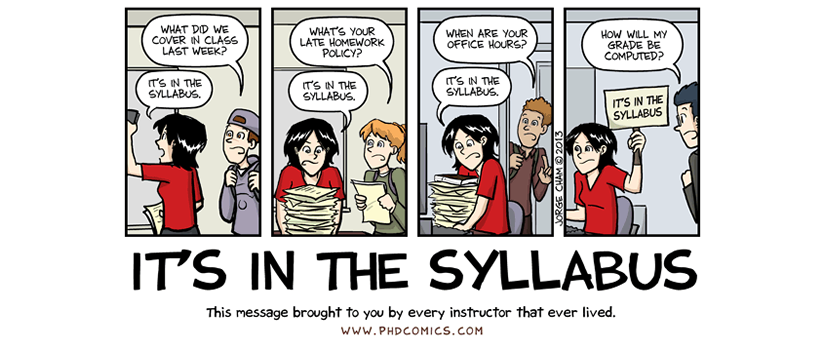
If you want to be an effective university teacher and have a manageable teaching (and email) workload throughout the semester, then you must establish clear expectations for your students. In this post I’m going to discuss how to use your syllabus to establish clear expectations for your students and proactively address student concerns and issues as much as possible. Let’s get started!

The Syllabus

As you know, your course syllabus should provide all of the information that your students need to know about your course and what they need to learn and do to be successful in your course. It also is a tool for setting/managing expectations and establishing boundaries. It is important to be up front with students about things such as: when you are available/unavailable, your email response time, consequences of late assignments, requests for extensions, how to submit assignments, and so forth.

Your institution and/or faculty/department likely has a standard syllabus template that you are asked/required to use or can adapt. Although it is tempting to keep recycling and updating old versions of syllabi, always check to make sure that the information is up to date and that all the hyperlinks still work.

What I include in my syllabi:

  • Course information:
    • Course name, number, and calendar description
    • Course objectives
    • Class schedule
  • Professor information:
    • Professor/Instructor name and contact information
    • Office hours and availability
    • Email policy
    • FAQ discussion board
  • Required learning resources (typically books or software programs)
  • Technology requirements (especially for online classes)
  • Assignment information:
    • List of summative assignments/tests/exams, due dates, and their % grade for the course
    • List of formative assignments/tests and due dates
    • Detailed assignment instructions (may choose to make this a separate document)
    • Assignment grading rubrics (as applicable; may choose to make this a separate document as well)
    • Assignment submission instructions
    • Information about late assignments and/or missed tests/exams
    • Information about requesting extensions
  • Information about unversity student resources including learning accommodations, student services, health and counseling services, etc.
  • Information about plagiarism
  • Information about the appeal process
  • Grading scheme for the course
  • Easter egg for students who read the syllabus

Many of these sections are fairly standard but the ones that I find really make a big difference for students and for me are: Professor information and Assignment information.

Professor Information:

In terms of office hours, I only do these by appointment and try to keep it to business hours M-F. However, some of my master’s students are nurses working shifts so I make sure they know that I am willing to be flexible for them. You may want to block off certain days/times for student meetings. I find that student questions/meeting requests happen when there is a test or assignment coming up or after they get an assignment or test back so I don’t really find it helpful to block off consistent time every week.

I have a lot of rules for students about sending me emails. In terms of my email response time, I tend to be really on top of my inbox and generally respond in less than 24h. However, my official policy is within 48h to give me a buffer and set a reasonable expectation for students. I also ask that students type the name of the course in the subject line and if it is a legit emergency to indicate that it is urgent. When I give back assignments, I ask that students read over all of my feedback and reflect on their assignment AND that they wait at least 24h before they email me to request a time to meet with me about it. I am more than willing to discuss assignments with students but I find that they are in a better frame of mind when they have time to reflect on their work and the feedback I have provided. Recently I have held optional live sessions online for students to ask any questions that they have about an upcoming assignment or test. Often more than one student has the same question so it is an effective way of helping the whole class at once.

Another tool that I have used within my learning management system (LMS) where the course is housed (we use D2L Brightspace) is to create an FAQ Discussion Board where students can ask questions that they have about the course or assignments. I also encourage students to look in the syllabus and the assignment instructions and grading rubrics to see if they can find the answer to their question before reaching out to me. Nine times out of ten, the information they are looking for has already been provided. This prevents me from getting a lot of repetitive questions via email.

Sometimes a student will email me about something that I hadn’t thought of and that the whole class would benefit from. In these cases, I usually email the entire class or post a news item/announcement in D2L to share the information with everyone.

Assignment Information:

I try my best to provide students with very detailed assignment instructions and marking rubrics (when applicable). I encourage students to mark their due dates in their calendar/planner, start working on their assignments early in the term, and sometimes include smaller low stakes assignments along the way to get them started. When possible I also include example assignments (in the course site, not actually in the syllabus) from previous students (with permission) so that they understand what I am asking them to do. Obviously this isn’t possible for every type of assigment or for tests but it helps clarify expectations tremendously. For tests, I also find it helpful to have a marking key with justification for correct and incorrect answers. Yes, it is time consuming to make this but it is super helpful to have on hand when explaining to students where they went wrong or misunderstood a question/answer. It also helps me check that I didn’t write a wonky question and when I am lucky enough to have TAs, it helps them understand how to mark.

Providing students with information up front about what happens if they submit assignments late (or never) or miss a test or need an extension is also really important. With the current pandemic, many of my students have had additional challenges (many of them are nurses working on the front lines or in management positions and have kids at homes, etc.) so I have tried my best to be supportive and flexible with due dates this year. I usually give students 48 hours of extension time that they can use any time during the term as long as they let me know a few days before the due date. This information is included in the syllabus. Generally, few students use this but it helps reduce their stress because they know they have that buffer if they need it.

The last thing that you may want to include in your syllabus is an easter egg that students will find if they actually read your syllabus. If it is a smaller class and you don’t mind getting a bunch of emails you could ask them to email you a picture of an animal or a car (or whatever). Another approach (which I prefer) is to set up a short survey using Microsoft or Google Forms (depending on what your school uses). Insert the link into your syllabus near the end with brief instructions to the student to click on it.

Example text:

Let me know that you read the syllabus by completing this brief survey: click here.

Sometimes the hyperlinks can be really long so you can shorten the text to display by clicking on the second letter in, typing what you want it to say, and then deleting the first letter and the remaining letters after what you typed. This looks better and also can make the easter egg less obvious to students who aren’t actually reading the syllabus.

So there you have it!

Is there anything I missed?

I would love to hear what you include in your syllabi. Comment on this post if you have something to share.

Annual planning as an academic

As an academic, I think it’s important to understand the ebb and flow of your academic year in order to plan ahead and be strategic with how you invest your time and energy at different times of the year.

Hallelujah! 2020 is almost over forever. I’m sure I’m not the only one who felt like this year was 15 years long. I am done with it and ready to move on. Who’s with me?!

While January 1st is not my first choice for the “start of the year”, it is an opportunity for a fresh start and a time when many of us reflect on the past year and think about what we want to accomplish in the year ahead.

In this post, I’m going to talk about the different “years” that we deal with in academia (and as a parent if that is applicable to you) and how you can use that information to strategically plan your year.

As an academic, I think it’s important to understand the ebb and flow of your academic year in order to plan ahead and be strategic with how you invest your time and energy.

There are multiple “years” that you need to be aware of: 1) the calendar year, 2) the employment year, 3) the academic year, and 4) your children’s academic year (if applicable).

1. The calendar year. January 1st to December 31st. This is the most obvious year but other than taxes, vacation time, and the normal calendar, it is not actually the schedule that we really live by in academia. That being said, the calendar year can sometimes be used to your advantage (or not) when it comes to publications, conference presentations, and research grants.

2. The (university) academic year. This is another year that we are very familiar with since we have spent most of our adult lives at the university in some capacity. In Canada the academic year runs from September of one calendar year until August of the following one. It is divided into Fall Term (Sept-Dec), Winter Term (Jan-Apr), and Summer Term (which includes multiple course timeframes between May-Aug). For me, the academic year is all about teaching responsibilities, graduate student progress, and administrative deadlines. Normally professors are required to teach during 2/3 of these semesters/terms, with one term to focus more on research. That looks great on paper but in real life, most research happens over the full year, not just over 4 months. However, knowing your teaching responsiblities does allow you to prioritize the most time-consuming aspects of your research when you have less/no teaching.  

3. The employment year. Typically, this year is from July 1st of one year to June 30th of the following year. This is the “year” that counts towards probation, tenure, promotion, and years of service. Often you will be required to provide an updated CV or progress report by June 30th every year to show what you have done in the last year. This year is also used to determine when you are eligible for sabbatical leave and your possible retirement dates.

The employment year is a bit awkward because it includes parts of two academic years: a) Academic Year 1: Tail end of summer term (July/August), and b) Academic Year 2: Fall term, Winter term, and first half of summer term (May/June). However, I still think it is the best year to use for planning as an academic.

If you are on the tenure track or pursuing promotion to full professor, you should absolutely print out a copy of your employment contract and write down the key dates related to submission of your applications for probationary review, tenure, and promotion. I also encourage you to go buy a sturdy 2-3′ binder and start creating your portfolio of evidence of meeting the criteria for tenure as you go. It is so much easier to do this as you go than waiting until the last minute!

4. Your kids’ academic year. If you have school-age children like I do, then you also deal with their academic calendar in your planning. In Canada, the school year runs from after labour day in September until the end of June. This year aligns almost perfectly with your employment year, minus the summer (July/August). Remember how the summer semester was supposed to have “extra” time for research? About that…

Seriously though, if you have kids, you need to find something for them to do when you are working in the summer and also plan for some family vacation time. If you are going to have students working for you in the summer you also need to consider how you are going to deal with that. Are you going to make them take vacation at the same time you do? Are there things that they can work on independently? Or maybe you have a post-doctoral fellow or senior graduate student who can step up and provide some leadership while you are on vacation?

Putting all these years together we get the following:

Note that I used the employment year as the base year for this because in my opinion it is the most important one as an academic employee. From this perspective, we are actually halfway through our “year” rather than at the beginning of it.

Planning Strategically for the next 6 months:

  1. Make a list of the things that you must do in the next 6 months.
  2. Is there anything that you can delegate, defer, or make easier? If yes, take action to make those things happen.
  3. Schedule your remaining must dos into your calendar.
  4. Make a list of the things that you want to do in the next 6 months.
  5. Rank the items on your want list.
  6. Schedule your want list by priority.

Example:

  1. My MUST DO list for January-June 2021 looks like this:
    1. Teach graduate course on healthy public policy & determinants of health (online, synchronous)
    2. Teach undergraduate course on professional practice (online, asynchronous)
    3. Oversee development of specialty nursing professional development certificate
    4. Transition to Associate Dean role
    5. Move to Moncton for new role (sell house, find new place to live, etc.)
    6. Graduate student supervision (currently 4 students)
    7. Co-lead of 1 major research project
    8. Co-investigator on another major research project
    9. Sign up kiddo for summer day camps
  2. Is there anything that you can delegate, defer, or make easier? Not really lol…
  3. Schedule your remaining must dos into your calendar. Many of my must do commitments have weekly times allocated to them. For teaching, I also make sure that I put all of the assignment and test dates into my calendar and block off time for marking and meeting with students afterwards. Selling my house and moving is going to take up a lot of time and energy so I am going to wait until I am done teaching in April before I start looking for a realtor and putting the gears into motion for that. I have the advantage of having a lot of experience moving which will help but it is still a lot of work! Day camp sign ups are usually in May/June so I will put a reminder in my calendar for that.
  4. My WANT to do list for January-June 2021 looks like this:
    1. Finish and submit 2 journal articles that I have been working on
    2. Have a big BBQ party to say goodbye to our Fredericton friends (depending on COVID19)
    3. Compete in a powerlifting competition
    4. Lose 20lb
    5. Plan a fun camping trip vacation
  5. RANKED LIST:
    1. Plan a fun camping trip vacation
    2. Lose 20lb
    3. Finish and submit 2 journal articles that I have been working on
    4. Compete in a powerlifting competition
    5. Have a big BBQ party to say goodbye to our Fredericton friends (depending on COVID19).
  6. Schedule your want list by priority.
    1. Planning for the camping trip vacation will actually have to happen later on once I have sold my house and have specific dates for moving. I am confident it will happen but even though it is #1 on the want list, it will have to wait.
    2. Losing 20# is an important goal for me this year. I have been sitting so much the past year and feel unhealthy. To work towards this goal I have scheduled in time for walking the dog twice a day and working out in my home gym. I also schdeuled in time for weekly meal planning, grocery pickup, and meal prep.
    3. These 2 articles are so close to being done! I blocked off time in the next 3 weeks to work on each of them and polish them up.
    4. I haven’t competed in powerlifting for 6 years (yikes) but it is something that I really like doing and would be fun to do with my powerlifting friends. The one I want to do is in early April on PEI which has been super strict with COVID19 restrictions. I’m still on the fence about this one because it is during a busy part of the semester and there is still a lot of uncertainty about COVID19. I also just realized that it is on Easter weekend so I think that specific competition is going to be a no for me this year. The next 6 months is going to be busy so while I will still work on my strength and fitness, I think the wise choice is to look at competing next year instead.
    5. BBQ party TBD…will have to wait and see!

I hope this process helps you with your planning for the next 6 months 🙂

Happy planning!

Nursing workforce planning when everyone has a nursing shortage…

For quite some time academics have been predicting a severe nursing shortage in Canada and around the world. This was delayed because of the economic crisis of 2008 which caused many nurses to delay retirement and keep working. Unfortunately, our population has continued to get sicker and older and efforts to address the predicted shortage have fallen short. As a result we are now in the midst of the exact circumstances we were warned about: We don’t have enough registered nurses and those we do have are often working short-staffed and overtime. In some places it’s even become a challenge to schedule vacations because there just isn’t anyone to cover.

So how to solve the problem?

Option 1: Train more nurses. Considerations: nurses need full-time jobs when they graduate and governments and universities need to invest in nursing education (including hiring more educators for more students).

Option 2: Recruit nurses from other places. Considerations: Taking nurses away from places that also have a nursing shortage is unethical, not all nursing education is equal, and the process to get registered and licensed in Canada can take a couple years. In addition, bringing over foreign nurses to work below their scope of practice as personal care workers until they complete the process (if they can) is completely unethical.

Option 3: Let all nurses work to their full scope of practice (optimize use of health human resources). Considerations: In Northern and remote areas of Canada RNs are able to work to their full scope but in many hospitals and other health care organizations they work below their scope. For example, nurses have the expertise to assess wounds and make decisions about dressing changes but in some hospitals they need an order from a physician to make any changes. We are seeing LPNs (and RPNs in Ontario) starting to work more up to their full scope of practice which is great but all nurses should work to their full scope of practice. Appropriate staff mix is also essential (example: the ratio of RNs and LPNs should be different on different units).

Option 4: Health promotion and prevention (invest in public health and address social determinants of health). Heaven forbid we actually slow the flow of patients that need nursing care in the first place…but addressing the root causes of illness and disease would go a long way to decreasing use of the health care system in the long term.

On Legacy and Goodbyes

I have many thoughts about my first year at UNB and as a nursing professor. Not unexpectedly, it has been a year of intense change, growth, and learning, but also of deep personal loss. In October 2016, just months after starting my career as an Assistant Professor, I said goodbye to my PhD supervisor the night before I walked across the stage in my beautiful purple robes to be hooded as Dr. Read and get my diploma. After leaving the hospital I broke down in tears and sobbed.  I still don’t know how to deal with this loss. The juxtaposition of experiencing one of the happiest and saddest events in my life at the same time was (and is still at times) overwhelming.

This experience has definitely influenced my perspective on my work as I begin my career. Heather was a nursing graduate of UNB where, serendipitously, I now work.  She influenced nursing research, practice, and policy nationally and internationally through her work on structural empowerment and healthy work environments, but arguably her biggest, broadest impact has been through her influence on her students and colleagues. Working with her was a one-of-a-kind experience and I feel so blessed to have had the time with her that I did.  Being a supportive supervisor and mentor for graduate students has become a really important priority for me because I know it matters, deeply.

In retrospect, I think I was in denial about the fact that she wouldn’t always be around.  As her illness progressed, she worked from home more frequently and we (her research staff) would run down to the dental circle to exchange documents and edited drafts with her when she pulled up in her car. It became the new normal and for better or worse she was able to keep working.  The best days were when she would come sit in the RA office with us, pull up a chair, and chat about research and life (and Roger Federer of course!). Despite her busy schedule and everything else, Heather was extremely generous with her time and energy.  Her high expectations and drive weren’t always easy to handle but she pulled out the best in me for sure and always said thank you for the work that I did for her.

God, this is so hard to write about.  What are you supposed to do when your supervisor dies and leaves you her laptop, a book chapter to write, an unfinished research study…? When you help clean out her office and see what’s left behind? The awards, degrees, books, and articles…. the artifacts of hours upon hours of work and intellectual capital.  When you witness her son saying goodbye to her and think about your own mortality and having to say goodbye to your own son down the road?  I’m not sure what the answer is but I see things a bit differently now.

Not that I was ever interested in doing things just because they look good on my CV, but I really do think about my work differently now.  Not to be morbid, but I am acutely aware that the impact of my own research and teaching is important and will live on after me.  Much of Heather’s ideas and knowledge have been passed on to her students and I am honoured to be part of that group of people.

My perspective on how I use my time has also changed and I cherish the time I have with my friends and family in this life even more, though admittedly I don’t spend nearly as much time with them as I would like. I don’t want to sacrifice relationships for my career and I have realized that I don’t have to. In fact, I am more convinced than ever that the relationships we have through our work are (or can be) an important part of our life.

Thanks for listening.


Unsolicited Advice for Writing a Research Article for a Journal

Writing research articles for peer-reviewed journals requires practice, patience, and persistence.  I am by no means a prolific scholar but I worked with one who was amazing (the late Dr. Heather K. Spence Laschinger) for six years and learned a thing or two about writing journal articles (and my record isn’t too shabby for an early career scholar either). I am also an award-winning peer-reviewer for several journals so I have seen a lot of excellent and not-so-excellent submissions which has made me a better scholar too.

One of the things I really love about this role is being able to provide helpful feedback to others that can help strengthen their work. Chances are I will never be your peer-reviewer (unless you are a nursing or management scholar) but I wanted to share some tips on how to present your best work and improve your chances of publishing your research. From a reviewer perspective I think this guidance is important too because we are volunteering  our time to review papers (yes, that’s right, we do it for free, mostly because we care and are mega-dorks) and trying to review a poorly written and/or disorganized manuscript is frustrating.

So, without further ado, here’s my unsolicited advice for writing a research article.

Select the journal first

But, how do I choose a journal?

First, read the aims and scope of the journal to make sure it is a good fit for your research. For example, if you did a study on job burnout, you might not want to submit it to the Journal of Applied Physiology. Burnout Research would be a better fit for your work. Journal-research fit, if you will, is super important because the editor wants to make sure that the articles are of interest to their readers.  You will not make it past the editor’s desk if your article isn’t a good fit for the journal so save everyone some time and do your homework before you submit (and even better, before you begin writing).

Ideally you should select 2-3 journals that are a good fit for your research and then compare them. Look at their impact factors and take a look at a couple of recent articles from each to get a feel for the kinds of studies they publish. Also look at the word length and author guidelines because sometimes that can be more important than impact factor if you need more space. I recommend always going for the best journal first and then keeping the others in mind in case your work gets rejected from the first choice.

Read the author guidelines and follow them EXACTLY.

Don’t waste your time writing a 10,000 word paper with 10 tables and figures for a journal that wants 5,000 words and a max of 4 tables and figures. Author guidelines are not suggestions – they are rules! Your job as an author is to make it as easy as possible for the editor to give your paper the green light to move on to the peer-reviewers. You also want to make it easy for the reviewers to focus on the content of your paper, not the writing, grammar, and formatting, etc. It is also worth repeating that the journal already gave you the guidelines!  It’s not rocket science, it’s attention to detail (and it’s important!).

Use a reference management software program.

While it is tempting to just use the copy and paste feature from Google Scholar, in the long run, it will save you a ton of time to save and organize your articles systematically. I use Mendeley (it’s free) so I will speak directly about that program. Mendeley has many cool features that make life easier for researchers and students.

  1. You can upload PDFs using drag and drop and the program will populate all of the reference fields automatically (always check for accuracy though because they are often imperfect).
  2. The program then allows you to highlight and make notes directly on PDFs of your articles so you don’t have to print them out.
  3. It has a cite and write feature for Microsoft Word that allows you to insert citations from your reference library while you write.
  4. It generates a reference list for you in the style of your choice. This will save you about a million years if your paper ends up getting rejected and you need to submit to another journal that uses a different referencing style (trust me, it is painful to switch styles manually if you haven’t experienced this).
  5. You are likely to reuse some of your references in the future for grants or papers so a reference management program keeps you organized (and again, saves you time looking up the same article 20 times).
  6. Your Mendeley library is saved on a cloud so you can access it on any computer. I love this feature because I can access my libarary at home and work and on my laptop so I never have to worry about where my files are.

Write the literature review/ theory section first.

Although not everyone emphasizes theory in their work I think it is really important. I am really not impressed by empirically-driven papers that dump a bunch of variables into a statistics program and tell me that they are significantly related to one another statistically. I want to know if those relationships are meaningful. In other words, why and how are things related and what are the implications? This is where theory and logic come in. Let’s pause here and think about an example: both ice cream sales and drownings increase significantly in the summer. Logically, we know that drownings do not cause increased ice cream sales or vice versa, but rather, both are related to an increase in temperature (when it gets hot people are more likely to want to eat ice cream and to cool off in the water). Another example: Mud and rain are positively correlated but we know that rain causes mud, not the other way around! In both examples, the data could support relationships that are not logical, demonstrating the need for theory-driven research. Don’t start with your data; start with why! (“Start with Why” is also the title of an excellent book by Simon Sinek, FYI).  If you are doing a qualitative study then theory is equally important in terms of identifying and explaining the paradigm and method that you are using. Helter skelter coding of interviews or focus groups doesn’t quite cut it.

Write the methods and results sections next.

These should be the easiest parts of your paper to write. In the methods section you simply explain what you did in your study and in the results you describe the findings. Writing these sections makes your paper feel like a “real” article and gives you the content you need for your discussion section and conclusions.

Your methods section should outline your study design, sampling procedures, data collection methods, intervention and control groups (if applicable), and data analysis methods. For quantitative studies, providing accurate information about your measures is really important. Describe each one and provide support for their validity and reliability.

A quick note about tables and figures here – make sure they are formatted the way the journal wants them and that they are easy to read and understand. I suggest using the full names of variables rather than abbreviations (e.g., “job satisfaction” is easier to understand at a glance than “jstotal” or whatever code name you came up with in SPSS or SAS).  Never ever copy and paste output from statistics programs!  Just don’t. As a reviewer it makes me cringe when people do this. You can easily copy it into a word document and reformat it to meet the journal guidelines.  When you don’t it looks like you either didn’t read the journal guidelines or you didn’t care.  For bonus points, if you have space to include a diagram that shows your model of how variables are thought to be related in your study, it is super helpful to reviewers and readers (and arguably to yourself).

Tackling the discussion.

The structure of this section is going to depend on your research and the journal guidelines but generally, it is a good idea to have an introductory paragraph that sums up the overall findings and then subheadings to discuss different key findings in further detail (keep it logical and organized). You should interpret the meaning and implications of your results and discuss how they fit with past research. This is one of the toughest sections to write because it requires the synthesis and integration of ideas from multiple sources. You should not just paraphrase or summarize what was found in other studies; you are explaining, linking, comparing, and analyzing your results and those of other studies.  You are pulling out the meaningfulness of your study.

Limitations.

Despite common limitations for studies with similar designs, most journals still require that you provide a limitations section. For example, obvious and common limitations include sample size and power, response rate, cross-sectional designs, common method bias, sampling bias, and social desirability bias. Pick two or three of these to address (not all of them!). If there is something particular that you think limits the validity or reliability of your results or their generalizability beyond your study, it is important to include it in this section and explain the potential implications or cautionary interpretation needed. As much as possible, keep this section short and sweet.

Introduction section.

You are almost there! Again, make sure you follow the instructions for authors for the journal because some of them are very particular about what to include in each section. Often the introduction includes a statement about the purpose and/or aim of the study and is the place where you need to introduce the reason why your study was needed. The introduction is an excellent place to use some key statistics that highlight the severity or reach of the problem at hand and grab the reader’s attention. At the end of the introduction it should be obvious what the problem is and how your research is going to address that problem.

Writing the abstract.

Think of your abstract as the profile picture of your article. People will decide whether or not to read your paper based just on this short blurb. Whether we approve of it or not, sometimes people only read the abstract because they don’t have access to the full article or they are pressed for time. Abstracts are also used in the systematic review process and for conference presentations so learning to write excellent abstracts is a valuable skill. The biggest challenge is fitting everything you want to say into 150-300 words (just look at the length of this blog post lol!). Not easy and again, every journal has different guidelines. Some want a descriptive paragraph but most have subheadings (e.g., Introduction, Purpose, Methods, Results, Discussion, Conclusion, keywords). Generally you have room for 1-2 sentences for each section so you have to be concise and edit a lot!  The best advice I have for this process is to start from scratch instead of cutting and pasting sentences from your paper (always too long and too detailed) and to write only one essential sentence for each section. Then you can add as needed and as room permits.

Consistency.

The last point I want to make is that it is essential that your entire paper is consistent from start to finish. If you are examining the effectiveness of a weight loss intervention on cardiovascular risk factors in overweight men, then the whole entire paper should focus on that. There shouldn’t be new surprise variables like vitamin D consumption or social support introduced in the middle of the paper! Likewise, your discussion and implications should be logical and realistic. One study never proves anything 100%. Recall that with hypothesis-testing research a significant result just means that you are 95% sure (or 99% sure, depending on your p-value) that your results didn’t happen by chance.  You are contributing to a body of evidence and an ongoing research conversation. To improve consistency, after your first draft is written take a break and read it from start to finish with fresh eyes. Read it critically and ask yourself if there is anything that doesn’t make sense or flow quite right. Talk about your variables in a logical order and keep the same order throughout your paper and in tables and figures. This creates less work for the reader and makes it easier to follow.  Once you are done editing, get someone else to edit it. If you are working in a team and different sections were written by different people, it is especially valuable to have one person edit the whole document and make it flow (everyone has a unique style!). If English is not your first language and you are submitting to an English-language journal definitely try to get it proof-edited by a professional for grammar and spelling before you submit.

Hope you found this helpful and if you are a nurse, please check out my new feature Nursing Research Summaries. I think you’ll find that helpful too!

Happy writing!