Blog

Why Tenure isn’t Everything

Many doctoral students think that getting published in a top journal and getting tenure are the only things that matter in their career.  While I think those things are valuable achievements, I believe that this task-focused approach to doctoral education is dead wrong.  Here’s why.

1. Relationship-building is more important than you think.  Are outcome-focused type A overachievers who leave little time for “unproductive” things like spending time with other people or having fun really more likely to be successful in life?   Admittedly, the academic pursuit of tenure and endless productivity can make you feel guilty for spending time doing something unrelated to your work.  Relationships are inherently inefficient but they certainly aren’t useless, even if they don’t have an immediate outcome or “accomplish” anything.   Co-students and supervisors, other faculty members, and colleagues you meet at conferences make your career more rewarding and more fun.  They also provide you with support, constructive feedback, a sounding board for new ideas (which often sound better in your head than they do out loud), and occasionally, a shoulder to cry on.   On the flip side, you will also be able to contribute to others’ projects and provide feedback to help others.  My experience as a nurse has made it pretty obvious that relationships are one of the most valuable aspects of our lives and that we need to value them more.  Building positive relationships takes time and energy but at the end of your life, are you really going to regret the time you spent with other people?  Not likely.

2.  Burnout prevention

Sometimes we are overambitious and take on too much.  I have done this more times than I would like to admit.  During my first undergraduate degree I refused to take a student loan so I worked 10 part-time jobs while taking a full course load and having an active social life.  My schedule was crazy! After final exam period I slept for almost a week straight to recover from the burnout.  Don’t do this to yourself!  I have learned that a much more sustainable method is to limit the number of projects and commitments you take on and do them well.  If you take on too many things at once you are probably going to do a mediocre job and end up exhausted.  I also don’t advise doing things just because they look good on your CV.  If you invest your time and energy into things that help you learn and grow and that you are interested in, you are going to excel at them and have a lot more fun.  I truly believe that if you are engaged in the learning process and doing work that gets you excited the publications and tenure-track position will follow.  Enjoy the process and pace yourself – this is a marathon, not a sprint.

3.  Today is the only day.

As much as we plan and dream, the only day we ever have is this one.  Take advantage of it.  Sure, there may be times when you have to stay inside on a sunny day to meet an urgent deadline and you will spend many many many hours sitting in front of a computer screen working with data, writing, and picking at powerpoint slides.  Take breaks. Spend time outside.  Take care of yourself physically and mentally.  Most importantly, make time for the people you care about.  You really never know when your time will be up.

Tenure is a good goal for many of us and it is something that I am working towards but right now being a doctoral student is pretty darn amazing.  Every day is a learning adventure and I am building my research toolkit.  I get to work with smart people who have a lot of knowledge and ideas to share and who are passionate about nursing and health care.   I get to ask questions and think about ideas.  I am also working with the best supervisor, committee, and research team I could ask for.  Tenure will be nice but it can wait.
Why I Love Working with Older Adults

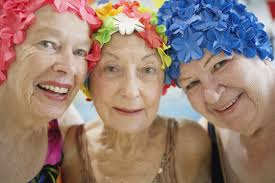
older ladies

During my undergraduate nursing degree, many of my colleagues were passionate about working with children or pursuing the excitement of the emergency department.  To be honest, I wasn’t really sure where I saw myself working when I graduated but luckily, I found the perfect spot.  I work in Specialized Geriatric Services on a rehabilitation unit. Like all nursing specialties, it can be challenging and hard work at times but it is also extremely rewarding to be part of the healing journey.  Going to work still makes me feel like I won the lottery!  I get to help people who are mostly amazing and I get paid for it?  How lucky can a girl get?

When I think about it now, it seems obvious that I work in geriatrics.  In my past life as a personal trainer I helped run a cardiac rehab program, taught fitness and aquafit classes for seniors, and worked with many older clients.  I grew up in Nova Scotia which is pretty traditional in a lot of ways and I think that has also had a profound influence on me.  I enjoy reading, gardening, and quilting (among other things), and I cringe at the thought of living in a fast-paced city like Toronto or having to drive more than 15 minute to work.

Seniors have perspective, life experience, and many also have wisdom.  Some are full of colourful stories.  Seniors tend to value people and experiences more than material wealth (to be fair, I also have a lot of young friends who share these values).  Many of them appreciate a good conversation or a listening ear;  they live in the real world, not the mind-bubble of their smart-phone.  To be sure, there are grumpy old people and some who are not doing so hot (just like any other age group), but generally I find older adults to be kind, sincere, and appreciative.

I think that all nursing programs should have a core course devoted to seniors.   Not only are they wonderful people to work with but their physiology is different (e.g. responses to medications are different than healthy young adults which drugs are tested on) and they face unique psycho-social challenges that younger people don’t think about like losing your independence and living on a fixed income.   I learned a lot about aging during my kinesiology degree but I am really keen to further my expertise in this area and recruit more nurses to this wonderful area of nursing practice!

Wishing you a Happy Canada Day!

-Emily


International New Graduate Nurse Research Colloquium

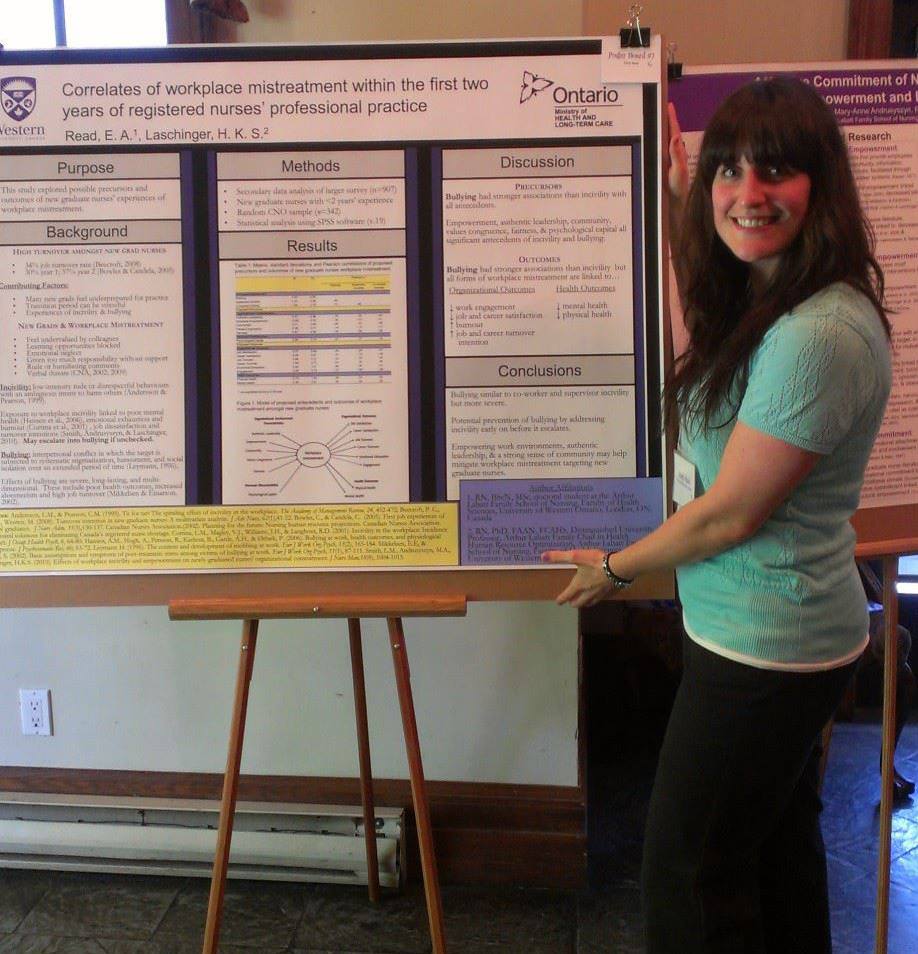
On June 20th, 2013, my supervisor, Dr. Heather Laschinger, hosted a wonderful research colloquium with invited researchers from around the world who all have a special interest in gaining a better understanding of the challenges facing new grads during their transition from student to professional nurse.

I feel so fortunate to have been invited!  It was a fantastic day of sharing ideas and research results, as well as thinking about what we can do moving forward to help nurses transition into their new roles.  I also had a chance to share a poster of my recent work about correlates of workplace mistreatment (i.e. incivility and bullying) directed towards new nurses in Ontario.   I wish that kind of research wasn’t needed to begin with but I think a lot of it has to do with structural factors of the work environment (e.g. leadership, workload, resources, support, etc. available to do your job) and personal factors that individuals bring with them to their job.  It is challenging to be kind and happy when you’re working overtime, have a heavy patient load, and are exhausted!    Nurses are valuable health human resources and we definitely have some work to do in supporting them/us and in particular, during transitions to new career roles (new grads or otherwise!).

Overall it was an inspiring day and I am so thankful that so many knowledgeable and fabulous guests were able to attend!    Christine also did a terrific job putting the event together and making the day run seamlessly 🙂  Nicely done everyone!

emily poster 2013

Are nurses too fat?

The most recent issue of Canadian Nurse contains an article about the sad state of nurses’ health but I don’t think it provided the whole picture.  Although I am a nurse, my background is in exercise science and personal training so I have a few things I’d like to add.

1. Most nurses are middle-aged women.  This affects nurses’ health for a few reasons.  Physiologically women have higher body fat percentages than men because of our hormone profile which supports our reproductive role.  Having less muscle mass and high levels of estrogens in our bodies influence our metabolic rate and our body composition.

From a sociocultural perspective, women are still (!) bombarded with messages that they should be thin, rather than fit, making many prone to following fad diets and restricting calories.  This generally results in a “yo-yo dieting” pattern whereby the dieter loses weight while restricting, only to regain it all back, plus a little extra.  Over time, this can make you heavier than you were to start with and make it more difficult to lose weight.  Another thing that people often don’t think about is that the number on the scale does not tell you if you’ve lost fat or muscle. If you lose weight too quickly or are not eating enough calories you are likely losing muscle as well as fat.  As mentioned earlier, this reduces your metabolic rate and doesn’t help you over the long run.  As we age, our metabolism slows down naturally so keeping muscle is a good thing!

As if we don’t have enough on our plate, women generally take on the roles of caregiver, organizer, cleaner, cooker, etc. at home.  So after taking care of patients for 12-hour shifts women often take on their “second shift”, leaving little time for sleeping, let alone physical activity.  And yes, this can apply to men who take on these roles as well but generally speaking our profession is still dominated by women.

2. Most people don’t really understand exercise and nutrition.

Before I knew what a peer-reviewed journal article was, I sought out expert advice about fitness and nutrition from my local library.  While the information from magazines and books isn’t all bad, there is a lot of misinformation out there.  Just because some celebrity follows a certain regime doesn’t mean that it is healthy or appropriate for everyone!

I truly believe that there is no one-size-fits-all approach.  Individuals have different preferences, activity levels, genetics, and budgets to consider.  I am a big advocate of exercise and nutrition as medicine, unfortunately the fitness and nutrition industries are largely unregulated, making it challenging to find professionals who actually know what they are doing.

Which brings me to my next question: how much do most nurses actually know about exercise and nutrition?  Should we be providing advice to patients if we are not experts in this area?  I have mixed feelings about this.  On one hand, as nurses we are often asked to provide general information to our patients and we are readily accessed by the public. Our services are covered under our public health care plan.  On the other hand, we have lots of keen people graduating with degrees in kinesiology and nutrition who ARE experts in these areas but their services are largely available only through the private sector.  Yes, we have physiotherapists and dieticians working in hospitals and clinics, but the opportunities to use them are limited. If you want to hire a personal trainer and invest in healthy food, you are largely on your own.

Really this comes down to the current system’s general focus on disease management rather than preventative health care.  We spend millions on rehab, surgeries, cancer care, etc. and I’m not saying that we don’t need those things too but if we focused more on preventative health care and influencing the social determinants of change that affect people’s everyday lives we could save a lot of suffering and a lot of money down the road.  That applies to nurses too!

We need to create healthy work environments with the structure and culture to support nurses’ health and wellbeing.  Personal choices are also important, but there are real barriers to being able to take good care of yourself when you are a staff nurse working shifts.  Colleagues call in sick so you work short-staffed or work extra-hours to fill in for them – often this results in you becoming run down and getting sick, perpetuating the vicious cycle.  Patients are getting heavier, older, and sicker, adding to the workload we are expected to handle.  There are physiological effects of working nights, not getting enough sleep, and working in a high-stress environment.  To add insult to injury, the less fit we are, the lower our capacity to handle our workloads and the physical and mental strain from working.  Unlike machines, nurses do need time to rest and recover. Unfortunately working out is another stressor added to the mix. Sometimes what your body needs most is sleep.

I hope this doesn’t sound too negative.  There are nurses who manage to take very good care of themselves despite the obstacles.  I am one of them.  I’m not perfect by any means but after a few years of running around trying to be everything to everyone, I have found what works for me.  I have my road bike set up on a trainer in my bedroom and free weights kicking around so I can always do a quick workout at home if I can’t make it to the gym. I make my own food and bring it to work and I eat vegetarian most of the time.  I don’t have cable (but I do watch movies sometimes).  And yes, sometimes I choose sleep or a warm bath over exercise but I feel refreshed and ready to go the next day.  It is about finding balance and for each of us that is going to mean something individual.

Regardless of public perceptions, health is not about being skinny or having a certain BMI (according to which, almost every athlete would be considered overweight or obese!).  Are we role models for health because we are nurses?  Absolutely, whether it is fair or not.  But how is it that we define health?  Are we embracing the unrealistic body image ideals of our culture instead of a holistic view that appreciates multiple dimensions of well being?

While I think that we need to raise awareness of nurses’ health issues through articles such as the one in the current issue of Canadian Nurse, there are a lot of things to consider that were not brought up in the article.  I hope my thoughts contribute to the discussion and I would love to hear what others have to say on this topic!

Have a terrific day!

-Emily

How to Choose a Supervisor

Choosing your supervisor is one of the most important decisions that you will make as a graduate student.  Personally, I have been very fortunate with regards to supervisors.   I have worked with excellent scholars who have been supportive and kind, yet pushed and challenged me to learn and improve.

As a graduate student, the importance of having a good relationship with your supervisor cannot be under-emphasized.   I started looking for my doctoral supervisor two years before I applied for the PhD program and was fortunate to be able to work with my prospective supervisor as a research assistant during that time.  This gave me direct experience working with her and helped us develop a positive working relationship.  I knew going into my program that she was someone who I wanted to continue working with and vice-versa.  I primarily choose Western because she is an expert in her field and I enjoy working with her.  I lucked out because Western is also an amazing university with one of the best nursing programs in Canada.

I’m not sure that there are any truly bad supervisors out there but I have heard horror stories from friends in other disciplines.  I think it’s also important to consider that two people may be fantastic but have difficulty working together if it’s not the right fit.   If you are in the process of trying to choose a supervisor, here are some suggestions to help you get started.

1. First and foremost, do your research interests align?

You may really like someone but if they are an expert in something that doesn’t really interest you, it is probably best that you don’t work with them.  Investing your time and energy into something that you don’t enjoy is only going to make you miserable and potentially put strain on your relationship.

2. Clarify expectations on both sides. 

What do you expect from your supervisor and what do they expect of you?  Sounds pretty basic but you’d be surprised how many people don’t know what they should expect or look for in a supervisor, or on the flip side are unclear about what they are expected to do as a graduate student.

Start by thinking about what you want to learn through your graduate studies.  What skills and expertise are you aiming to acquire?  Graduate school should be about more than just getting a piece of paper!  This is an exciting opportunity to learn so take advantage of it.  (If you don’t feel this way, perhaps you should reconsider your decision or engage in some personal reflection about your approach to learning).  What do you need from your supervisor to help you be successful in achieving your goals?   Regular meetings?  Constructive feedback?   Opportunities to work on research projects?  High fives?

Ask potential supervisors what they expect of their students.  What GPA do they expect you to maintain?  Which courses do they expect you to take?   How long does it generally take their students to complete their degrees?   What is the expected timeline?   Do they want you to attend certain conferences or work for them as a research assistant?

Being up front about expectations can help you both decide if this will be a mutually beneficial relationship and eliminate a lot of frustration and misunderstanding down the line.

3. Talk to a current or former student.  

Having a coffee with someone who has worked with your prospective supervisor is a great way to get a sense of what they are like to work with.  It can also give you some insight into other aspects of the program such as coursework, other faculty members, and most importantly, its culture.  Is it competitive or cooperative?  Are most students working full-time as nurses, managers, and educators or are they full-time students who spend time together regularly?   Try to get a feel for what the experience has to offer and how that aligns with what you are looking to learn and accomplish as a grad student.

Final Thoughts:

I’m sure there are other questions that you will come up with, but I hope this is helpful in getting the gears going!  I am a strong advocate of nursing graduate education and I think that we need to do a better job of encouraging and supporting nurses who are interested in furthering their knowledge and expertise in this way.   Positive relationships within the academic environment are just as important as those in the health care setting so I encourage you to seek out a supervisor who will offer you their best and who will bring out the best in you.

Have a great day!

-Emily

STTI Conference Reflections

I just arrived home from the Sigma Theta Tau International (STTI) conference in Indianapolis about creating healthy work environments.  It was a full day of driving there and back from Ontario but well worth the journey!   Everyone I met was so positive and inspiring – I wish we could spread this positive energy to the four corners of the earth and remind our colleagues that healthy workplaces are possible.  Are there barriers?  For sure.  But without a vision and passion for change, we are going to stay where we are, which unfortunately isn’t always  ideal.

Some of the highlights of the conference for me were listening to the panel discussion that kickstarted the conference on Friday morning, hearing Dr. Cindy Clarke speak later that day, and having a discussion about some of the challenges of having an academic career in nursing.

I had a real “light bulb” moment on Saturday when we were discussing the importance of recruiting and retaining doctoral-prepared nurses in academic positions and the value of  staying current in our clinical practice in addition to balancing the demands of teaching, research, and service while pursing tenure.

It dawned on me that the academy was not built with practice disciplines in mind, therefore clinical practice is not valued at many institutions in the same way as the traditional tripod of responsibilities (i.e. teaching, research, and service).   How can we be expected to prepare undergraduate students to become professional nurses if we are not up to date on our nursing skills and current best practices?  On the other hand, how can we possibly become and remain experts in all domains and still have a life?!    I’ll be the first to admit that I work 50-60 hours/week on research and schoolwork and the remainder of my time is spent with my son, working out, squeezing in other activities (like writing and grocery shopping) and sleeping.

Although I love my job as a staff nurse I am dreading going back to work in September when my maternity leave ends.   I know from experience that spreading yourself too thin takes a toll on my body and my mental health.  Not to mention that when quantity of activities increases past a manageable level, quality often suffers.   Having to choose between spending time with my son (which I will never get back) and running around like a crazy person trying to build my CV and establish my career is not easy.   I care deeply about nursing and I want to contribute to our profession in a meaningful way.  I also love my son and cherish all the time we have together.

Women already face enough challenges pursuing academic careers without the added obstacles of pursing one in nursing.  How can we expect nurses to give up their high-paying (and often unionized) staff nursing jobs to go back to school and still support their families?  Moreover, how can we expect nurses to complete their doctoral work while teaching or working full-time and often working the second shift at home as a mom and house manager?   Yet, so many do.   If we are going to successfully recruit and retain nursing faculty, we need to be more supportive of talented nurses who want to become educators and researchers.  We need to recognize and appreciate that as individuals we cannot and need not be experts in everything.  Every nurse has different gifts and strengths to offer that bring a wealth of knowledge and ways of being that enrich our profession.

For me, valuing, respecting, and embracing diversity is fundamental to creating a healthy profession and a healthy work environment.  Just because I have a passion for research and teaching and a few extra letters next to my name doesn’t mean I don’t admire and value the experience and expertise of seasoned staff nurses.  It would be completely ignorant of me to think that I know more or better than others; I simply know differently.  I would be gravely mistaken if I thought that what others have to offer makes me “less than”.  I can only hope that my colleagues in practice embrace the same attitude: I might be pursing an academic career but I am still a “real” nurse.

Thankfully, my nurse colleagues in academia have been so supportive and encouraging!   I have so much to learn and a long way to go but I am inspired by the courage, wisdom, and strength of the nurses who have led the way before me.   I am so fortunate to be surrounded by such wonderful scholars and nursing leaders.   Together we are all going to accomplish so much!

Why I am still in school…

For my first post, I thought I would share with you a little bit about what inspired me to pursue a career in nursing and academics.  

My career journey hasn’t exactly been straight forward.  When I was five years old I dreamed of being an author when I grew up.  My friend Meaghan and I would make up stories in little handmade notebooks and her father would type them up on his fancy typewriter, handing us back our “published” stories on crisp white paper.  Then we would make the illustrations by hand and use construction paper to make front and back covers. Oh how I loved making up stories!  

I was by all accounts a very shy, introverted child and spent most of my time reading.  Thankfully this has served me well in graduate school, as I have become quite a fast reader because I’ve done so much of it.  At any rate, I have always enjoyed the world of ideas and learning new things.  I am not the brightest star in the sky by any means, but I do tend to approach life with curiosity and lots of questions.  

As a naive 18-year-old from a small town in Nova Scotia I came to Western to study English literature.  Although I adored studying literature and writing, I wasn’t confident that I would be able to make it as a writer so I took a year off mid-way through and ended up at Acadia University where I completed a kinesiology degree.  It was here that one of my professors approached me to do an honours thesis project with him in exercise physiology.  I jumped at the chance and ended up creating a field test for athletes to assess fatigue and overtraining.  Through this experience I learned how to conduct research from start to finish and had so much fun doing it that I applied to do a master’s degree at Western, in hopes of doing my PhD.  

It is also worth mentioning that I had also applied to the University of Calgary’s accelerated nursing program and was accepted.  I remember telling my mom that I was thinking about becoming a nurse and then pursing a career in nursing research.  As it turns out I ended up doing this anyway but with an MSc in kinesiology and then a degree in nursing.  In the long run, I think this has served me well because I have such a rich background in health sciences to bring to bear on my work.  I have worked as a personal trainer and now work as a nurse on a geriatric rehabilitation unit which is the cat’s meow as far as I’m concerned!  I love working with older adults and the staff on my unit are so knowledgeable and supportive.   Some days I can’t believe that I get paid to do a job that I love so much.

I realize this is becoming a really long post, but I think it helps to get a bit of background on who I am and what inspires me to do the work that I am pursing.

My main motivation is that I care about about people and envision a society where people have the means to be healthy and happy, to experience friendship and community, and live good lives.  It saddens me that there is so much suffering, poverty, and disease in our own backyards and that people face so many barriers to being healthy and happy.  In particular, it doesn’t make sense to me that many of our health care providers are stressed out, unhealthy, and unhappy in their jobs.  We spend a tremendous amount of our life energy at work and it can have a huge impact on our mental and physical health.  How can we expect patients to be taken care of if we aren’t taking care of ourselves?  Thus, my research area of interest is examining how we can create healthy work environments that contribute to nurses’ health and wellbeing, as well as trying to understand how that affect outcomes for patients, health care organizations, and the health care system as a whole.

While I love my job as a nurse, I find research exciting and see the potential it has for creating new evidence to inform best practices and make our health care system better.  I hope that one day I can look back on my career and know that I made a valuable contribution with what I had to offer. I genuinely want to leave the world a better place for having had me in it. And that is why I have just completed my 12th year of university.