Blog

So you want to be a Nurse Practitioner?

np

First let me say that Nurse Practitioners (NPs) play a valuable role in our health care system.  As nurses with clinical expertise from years of experience working with patients and advanced educational training, NPs have a lot to offer patients, healthcare teams, and organizations.  NPs are awesome and job opportunities for nurses in this role are increasing, in part because they are a more cost-effective healthcare resource than general physicians.

However, in talking to nursing students, reviewing scholarship applications, and entering survey data from new graduate nurses, I have noticed that everyone and their dog seems to want to be an NP.  I have also fielded lots of questions from people about how to get into the NP program, mainly “what GPA do I need?” and “what’s the minimum amount of experience I need before I apply?”   Another thing that I have noticed is that many people who did not choose nursing as their first career choice wanted to be doctors which makes me wonder if some people see nursing only as a means to become an NP, under the misconception that NPs and doctors are pretty much the same thing.  Let’s unpack this a little bit.

1. We need more NPs but we need way more nurses.  I hate to bust your bubble but from a resource planning perspective we need way more RNs in the workforce than NPs.  It’s actually more competitive to get into nursing and Canadian NP programs than medical schools. To boot, in Ontario you are only allowed to apply to one program per year so if you don’t get in (which is highly probable), better luck next year.

2. If you don’t want to be a nurse, do something else.  This may seem ironic coming from someone who’s career goal is to becoming a nursing professor but I wholeheartedly love being a geriatric rehab nurse and if I didn’t care so much about the bigger picture I would be happy to work full-time as a staff nurse.  I believe that most nurses who become NPs really want to make a difference in that role and I admire that.  However, I think that one of the things that makes the NP role so valuable is the wealth of nursing experience that people bring with them.  You can’t skip that part and if you don’t like getting your hands dirty working in the trenches, perhaps you should reconsider your career choice.   After all, chances are pretty good that you will work as an RN rather than an NP for most of your career.  There are also tons of other people who would love to be a nurse and you are taking their spot.  I’d also like to point out that if you wanted to be a doctor and end up working as a staff nurse you might end up really hating your job and being resentful.  Maybe not the best life choice.

3. 2 years of experience is not enough for most people and who cares about your GPA, really.  Some of my research work is on new graduate nurses and we consider a new graduate nurse anyone with less than 2 years of nursing experience (and sometimes even 3 years or less).  Patricia Benner also outlines the stages of development from beginner to expert nurse, stating that it takes about 3 years to become competent and at least 5 to become an expert.  Given that we know that it takes several years to develop nursing expertise, it baffles me that nursing schools allow nurses with a minimum of 2 years of clinical practice to apply to their NP preparatory master’s programs.  Moreover, it concerns me that some people are in such a rush to become NPs without considering the amount of responsibility that comes with their new role and the benefits of having more experience (to their patients as well as themselves).  There are exceptions I’m sure but I really think we need to reconsider the minimum experience requirements, especially considering that there is high demand for NP education.

While I’m on the topic of NP education, I don’t think GPA is necessarily a good indicator of an excellent nurse or of someone who will make a fantastic NP.  That isn’t to say that you can’t have a high GPA and also be an awesome clinician.  My point is that there are amazing nurses who are highly knowledgeable and skilled, with high levels of emotional intelligence and leadership skills that may not have achieved a 4.0 in their undergraduate nursing program.  I don’t think we need to throw the baby out with the bathwater here because the NP program is demanding and rigorous but it would be nice to see other elements included in the application process.  In real life it doesn’t matter what your GPA was if you have limited social skills or can’t apply the knowledge that you learned in a meaningful way.

Before you jump on the “I want to be a Nurse Practitioner” bandwagon, I hope that you will take some time to engage in self-reflection about where you are in your career and what skills, knowledge, and experience you have to offer, as well as areas that you want to develop further.  Just because you have a perfect GPA and can apply to an NP masters program after 2 years of working  doesn’t mean you should. Not everyone is cut out to be an NP and being an RN can be as rich and rewarding a career as you want it to be.
Relationship-building in a Task-Focused World

Increasingly, employees are asked to do more with less.  Arguably, this is the goal of Capitalism: to squeeze out as much work as possible for the least amount of money in order to maximize economic growth. I don’t think that this is a particularly helpful way to approach healthcare, as I believe that it is a basic human right, not a privilege, and that relationships with other people are fundamentally inefficient but extremely important.

In nursing the pressure to perform and maximize efficiency can be particularly difficult to cope with, as increased workloads leave less time to spend with patients and their families which is an important part of our job.  It may not seem like having a conversation is “work” but it is through conversations that patients communicate their needs, hopes, fears, and values (among other things).  By getting to know our patients, we are able to ensure that we provide care that meets their needs and treats each individual holistically, rather than as a list of tasks on our daily to-do list.

Building positive relationships with co-workers and leaders are also essential to creating a positive working environment where nurses and other members of the healthcare team can work together to deliver high-quality patient care.  Investing time and energy into these relationships is not efficient in the short term but pays dividends down the road in terms of staff retention, decreased voluntary absenteeism, decreased short-staffing (which leads to more sick time and burnout, etc.), and of course reduced time spent recruiting, interviewing, and training new hires.  It’s not rocket science that people who like their co-workers and their work environment are more likely to stay than those that dread coming in to work every day.  Strong relationships also facilitate good communication and trust among team members and generate shared understandings of work processes, as well as who knows what, and who to ask when you need help.

While we cannot ignore the tasks that need to be accomplished, as these are obviously important, we need to change how we think about relationships in the workplace.  Culturally, we have a tendency to judge relational work as “non-work” when in fact connecting to others in the workplace is very valuable (and sometimes extremely challenging) work.   Unlike patient care tasks that are easy to quantify and check off, it seems artificial and contrived to make a checklist that says “talked to each of my patients about their concerns”, “invested in my relationship with Susan by asking her about her son’s wedding”…etc.  I would also argue that most of us are naturally social and interested in other people so we do a lot of this work anyway and that trying to maximize relational “efficiency” by reducing these things to tasks is ridiculous (and insulting).

I understand that healthcare is expensive and many of the pushes to increase efficiency are driven by our aging population, aging workforce, government austerity, union wage increases, and the economic recession of 2008 (to name a few things).  It is complicated.  However, we need to invest in people and create healthy workplaces that foster a sustainable workforce and allow our healthcare professionals time to invest in relationships with patients. Pushing people harder and harder to produce more with less is not a long-term solution and will cost us more in the long-run – not just in terms of money, but in quality of life, happiness, and patient care.

Maybe the next time you see a nurse, doctor, or healthcare leader talking with a patient or a colleague, you should acknowledge that they are engaging in valuable work.  Just because we’re not doing a task like inserting an IV or giving a medication doesn’t mean that it’s not important.


Being a Mom Changes the Game

It’s taken me quite a while to understand how having children really changes your life and forces you to make choices about your priorities. Since today is Mother’s Day, I thought it would be a good time to share some of the ways I have found some sort of work-life balance.

1. I have mastered the art of the 10 minute cleanup. At the end of the day I set the stove timer for 10 minutes and clean as much as I can. Sometimes this motivates me to keep going and other times I get half the toys in a basket and the dishes washed.

2. I continue to negotiate balance. Some weeks I have a lot of work commitments and some weeks it’s a little slower. Learning to anticipate the ebb and flow and accept it has been really key for me. For example, last week I had a presentation to prepare for, a teaching job application to submit, a training session at the hospital, and work to do for my supervisor. It was a busy week and I ended up taking a few days off from the gym. Big deal. Got back to it the next day and life goes on. This doesn’t mean I’m always happy. Sometimes it is very frustrating when you can’t do everything that you wanted to do. For me, acceptance is a helpful way forward.

3. Unless I am going to be teaching, presenting, or meeting someone important, I don’t wear fancy clothes or do my hair. Maybe this sounds silly but getting ready in the morning takes time and effort and I would rather have my hair in a bun and spend some quality time with my son in the morning than fuss with a hair straightener and panty hose. If you spend thirty minutes a day getting ready that adds up to 2 ½ hours per week! This doesn’t mean I’m a total slob. I draw the line at tank tops and yoga pants (unless I am writing at home, in which case it’s pretty much guaranteed that I am wearing workout clothes). I also don’t own a lot of clothes which means fewer choices but that’s sometimes a good thing.

4. I prioritize fitness and health. Recreation and leisure time is really important to me so our entertainment is playing at the park, going swimming, etc. I also plan healthy meals and cook at home. We have a lot of fun together, spend time outside, and I find myself refreshed for the week ahead.

5. I have amazing support. It’s not easy to be a single parent while working on a doctorate and building an academic career. If I want to go to a conference or attend a workshop I need to find someone to look after my son while I go. I can’t just go to Toronto for the day or stay late on campus. Thankfully, I have found an amazing daycare and many friends and family members have helped me out when I need some help. I have also learned that I need to be more selective about my commitments. While I would love to go to everything and be part of many more committees and professional groups, I can’t do it all.

6. I remember why I am doing this. The reason I am pursing an academic career in nursing is to help create positive changes in health care and ultimately in people’s lives. I envision a health care system where quality of life and preventative health care is valued. I could go on about this but my point is that I am very fortunate to be doing my PhD with world-renown scholars in my discipline. Sure, I want to keep publishing and yes, I will literally jump for joy if I ever do receive an elusive CIHR grant, but at the end of the day, the impact that I have through the students that I teach and the research work that I do is the end goal. Publications, presentations, and grants are all helpful, but the way I see it, if you focus on doing work that matters and doing it well, those other things will come.


There is time to write and play trains, but the time to play trains is rather short, whereas there will always be another paper to write.  Happy Mother’s Day everyone!

Thoughts about Nurses and Strength Training

Nurses are a valuable part of our health care system and we work very hard to deliver good patient care.  As a profession we sometimes get a bad rap for not being exemplars of health because some nurses are overweight.  I would like to change the channel on this discussion and approach this issue from a different perspective.  Health is more than just looking good and being fit has important implications for the nursing workforce and healthcare generally.

First of all, body composition is only one component of being healthy.  Hopefully by now you know about the “skinny fat” phenomenon and why being thin doesn’t necessarily mean you are healthy.  On the flip side, I don’t think that people should use this an excuse to overeat.  I encourage us to embrace a more holistic view of health and well-being rather than simply judging nurses’ health based on their appearance.

Secondly, the nursing profession is predominantly made up of women (many of whom are aging) which is important for a few reasons. 

1. The Western cultural ideal of what women should look like influences the standard against which women are measured.  Most nurses are women so therefore some people judge nurses’ “health” based on how well they meet this ideal.  Again, you cannot tell solely by appearances how healthy someone is. 

2. Women and men have different hormones which, like it or not, influences our body fat levels.  Women are supposed to have more fat than men and as we get older (which many nurses are), we tend to put on weight because of changes in our hormones.  

3. Women have been fed a lot of BS about fitness and nutrition.  This ties into my point about the Western beauty ideal.  I find it shocking that I still meet so many women who are afraid of lifting weights because they think it will make them “look like a man” or who spend hours doing cardio and counting calories in their fat free asparatame-filled cancer-causing diet “foods” that have pretty much no nutritional value.  While this may come across as being a little harsh, I want to make it clear that I don’t blame women entirely for buying into the propaganda that has been fed to them for years.  There are tremendous rewards for those who live up to conventional beauty standards so how do you blame people for wanting to be successful, even if many of us don’t agree with the definition of “success” that has been handed to us?

At any rate, I think we do a very good job as women of being mean to each other and I think that needs to stop.  Be a beauty – there is nothing wrong with that if that is what you want.  However, you are more than just a beautiful object to look at!  You can be beautiful and strong and smart and whatever you want.  Sometimes it seems like there is this idea that you can only be one or the other – that beautiful women are stupid or that intelligent women don’t care about their physical appearance.  I don’t think I need to point out how naïve and simplistic these assumptions are.

So why am I talking about beauty in a post about fitness anyway?  Well I believe that many women steer clear of strength training because they think it will sacrifice their beauty.  In other words, if a woman thinks that lifting weights will make her look masculine, she will avoid doing it. 

So what? 

Well, as I mentioned, most nurses are women so this has some implications for our profession.  Nursing work can be very physical at times and requires a high capacity to do work.  Many of us work busy 12 hour shifts and help turn, stand, transfer, and walk patients throughout the day.   Back and shoulder injuries are common among nurses in addition to high levels of stress and burnout.  Being fit and strong can help increase our work capacity, prevent injuries, and improve work recovery.  Increasing our physical strength and endurance can help make our jobs (and lives) easier to handle, provide us with more energy, improve our personal health, help us manage stress, and improve our physical appearance.   With so much to gain, what are we waiting for?

Do Impact Factors Matter in Nursing?

I just got back from my first Academy of Management Conference and I was astonished by the emphasis on the importance and status of publishing in “A-level” management and business journals.  In nursing there is not a whole lot of emphasis on this and I started to wonder why not?   Is it because I’m studying in Canada?  Are we less knowledgeable about impact factors in Nursing?  Am I naive about the effect journal choice can have on my academic career?   Are there A-level journals that I don’t know about?   The purpose of this post is to give a brief overview of what impact factors mean in nursing and find out if there are “A-level” journals that I should know about.

What is an impact factor?

Impact factors are a measure of how often articles from a particular journal have been referenced by other articles.   The idea is that the best articles will be used by other researchers in the future, thus spreading good ideas and having an “impact” on the field.  Apparently in business and management departments at colleges and universities they often have formalized lists of “A-level” (best), “B-level” (better), and “C-level” (good) journals and professors’ careers are largely influenced by their ability to get articles published in the best journals.   I have been fortunate to work with very productive and supportive research teams and supervisors in kinesiology, medicine, and nursing where all article publications are celebrated equally.  Granted, if you get an article published in Nature or The Lancet that is a really big deal for anybody.

How do you interpret impact factors?

Impact factors were created to measure article and journal quality so the best journal should be listed first, followed by the second-best, etc.  However that is not true for nursing journals.  For example, right now the journal with the highest impact factor in nursing is Birth: Issues in Perinatal Care (impact factor = 2.84 [Science Watch, 2013]).   Does this mean that this is the “best” journal in nursing?   If you are studying issues related to childbirth and nursing, then absolutely!  Otherwise, probably not.  The journal’s high impact factor probably reflects the fact that a lot of nursing scholars are doing work in this area and that it is a popular resource for those scholars.  While I am sure that there is interesting and valuable work in there, I am doubtful that I will ever read, cite, or publish an article from this journal because it is unrelated to my research interests.   This raises the question of how useful it is to compare nursing journals that have different aims and audiences.  I think ranking is helpful but sub-categories and/or discretion are also required.

Impact on Research, Practice, or Both?

Another thing to consider is that an article could have a powerful impact on nursing practice despite not being cited by other researchers.  Many nurses taking DNP, NP, master’s, and bachelor-level degrees are not necessarily going to be conducting research but they are likely to be knowledge consumers that apply the findings of nursing research to their professional practice.  On the other hand, just because an article is well-known and often cited by other academics doesn’t necessarily mean that the article had an impact on practice (i.e. real life).  In fact, it is possible that an article could be cited a lot because people disagree with it or because it reflects an old way of thinking about something that is no longer relevant but helps the reader position new work.  Therefore, I believe that impact factors are an incomplete measure of actual impact.

Are there A-level Journals in Nursing?

Out of curiosity I looked up the promotion and tenure criteria for several prominent nursing schools in Canada and the U.S. and couldn’t find any evidence of a formal “good, better, best” categories of nursing journals, though all considered article quality and quantity as one indicator of productivity.   This leads me to believe that publishing in higher ranking nursing journals is still better but that there is room for discretion based on the topic or focus area of the work (e.g. maybe the #1 journal in mental health nursing is ranked 20th overall but still deserves credit for being the best in the specialty area).

What is the value of impact factors in nursing?

Impact factors can give us an idea of what areas of nursing research are most popular and receive the most attention by other scholars.  The relatively low impact factors in nursing compared to some prolific medical journals may also indicate that nurses are more likely to cite sources outside of nursing whereas other disciplines are unlikely to cite nursing scholarship (Polit & Northam, 2011).   As a developing scholar I certainly want my work to be taken up by others and make a difference, both in research and in practice.

Comparing impact factors of journals that are in the same specialty or research area makes sense and can help distinguish between different levels of scholarship quality, however we can’t just use the list as is to rank all of the journals in nursing without considering their specific focus.  In addition, it is important to create ways to assess and evaluate the impact that nursing research and scholarship has on nursing practice and, in particular, patient care and health outcomes.  Impact factors are important indicators of scholarship quality and academic success and productivity but they don’t paint the whole picture!


References:

Polit, D. F., & Northam, S. (2011). Impact factors in nursing journals. Nursing outlook, 59(1), 18-28. Retrieved from http://journals.lww.com/jcnjournal/Documents/ImactFactors_NursingOutlook_2011.pdf

Science Watch.  (2013).  Journals ranked by impact: Nursing.  Retrieved from http://archive.sciencewatch.com/dr/sci/10/mar28-10_1/

Why Tenure isn’t Everything

Many doctoral students think that getting published in a top journal and getting tenure are the only things that matter in their career.  While I think those things are valuable achievements, I believe that this task-focused approach to doctoral education is dead wrong.  Here’s why.

1. Relationship-building is more important than you think.  Are outcome-focused type A overachievers who leave little time for “unproductive” things like spending time with other people or having fun really more likely to be successful in life?   Admittedly, the academic pursuit of tenure and endless productivity can make you feel guilty for spending time doing something unrelated to your work.  Relationships are inherently inefficient but they certainly aren’t useless, even if they don’t have an immediate outcome or “accomplish” anything.   Co-students and supervisors, other faculty members, and colleagues you meet at conferences make your career more rewarding and more fun.  They also provide you with support, constructive feedback, a sounding board for new ideas (which often sound better in your head than they do out loud), and occasionally, a shoulder to cry on.   On the flip side, you will also be able to contribute to others’ projects and provide feedback to help others.  My experience as a nurse has made it pretty obvious that relationships are one of the most valuable aspects of our lives and that we need to value them more.  Building positive relationships takes time and energy but at the end of your life, are you really going to regret the time you spent with other people?  Not likely.

2.  Burnout prevention

Sometimes we are overambitious and take on too much.  I have done this more times than I would like to admit.  During my first undergraduate degree I refused to take a student loan so I worked 10 part-time jobs while taking a full course load and having an active social life.  My schedule was crazy! After final exam period I slept for almost a week straight to recover from the burnout.  Don’t do this to yourself!  I have learned that a much more sustainable method is to limit the number of projects and commitments you take on and do them well.  If you take on too many things at once you are probably going to do a mediocre job and end up exhausted.  I also don’t advise doing things just because they look good on your CV.  If you invest your time and energy into things that help you learn and grow and that you are interested in, you are going to excel at them and have a lot more fun.  I truly believe that if you are engaged in the learning process and doing work that gets you excited the publications and tenure-track position will follow.  Enjoy the process and pace yourself – this is a marathon, not a sprint.

3.  Today is the only day.

As much as we plan and dream, the only day we ever have is this one.  Take advantage of it.  Sure, there may be times when you have to stay inside on a sunny day to meet an urgent deadline and you will spend many many many hours sitting in front of a computer screen working with data, writing, and picking at powerpoint slides.  Take breaks. Spend time outside.  Take care of yourself physically and mentally.  Most importantly, make time for the people you care about.  You really never know when your time will be up.

Tenure is a good goal for many of us and it is something that I am working towards but right now being a doctoral student is pretty darn amazing.  Every day is a learning adventure and I am building my research toolkit.  I get to work with smart people who have a lot of knowledge and ideas to share and who are passionate about nursing and health care.   I get to ask questions and think about ideas.  I am also working with the best supervisor, committee, and research team I could ask for.  Tenure will be nice but it can wait.

Why I Love Working with Older Adults

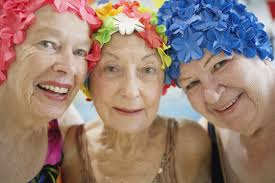
older ladies

During my undergraduate nursing degree, many of my colleagues were passionate about working with children or pursuing the excitement of the emergency department.  To be honest, I wasn’t really sure where I saw myself working when I graduated but luckily, I found the perfect spot.  I work in Specialized Geriatric Services on a rehabilitation unit. Like all nursing specialties, it can be challenging and hard work at times but it is also extremely rewarding to be part of the healing journey.  Going to work still makes me feel like I won the lottery!  I get to help people who are mostly amazing and I get paid for it?  How lucky can a girl get?

When I think about it now, it seems obvious that I work in geriatrics.  In my past life as a personal trainer I helped run a cardiac rehab program, taught fitness and aquafit classes for seniors, and worked with many older clients.  I grew up in Nova Scotia which is pretty traditional in a lot of ways and I think that has also had a profound influence on me.  I enjoy reading, gardening, and quilting (among other things), and I cringe at the thought of living in a fast-paced city like Toronto or having to drive more than 15 minute to work.

Seniors have perspective, life experience, and many also have wisdom.  Some are full of colourful stories.  Seniors tend to value people and experiences more than material wealth (to be fair, I also have a lot of young friends who share these values).  Many of them appreciate a good conversation or a listening ear;  they live in the real world, not the mind-bubble of their smart-phone.  To be sure, there are grumpy old people and some who are not doing so hot (just like any other age group), but generally I find older adults to be kind, sincere, and appreciative.

I think that all nursing programs should have a core course devoted to seniors.   Not only are they wonderful people to work with but their physiology is different (e.g. responses to medications are different than healthy young adults which drugs are tested on) and they face unique psycho-social challenges that younger people don’t think about like losing your independence and living on a fixed income.   I learned a lot about aging during my kinesiology degree but I am really keen to further my expertise in this area and recruit more nurses to this wonderful area of nursing practice!

Wishing you a Happy Canada Day!

-Emily


International New Graduate Nurse Research Colloquium

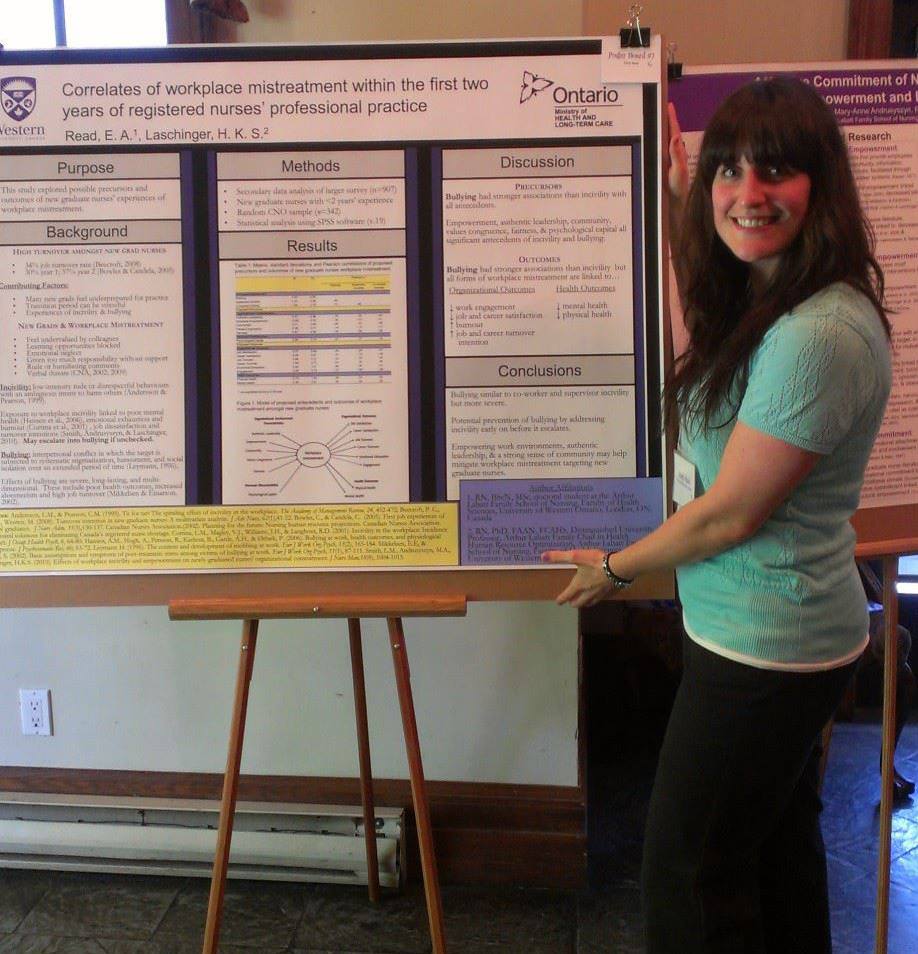
On June 20th, 2013, my supervisor, Dr. Heather Laschinger, hosted a wonderful research colloquium with invited researchers from around the world who all have a special interest in gaining a better understanding of the challenges facing new grads during their transition from student to professional nurse.

I feel so fortunate to have been invited!  It was a fantastic day of sharing ideas and research results, as well as thinking about what we can do moving forward to help nurses transition into their new roles.  I also had a chance to share a poster of my recent work about correlates of workplace mistreatment (i.e. incivility and bullying) directed towards new nurses in Ontario.   I wish that kind of research wasn’t needed to begin with but I think a lot of it has to do with structural factors of the work environment (e.g. leadership, workload, resources, support, etc. available to do your job) and personal factors that individuals bring with them to their job.  It is challenging to be kind and happy when you’re working overtime, have a heavy patient load, and are exhausted!    Nurses are valuable health human resources and we definitely have some work to do in supporting them/us and in particular, during transitions to new career roles (new grads or otherwise!).

Overall it was an inspiring day and I am so thankful that so many knowledgeable and fabulous guests were able to attend!    Christine also did a terrific job putting the event together and making the day run seamlessly 🙂  Nicely done everyone!

emily poster 2013

Are nurses too fat?

The most recent issue of Canadian Nurse contains an article about the sad state of nurses’ health but I don’t think it provided the whole picture.  Although I am a nurse, my background is in exercise science and personal training so I have a few things I’d like to add.

1. Most nurses are middle-aged women.  This affects nurses’ health for a few reasons.  Physiologically women have higher body fat percentages than men because of our hormone profile which supports our reproductive role.  Having less muscle mass and high levels of estrogens in our bodies influence our metabolic rate and our body composition.

From a sociocultural perspective, women are still (!) bombarded with messages that they should be thin, rather than fit, making many prone to following fad diets and restricting calories.  This generally results in a “yo-yo dieting” pattern whereby the dieter loses weight while restricting, only to regain it all back, plus a little extra.  Over time, this can make you heavier than you were to start with and make it more difficult to lose weight.  Another thing that people often don’t think about is that the number on the scale does not tell you if you’ve lost fat or muscle. If you lose weight too quickly or are not eating enough calories you are likely losing muscle as well as fat.  As mentioned earlier, this reduces your metabolic rate and doesn’t help you over the long run.  As we age, our metabolism slows down naturally so keeping muscle is a good thing!

As if we don’t have enough on our plate, women generally take on the roles of caregiver, organizer, cleaner, cooker, etc. at home.  So after taking care of patients for 12-hour shifts women often take on their “second shift”, leaving little time for sleeping, let alone physical activity.  And yes, this can apply to men who take on these roles as well but generally speaking our profession is still dominated by women.

2. Most people don’t really understand exercise and nutrition.

Before I knew what a peer-reviewed journal article was, I sought out expert advice about fitness and nutrition from my local library.  While the information from magazines and books isn’t all bad, there is a lot of misinformation out there.  Just because some celebrity follows a certain regime doesn’t mean that it is healthy or appropriate for everyone!

I truly believe that there is no one-size-fits-all approach.  Individuals have different preferences, activity levels, genetics, and budgets to consider.  I am a big advocate of exercise and nutrition as medicine, unfortunately the fitness and nutrition industries are largely unregulated, making it challenging to find professionals who actually know what they are doing.

Which brings me to my next question: how much do most nurses actually know about exercise and nutrition?  Should we be providing advice to patients if we are not experts in this area?  I have mixed feelings about this.  On one hand, as nurses we are often asked to provide general information to our patients and we are readily accessed by the public. Our services are covered under our public health care plan.  On the other hand, we have lots of keen people graduating with degrees in kinesiology and nutrition who ARE experts in these areas but their services are largely available only through the private sector.  Yes, we have physiotherapists and dieticians working in hospitals and clinics, but the opportunities to use them are limited. If you want to hire a personal trainer and invest in healthy food, you are largely on your own.

Really this comes down to the current system’s general focus on disease management rather than preventative health care.  We spend millions on rehab, surgeries, cancer care, etc. and I’m not saying that we don’t need those things too but if we focused more on preventative health care and influencing the social determinants of change that affect people’s everyday lives we could save a lot of suffering and a lot of money down the road.  That applies to nurses too!

We need to create healthy work environments with the structure and culture to support nurses’ health and wellbeing.  Personal choices are also important, but there are real barriers to being able to take good care of yourself when you are a staff nurse working shifts.  Colleagues call in sick so you work short-staffed or work extra-hours to fill in for them – often this results in you becoming run down and getting sick, perpetuating the vicious cycle.  Patients are getting heavier, older, and sicker, adding to the workload we are expected to handle.  There are physiological effects of working nights, not getting enough sleep, and working in a high-stress environment.  To add insult to injury, the less fit we are, the lower our capacity to handle our workloads and the physical and mental strain from working.  Unlike machines, nurses do need time to rest and recover. Unfortunately working out is another stressor added to the mix. Sometimes what your body needs most is sleep.

I hope this doesn’t sound too negative.  There are nurses who manage to take very good care of themselves despite the obstacles.  I am one of them.  I’m not perfect by any means but after a few years of running around trying to be everything to everyone, I have found what works for me.  I have my road bike set up on a trainer in my bedroom and free weights kicking around so I can always do a quick workout at home if I can’t make it to the gym. I make my own food and bring it to work and I eat vegetarian most of the time.  I don’t have cable (but I do watch movies sometimes).  And yes, sometimes I choose sleep or a warm bath over exercise but I feel refreshed and ready to go the next day.  It is about finding balance and for each of us that is going to mean something individual.

Regardless of public perceptions, health is not about being skinny or having a certain BMI (according to which, almost every athlete would be considered overweight or obese!).  Are we role models for health because we are nurses?  Absolutely, whether it is fair or not.  But how is it that we define health?  Are we embracing the unrealistic body image ideals of our culture instead of a holistic view that appreciates multiple dimensions of well being?

While I think that we need to raise awareness of nurses’ health issues through articles such as the one in the current issue of Canadian Nurse, there are a lot of things to consider that were not brought up in the article.  I hope my thoughts contribute to the discussion and I would love to hear what others have to say on this topic!

Have a terrific day!

-Emily

How to Choose a Supervisor

Choosing your supervisor is one of the most important decisions that you will make as a graduate student.  Personally, I have been very fortunate with regards to supervisors.   I have worked with excellent scholars who have been supportive and kind, yet pushed and challenged me to learn and improve.

As a graduate student, the importance of having a good relationship with your supervisor cannot be under-emphasized.   I started looking for my doctoral supervisor two years before I applied for the PhD program and was fortunate to be able to work with my prospective supervisor as a research assistant during that time.  This gave me direct experience working with her and helped us develop a positive working relationship.  I knew going into my program that she was someone who I wanted to continue working with and vice-versa.  I primarily choose Western because she is an expert in her field and I enjoy working with her.  I lucked out because Western is also an amazing university with one of the best nursing programs in Canada.

I’m not sure that there are any truly bad supervisors out there but I have heard horror stories from friends in other disciplines.  I think it’s also important to consider that two people may be fantastic but have difficulty working together if it’s not the right fit.   If you are in the process of trying to choose a supervisor, here are some suggestions to help you get started.

1. First and foremost, do your research interests align?

You may really like someone but if they are an expert in something that doesn’t really interest you, it is probably best that you don’t work with them.  Investing your time and energy into something that you don’t enjoy is only going to make you miserable and potentially put strain on your relationship.

2. Clarify expectations on both sides. 

What do you expect from your supervisor and what do they expect of you?  Sounds pretty basic but you’d be surprised how many people don’t know what they should expect or look for in a supervisor, or on the flip side are unclear about what they are expected to do as a graduate student.

Start by thinking about what you want to learn through your graduate studies.  What skills and expertise are you aiming to acquire?  Graduate school should be about more than just getting a piece of paper!  This is an exciting opportunity to learn so take advantage of it.  (If you don’t feel this way, perhaps you should reconsider your decision or engage in some personal reflection about your approach to learning).  What do you need from your supervisor to help you be successful in achieving your goals?   Regular meetings?  Constructive feedback?   Opportunities to work on research projects?  High fives?

Ask potential supervisors what they expect of their students.  What GPA do they expect you to maintain?  Which courses do they expect you to take?   How long does it generally take their students to complete their degrees?   What is the expected timeline?   Do they want you to attend certain conferences or work for them as a research assistant?

Being up front about expectations can help you both decide if this will be a mutually beneficial relationship and eliminate a lot of frustration and misunderstanding down the line.

3. Talk to a current or former student.  

Having a coffee with someone who has worked with your prospective supervisor is a great way to get a sense of what they are like to work with.  It can also give you some insight into other aspects of the program such as coursework, other faculty members, and most importantly, its culture.  Is it competitive or cooperative?  Are most students working full-time as nurses, managers, and educators or are they full-time students who spend time together regularly?   Try to get a feel for what the experience has to offer and how that aligns with what you are looking to learn and accomplish as a grad student.

Final Thoughts:

I’m sure there are other questions that you will come up with, but I hope this is helpful in getting the gears going!  I am a strong advocate of nursing graduate education and I think that we need to do a better job of encouraging and supporting nurses who are interested in furthering their knowledge and expertise in this way.   Positive relationships within the academic environment are just as important as those in the health care setting so I encourage you to seek out a supervisor who will offer you their best and who will bring out the best in you.

Have a great day!

-Emily