
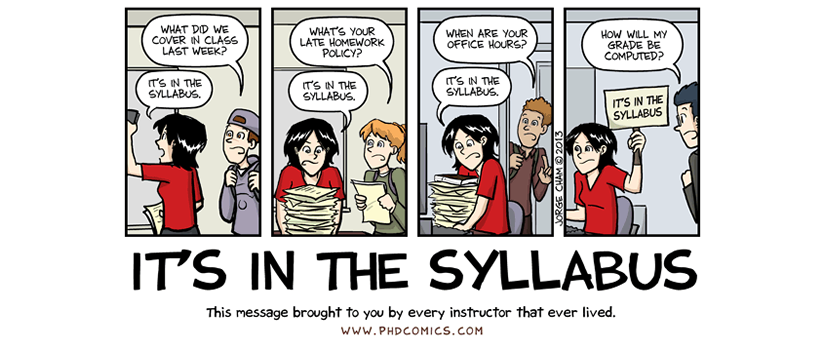
If you want to be an effective university teacher and have a manageable teaching (and email) workload throughout the semester, then you must establish clear expectations for your students. In this post I’m going to discuss how to use your syllabus to establish clear expectations for your students and proactively address student concerns and issues as much as possible. Let’s get started!
The Syllabus
As you know, your course syllabus should provide all of the information that your students need to know about your course and what they need to learn and do to be successful in your course. It also is a tool for setting/managing expectations and establishing boundaries. It is important to be up front with students about things such as: when you are available/unavailable, your email response time, consequences of late assignments, requests for extensions, how to submit assignments, and so forth.
Your institution and/or faculty/department likely has a standard syllabus template that you are asked/required to use or can adapt. Although it is tempting to keep recycling and updating old versions of syllabi, always check to make sure that the information is up to date and that all the hyperlinks still work.
What I include in my syllabi:
- Course information:
- Course name, number, and calendar description
- Course objectives
- Class schedule
- Professor information:
- Professor/Instructor name and contact information
- Office hours and availability
- Email policy
- FAQ discussion board
- Required learning resources (typically books or software programs)
- Technology requirements (especially for online classes)
- Assignment information:
- List of summative assignments/tests/exams, due dates, and their % grade for the course
- List of formative assignments/tests and due dates
- Detailed assignment instructions (may choose to make this a separate document)
- Assignment grading rubrics (as applicable; may choose to make this a separate document as well)
- Assignment submission instructions
- Information about late assignments and/or missed tests/exams
- Information about requesting extensions
- Information about unversity student resources including learning accommodations, student services, health and counseling services, etc.
- Information about plagiarism
- Information about the appeal process
- Grading scheme for the course
- Easter egg for students who read the syllabus
Many of these sections are fairly standard but the ones that I find really make a big difference for students and for me are: Professor information and Assignment information.
Professor Information:
In terms of office hours, I only do these by appointment and try to keep it to business hours M-F. However, some of my master’s students are nurses working shifts so I make sure they know that I am willing to be flexible for them. You may want to block off certain days/times for student meetings. I find that student questions/meeting requests happen when there is a test or assignment coming up or after they get an assignment or test back so I don’t really find it helpful to block off consistent time every week.
I have a lot of rules for students about sending me emails. In terms of my email response time, I tend to be really on top of my inbox and generally respond in less than 24h. However, my official policy is within 48h to give me a buffer and set a reasonable expectation for students. I also ask that students type the name of the course in the subject line and if it is a legit emergency to indicate that it is urgent. When I give back assignments, I ask that students read over all of my feedback and reflect on their assignment AND that they wait at least 24h before they email me to request a time to meet with me about it. I am more than willing to discuss assignments with students but I find that they are in a better frame of mind when they have time to reflect on their work and the feedback I have provided. Recently I have held optional live sessions online for students to ask any questions that they have about an upcoming assignment or test. Often more than one student has the same question so it is an effective way of helping the whole class at once.
Another tool that I have used within my learning management system (LMS) where the course is housed (we use D2L Brightspace) is to create an FAQ Discussion Board where students can ask questions that they have about the course or assignments. I also encourage students to look in the syllabus and the assignment instructions and grading rubrics to see if they can find the answer to their question before reaching out to me. Nine times out of ten, the information they are looking for has already been provided. This prevents me from getting a lot of repetitive questions via email.
Sometimes a student will email me about something that I hadn’t thought of and that the whole class would benefit from. In these cases, I usually email the entire class or post a news item/announcement in D2L to share the information with everyone.
Assignment Information:
I try my best to provide students with very detailed assignment instructions and marking rubrics (when applicable). I encourage students to mark their due dates in their calendar/planner, start working on their assignments early in the term, and sometimes include smaller low stakes assignments along the way to get them started. When possible I also include example assignments (in the course site, not actually in the syllabus) from previous students (with permission) so that they understand what I am asking them to do. Obviously this isn’t possible for every type of assigment or for tests but it helps clarify expectations tremendously. For tests, I also find it helpful to have a marking key with justification for correct and incorrect answers. Yes, it is time consuming to make this but it is super helpful to have on hand when explaining to students where they went wrong or misunderstood a question/answer. It also helps me check that I didn’t write a wonky question and when I am lucky enough to have TAs, it helps them understand how to mark.
Providing students with information up front about what happens if they submit assignments late (or never) or miss a test or need an extension is also really important. With the current pandemic, many of my students have had additional challenges (many of them are nurses working on the front lines or in management positions and have kids at homes, etc.) so I have tried my best to be supportive and flexible with due dates this year. I usually give students 48 hours of extension time that they can use any time during the term as long as they let me know a few days before the due date. This information is included in the syllabus. Generally, few students use this but it helps reduce their stress because they know they have that buffer if they need it.
The last thing that you may want to include in your syllabus is an easter egg that students will find if they actually read your syllabus. If it is a smaller class and you don’t mind getting a bunch of emails you could ask them to email you a picture of an animal or a car (or whatever). Another approach (which I prefer) is to set up a short survey using Microsoft or Google Forms (depending on what your school uses). Insert the link into your syllabus near the end with brief instructions to the student to click on it.
Example text:
Let me know that you read the syllabus by completing this brief survey: click here.
Sometimes the hyperlinks can be really long so you can shorten the text to display by clicking on the second letter in, typing what you want it to say, and then deleting the first letter and the remaining letters after what you typed. This looks better and also can make the easter egg less obvious to students who aren’t actually reading the syllabus.
So there you have it!
Is there anything I missed?
I would love to hear what you include in your syllabi. Comment on this post if you have something to share.

 Emily Read, PhD, RN