Blog

Sitting is the New Smoking…

sitting-is-killing-you

So apparently, sitting is the new smoking…and therefore, I am probably going to die.  Not really (I hope), but there has been a whole lot of attention to the “sitting epidemic” recently, highlighting how much time most of us spend sitting during a regular work day.  (Clearly, they have not spent any time with a staff nurse lately!).  The solution? A standing desk, of course.  Or a treadmill desk. Or taking frequent breaks. Making sure that you have an ergonomically designed work station….

On perhaps, we need to start asking different questions about how our work is designed. For example, in academe, we do spend a lot of time sitting at our computer working on all kinds of things from research grants to articles, powerpoints, data analysis, etc.  Some of this work is unavoidable I think but I also wonder if some of this time could be used more effectively. For example, do we really need to write 20 research articles using one dataset?  Do we really need another book chapter on such and such that a handful of people will read?  What if we publish one really strong paper and then talk to people about our ideas instead?  How much more fun (and time effective) is it to interview people, record a podcast, or share a conference presentation on YouTube?  Obviously, none of these things completely eliminates computer time but I am guessing that the impact of one really great Ted Talk is much broader and valuable than a research article buried in an academic journal that mostly only other researchers are going to read.  Unless of course, more research articles = more tenure points.

Sometimes collecting tenure points feels a bit like being Mario trying to get all the gold coins within reach (and apparently research activities that require copious sitting are as likely to kill you as sitting on your butt playing too many video games).

mario coins.jpg

So let’s assume that you just have to accept that your job requires some sitting.  What can you do to make it less bad?

  1. Take care of your body. Exercise. Eat nutrition food. Go easy-ish on the coffee (mostly). Get enough sleep.
  2. Plan ahead for the ebbs and flows of the school year. Midterms? Exam period? Research grant deadlines?  These are busy times, but they are not unexpected!  Get a calendar and plan ahead. I like to make extra healthy meals and stick them in the freezer to reduce cooking time. Having some exercise equipment in the basement is also really awesome for saving time when I am busy.  There have also been times when I have had to hire my babysitter to give me an extra morning or afternoon to do work on the weekend. (Fingers crossed that being a professor is more awesome than being a grad student working full time!).  Do I always get to do a full workout? No. But sometimes 10 minutes of exercise is better than nothing 😉
  3. Be super organized. You can waste a lot of time trying to simply locate documents, references, and sort through different versions of things.  Having a logical way to organize files and name documents will save you a ton of time. I even get my students to name their documents in specific ways so that I don’t end up with 25 versions of “Assignment 1”.  Using a reference management software program is also a really great way to save time with citing and reference lists, especially when you need to use different referencing styles for different journals. No more wasted time seeking and downloading the same reference articles over and over!  Lastly, using tags and folders in your email inbox is another strategy that saves oodles of time. If you can use the same main categories as your main files on your computer, that is even better!  I like to use gmail and get all of my other emails forwarded to that one account.
  4. Be reasonable. Sometimes I struggle with this. (e.g. “Of course I can have a baby and do my PhD and publish and compete in powerlifting and work at the hospital and teach, etc. at the same time…).  I like to set big goals and have a tendency to say yes to everything but I have learned that this usually leads to burnout. A better strategy is to take on a few things that you can really focus on. Reading (and re-reading) the Power of Less  is a helpful place to start.  Academia seems to reward people who work hard and do a lot but I think another point to consider is that learning and teaching is exciting!  Research and teaching are (should be) both about learning new things and understanding more about the world around us, as well as sharing that knowledge and excitement about learning.  It is hard to say no when you are excited about learning and sharing ideas!   Is it reasonable to spend 20 hours a week preparing for a class you are teaching for the first time?  Maybe not if you are teaching 3 courses and have other things on your plate.
  5. Aim for excellence, rather than perfection. I don’t think there is such a thing as “perfect”. The pareto principle, or 80:20 rule comes in handy here too. It states that 80% of your outcomes/effects will come from 20% of your work. Do you really need to make 50 slides for a 10 minute presentation?  Or, would 10-12 slides, well-designed, be more captivating and effective in getting your point across?  How much time are you spending sitting, working on things that have little to no impact?  After all, sitting is the new smoking….

I want an academic career. When’s the BEST time to have a baby?

The short answer is that there is no best time and that really, anytime is the best time. Nothing can ever prepare you for the challenges and joys of parenting – regardless of whether or not you are a grad student, a practising nurse, or a stay-at-home mom.

That being said, it helps if you have a committed partner and some sort of plan.  Personally, I did not have that experience. Let’s just say that the pill is not 100% effective.  I stuck with my life plan (sort of) and worked at the hospital as an RN until September and started my PhD 9 months pregnant (against all good sense I think) and took one week off from classes (because my supervisor made me). The “birth plan” involved my wonderful friend driving me and my roommate to the hospital where we streamed episodes of New Girl while I waited for my son to decide to make his grand entrance. My sister and her boyfriend flew in and met us there (he stayed outside).

Lucky for me, in Canada we get a year of paid maternity leave and you can be in school during that time – I didn’t plan this out at all but it definitely made life a lot less stressful. For the first semester we didn’t have a car so we got up early to catch the bus so I could take him to the wonderful home daycare we found, then back on the bus to school. After school I would go back on the bus to get him, and again on the bus to go home or sometimes to the Y and then home.  It was exhausting!  On the plus side, it really made me appreciate the amount of time and energy it takes to coordinate life when you don’t have a car.  Before my son was born I rode my bike a lot and it was hard to not be able to do that anymore.

One of the best things about being a single parent and a nurse was how much support I received from others. The nurses at work threw me a baby shower, offered support and advice, and even offered me lifts to and from work when they could.  My former roommate lived with us for a year until she finished her nursing degree (God bless her) and friends have helped take care of my son so that I could go to work, school, and conferences (one even road-tripped with us to Indianapolis!).  Their love and support made me realize how important relationships are in life and sparked my interest in workplace social capital (my dissertation topic).  In many ways, our lives have been richer because it was obvious to others that we needed them.  I’m not sure that it is always the same when people are married and it is assumed that they have all the support and help they need (I’m sure that it is different for everyone).

I think you can balance a demanding PhD program with being a parent but it requires focus, discipline, and support. The balance is always changing too! The time you get to do homework when you have a baby who sleeps a lot is different from the time you get when you have a busy 3 year old who wants to play all the time.  You have to learn to be more flexible and adapt to what your child (or children) need as they grow up.  My son has helped me slow down and reminds me daily to play and enjoy life.  Not that I didn’t before but children have such an awesome way of looking at the world.

At times I have had to make tough choices about work because of being the only parent – for example, this past fall I chose a day job as a research coordinator (which I find rather stressful) because it had regular hours – but because of that I had to give up my part-time staff nurse position at the hospital (which I love) and go casual. It’s straight-up difficult to find daycare for shift work – especially when you are part-time and don’t have a consistent schedule.  I miss seeing my co-workers and my patients. Research is rewarding and I have learned a lot this year but it’s different.

Ultimately, I think being a parent has made me a better person and has made me more efficient with my time. When I am home, I don’t want to be thinking about work so I work hard at work to be organized and focus on things that are important. I have one dedicated day a week to work on my thesis and try to keep it contained in that time frame. I think one of the big problems with academic culture is this idea that working longer hours makes you a better, more productive member of the academy.  Numerous studies show that overworking people actually makes people less effective, less happy, and has very damaging effects on their health.  That, however, is a topic for another post I think…

Grant Writing Success

In late November I was offered my dream job as an Assistant Professor at the University of New Brunswick in the Faculty of Nursing (I enthusiastically accepted!).  I am getting ready to board the train on the tenure track and plunged right into writing my first CIHR grant as a PI. Not for the reasons you might think either. While I do understand that obtaining funding is valued as a performance outcome for faculty members, having money to do your research allows you to – wait for it – do your research 🙂  That being said, being awarded the money which allows you to accomplish valuable work is not the only reason to write a grant proposal and it is not the only measure of success (although, again, it is super helpful and makes it easier to do what you are trying to do).

So what else defines a successful grant application?  For me, success includes learning more about the research problems that I am interested in examining, learning more about what other researchers have done, and thinking about what we need to know and/or do to solve these problems (ultimately contributing to a healthier health care system and society I hope!). Building connections with other researchers, health care providers, and policy makers can also be a lot of fun!  Over the last few months I have been able to connect with others who share common interests and also have unique expertise and experience to bring to the project that I initiated. Regardless of whether or not we get funded for the project, we now have developed a plan, a budget, and have a good handle on what we want to accomplish through our research.

As a new kid on the block in New Brunswick it has also been really helpful for me to start meeting people and getting a better understanding of my new province. I grew up in Nova Scotia but each province has a different approach to health care delivery and my training and experience in nursing has been in Ontario in an urban centre which is quite different than Fredericton.  Making connections now will make it easier to fit in when I get there and I feel like it is a very welcoming place.

I do think our project is important and worth funding but I also recognize that there are limited funds and lots of great ideas worth funding.  It also depends on who ends up reviewing our application and the other projects that are being submitted.  At this point I’m not sure if you get “tenure points” for submitting applications that don’t get funded but it’s not like a straight-forward sport like track and field where there is a clear winner. Train hard, eat right, be the best, win, right?  Research grant competitions are more like artistic sports like figure skating and gymnastics where judges (reviewers) assess the relative value of competitors/applications and assess whether or not you will be able to successfully do the proposed research. Comparing research projects and teams that are qualitatively diverse makes it harder to decide which projects should be funded.approved

For these reasons, I think it is important to define success not just in terms of getting funded or not. As a novice PI, I am uncertain whether that will go in my favour or not.  After 4 degrees, 3 theses, and being able to balance all the demands of school, work, residence life, teaching, research, and being a single parent while also staying fit, I am 110% confident that I will be a good team leader and that we will be able to carry out the project as a team.  Of course, when you submit a research grant application you can’t put “single mom/time management ninja” or “worked 10 part-time jobs including running a residence hall while completing my undergrad” as part of your accomplishments/skills (and if you did, it would probably count against you).  Again, another reason why I think it is important to always do your best and see the process and the development of the proposal as an accomplishment and an opportunity to learn and grow as a writer and researcher.

Of course, if we do get the grant, it will be icing on the cake and I will be literally jumping for joy because we can start putting our research plan into action.  There is absolutely no denying that actually getting the grant is a successful outcome too!  And a very sweet one at that! However, if it is the only outcome that you focus on, I think that you miss out on a lot of other great things about writing research grants.


Cooking Once a Month is awesome

Some of advice I ever got about Grad School was from a former professor who told me how batch-cooking and freezing meals helped her complete her dissertation. This simple strategy makes a huge difference in terms of productivity and eating healthy (if you choose recipes carefully).  For most of us our leisure time is limited (and sacred), especially if you are balancing family life and a demanding career. Who doesn’t want to spend less time in the kitchen and more time playing, connecting with others, being active, and having a life!

Batch cooking may just be your ticket!  The basic idea is that you cook multiple meals on one day and freeze most of them so that you have less prep down the road.  I’ve been doing this on a weekly basis for a while now but recently I felt like I was in the kitchen all the time so I started looking for new ways to do this.

After scouring the web I found several menu subscription services but nothing that offered many choices – most had 1 menu a month, take it or leave it. So of course I decided to do it on my own but I got quickly frustrated because there are too many recipes to choose from on the internet and I couldn’t decide which ones I wanted to make. It was taking up a lot of my time and the whole point was to save time and make life easier – not spend hours trying to decide what I wanted to have for dinner!

Finally, I found Once a Month Meals – a group of moms who offer several types of menus (e.g. traditional, vegetarian, paleo, etc.) to choose from and make it easy for you to cook meals for an entire month.  For each menu you get the recipes, an organized shopping list, prep day instructions (chopping, etc.), cooking day instructions, thaw list (to help you plan when to take things out of the freezer so you can eat them), serving day instructions (some recipes have add-ons or need cooking), and labels. Obviously it would take a few hours to do all this on your own!

You can also swap meals to make your own custom menu if there is something that you don’t like.  Just enough choice to be flexible without being overwhelming. The other great thing about Once a Month Meals is that they provide very helpful tips and resources to help you every step of the way and save you a lot of headaches.  For example, starting with a mini menu rather than a full menu was a really good idea.

I signed up immediately and yesterday I did my first mini menu.  It was a huge success!  Take a look at how my day went:

Before the big day:

  1. Pick your menu. I chose to do a mini-menu because I only had 1 day free to do everything (shop, prep, and cook).
  2. Decide how many people you are cooking for.  Even though there’s just me and my son I chose to cook for 4 people so that I would get more meals for basically the same amount of work. (Tricky, I know lol) The recipes and shopping list automatically update to correspond to the number of meals you select. Thank you Once a Month Meals!  This is super helpful.
  3. Check supplies and ingredients in your kitchen.  Do you really have 4 apples in the fridge for that recipe? Do you have a slow-cooker if you need one?  Cross-check the shopping list with your inventory and makes notes so you won’t forget.
  4. Add other things you want to buy for the week to your list. The menus don’t cover all of your meals and snacks so add in whatever else you need for the week. For us that’s stuff like milk, yogurt, salad greens for lunches, coffee, etc.

Shopping tips:

  1. Bring a pen so you can check off everything as you put it in your cart.
  2. Be prepared to spend more than your typical shopping trip. You are cooking more than you usually would so obviously it will cost more money. However, it also will save money because you will waste less food and make fewer last-minute trips to the grocery store or fast food joints.  (If you have time and energy for price-matching and/or coupon clipping this can help you save money too).
  3. Don’t go shopping when it is busy. Not something that I enjoy anyway but if you are trying to buy a lot of food it can be overwhelming to deal with a ton of people at the same time.

Prepping and Cooking:

I decided to prep and cook each recipe 1 at a time. The fine folks at Once a Month Meals recommend doing prep the night before your cooking day and I think that would be faster, especially if you are cooking a full menu.  For example, I ended up chopping garlic 3 or 4 separate times for different recipes instead of doing all the garlic at once. Research shows that switching between tasks takes more time than doing one at a time. Another benefit is that you lower the chance of cross-contamination (meats and veggies) and use fewer cutting boards 🙂

Tips:

  1. Clean your kitchen before you start.
  2. Prepare slow-cooker dishes first. Set em’ and forget em’ while you work on other recipes 🙂
  3. Wash dishes as you go. This reduced the number of dishes that I used and the cleanup I had at the end.
20150330_092258
All cleaned up and ready to cook!

What I made:

1. Paleo meatloaf:

20150330_104532

2. Crockpot sweet potato chili

20150330_104545


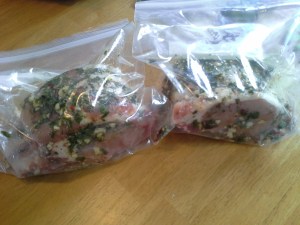
3. Garlic herb Crusted Pork Roast (sub for pork tenderloin)

20150330_111133

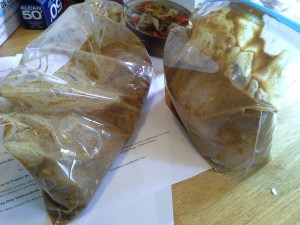
4. Almond butter chicken

20150330_114008

5. Jalapeno Chicken Burgers

20150330_120704

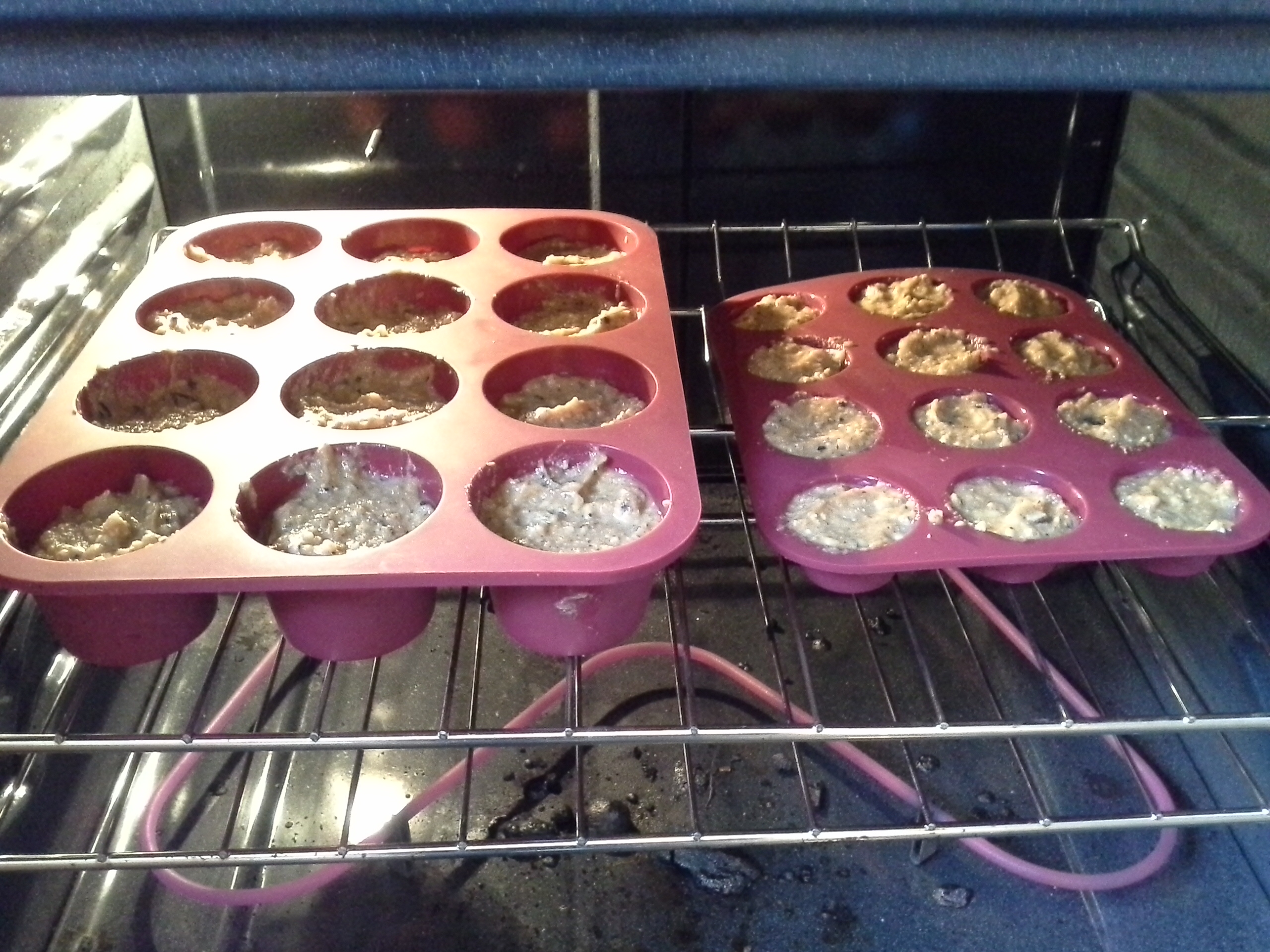
6. Pumpkin walnut protein muffins (my recipe that I added on)

20150330_124132

Grocery shopping took me an hour and a half and cooking took me 4 hours (10am-2pm). We had chili for supper (it was awesome!) and now I have a freezer full of yummy meals to help me through this busy month of marking and writing publications 🙂  You can have better work life balance and Once a Month Meals can help. Check it out!

Lessons from my First Year of University Teaching

Last term I taught the 3rd year data analysis course for nursing students at Western.  Boy, was it a ton of work!  Overall, I really enjoyed the experience and learned a lot about how teaching and learning has changed since I first began university back in 2001.  Currently I am teaching a graduate-level course in post-positivist (quantitative) research methodology and that is a super fun!  I really enjoy in-depth intellectual discussions about research with a small group (18 students) rather than talking at 120 undergrads who don’t care about statistics at all and want the “right answer” (which isn’t always possible).

Here are the top lessons I learned about teaching so far (I am sure there are many more to come!)

1. I am a dinosaur.  I grew up going to the library, reading hard copy books, writing out essays on paper with a pencil, etc. Students these days have always had the internet at their fingertips and they will sit there and Google everything that you say like fact-checkers at a political debate. Take home message: I need to learn how to use technology to my advantage and not waste valuable time in class lecturing off of PowerPoint slides when I could be using more engaging activities during face-to-face time.

2. Students need structure more than I realized.  One of the assignments last term was to do a content analysis of transcripts from interviews or online forum discussions by patients with different conditions.  Rather than embrace the freedom of interpreting the data for themselves, many students were frustrated because there was no certain correct answer (like so many things in real life).  We gave them a reference for an article that told them step-by-step how to conduct a content analysis and about 1/3 of the class did not read it, resulting in them doing the assignment in a way that did not make sense. Somehow the fact that they did not read the article that they were explicitly told to read was my fault. Interesting.  Take home message: Repeat key instructions in class, post them on slides, etc. Give them explicit instructions.

3. TAs are like a box of chocolates. Seriously though, you never know what your TA will be like and they may not know the course material or mark assignments the way that you would like them to be marked.  They are also graduate students with their own coursework, lives, etc. so be realistic about expectations. Despite having good rubrics, the assignments that we had in the course were lengthy and complex which also made it challenging for the TAs. Also, students will blame you for delays in marking and mistakes on their rubrics, even if you make sure they know their TA does the marking.  Take home message: Design assignments that are staged so that they are easier to evaluate by someone with little content knowledge of your course.

4. PhDs do not prepare people to be awesome teachers.  I really thought that my experience teaching lifeguarding and first aid, personal training, and coaching basketball would make teaching easier but university teaching is very different.  It is kind of sad that students pay so much money for school and the quality of teaching is so varied.  I really like that tenure-track teaching positions are becoming more prevalent and that most schools are providing support for teaching.  I feel lucky to be able to gain some teaching experience and attend workshops and courses at Western’s Teaching Support Centre during my doctoral program. I cannot imagine how difficult it must be to pop into a tenure-track job and try teaching for the first time while trying to apply for grants, publish articles, and commit to service.  This job is crazy.  Don’t get me wrong, it is what I want to do (and as an RN I know that I have lots of other options), but I am also not naive to the demands of the career path I am pursuing. Take home message: I need to devote more time to learning to be an effective teacher so I can have a successful transition into a tenure-track position.

Now to get back to working on that dissertation proposal!  (It is almost done and I am planning to defend in the Spring so that I can get started on data collection!).

So you want to be a Nurse Practitioner?

np

First let me say that Nurse Practitioners (NPs) play a valuable role in our health care system.  As nurses with clinical expertise from years of experience working with patients and advanced educational training, NPs have a lot to offer patients, healthcare teams, and organizations.  NPs are awesome and job opportunities for nurses in this role are increasing, in part because they are a more cost-effective healthcare resource than general physicians.

However, in talking to nursing students, reviewing scholarship applications, and entering survey data from new graduate nurses, I have noticed that everyone and their dog seems to want to be an NP.  I have also fielded lots of questions from people about how to get into the NP program, mainly “what GPA do I need?” and “what’s the minimum amount of experience I need before I apply?”   Another thing that I have noticed is that many people who did not choose nursing as their first career choice wanted to be doctors which makes me wonder if some people see nursing only as a means to become an NP, under the misconception that NPs and doctors are pretty much the same thing.  Let’s unpack this a little bit.

1. We need more NPs but we need way more nurses.  I hate to bust your bubble but from a resource planning perspective we need way more RNs in the workforce than NPs.  It’s actually more competitive to get into nursing and Canadian NP programs than medical schools. To boot, in Ontario you are only allowed to apply to one program per year so if you don’t get in (which is highly probable), better luck next year.

2. If you don’t want to be a nurse, do something else.  This may seem ironic coming from someone who’s career goal is to becoming a nursing professor but I wholeheartedly love being a geriatric rehab nurse and if I didn’t care so much about the bigger picture I would be happy to work full-time as a staff nurse.  I believe that most nurses who become NPs really want to make a difference in that role and I admire that.  However, I think that one of the things that makes the NP role so valuable is the wealth of nursing experience that people bring with them.  You can’t skip that part and if you don’t like getting your hands dirty working in the trenches, perhaps you should reconsider your career choice.   After all, chances are pretty good that you will work as an RN rather than an NP for most of your career.  There are also tons of other people who would love to be a nurse and you are taking their spot.  I’d also like to point out that if you wanted to be a doctor and end up working as a staff nurse you might end up really hating your job and being resentful.  Maybe not the best life choice.

3. 2 years of experience is not enough for most people and who cares about your GPA, really.  Some of my research work is on new graduate nurses and we consider a new graduate nurse anyone with less than 2 years of nursing experience (and sometimes even 3 years or less).  Patricia Benner also outlines the stages of development from beginner to expert nurse, stating that it takes about 3 years to become competent and at least 5 to become an expert.  Given that we know that it takes several years to develop nursing expertise, it baffles me that nursing schools allow nurses with a minimum of 2 years of clinical practice to apply to their NP preparatory master’s programs.  Moreover, it concerns me that some people are in such a rush to become NPs without considering the amount of responsibility that comes with their new role and the benefits of having more experience (to their patients as well as themselves).  There are exceptions I’m sure but I really think we need to reconsider the minimum experience requirements, especially considering that there is high demand for NP education.

While I’m on the topic of NP education, I don’t think GPA is necessarily a good indicator of an excellent nurse or of someone who will make a fantastic NP.  That isn’t to say that you can’t have a high GPA and also be an awesome clinician.  My point is that there are amazing nurses who are highly knowledgeable and skilled, with high levels of emotional intelligence and leadership skills that may not have achieved a 4.0 in their undergraduate nursing program.  I don’t think we need to throw the baby out with the bathwater here because the NP program is demanding and rigorous but it would be nice to see other elements included in the application process.  In real life it doesn’t matter what your GPA was if you have limited social skills or can’t apply the knowledge that you learned in a meaningful way.

Before you jump on the “I want to be a Nurse Practitioner” bandwagon, I hope that you will take some time to engage in self-reflection about where you are in your career and what skills, knowledge, and experience you have to offer, as well as areas that you want to develop further.  Just because you have a perfect GPA and can apply to an NP masters program after 2 years of working  doesn’t mean you should. Not everyone is cut out to be an NP and being an RN can be as rich and rewarding a career as you want it to be.

Relationship-building in a Task-Focused World

Increasingly, employees are asked to do more with less.  Arguably, this is the goal of Capitalism: to squeeze out as much work as possible for the least amount of money in order to maximize economic growth. I don’t think that this is a particularly helpful way to approach healthcare, as I believe that it is a basic human right, not a privilege, and that relationships with other people are fundamentally inefficient but extremely important.

In nursing the pressure to perform and maximize efficiency can be particularly difficult to cope with, as increased workloads leave less time to spend with patients and their families which is an important part of our job.  It may not seem like having a conversation is “work” but it is through conversations that patients communicate their needs, hopes, fears, and values (among other things).  By getting to know our patients, we are able to ensure that we provide care that meets their needs and treats each individual holistically, rather than as a list of tasks on our daily to-do list.

Building positive relationships with co-workers and leaders are also essential to creating a positive working environment where nurses and other members of the healthcare team can work together to deliver high-quality patient care.  Investing time and energy into these relationships is not efficient in the short term but pays dividends down the road in terms of staff retention, decreased voluntary absenteeism, decreased short-staffing (which leads to more sick time and burnout, etc.), and of course reduced time spent recruiting, interviewing, and training new hires.  It’s not rocket science that people who like their co-workers and their work environment are more likely to stay than those that dread coming in to work every day.  Strong relationships also facilitate good communication and trust among team members and generate shared understandings of work processes, as well as who knows what, and who to ask when you need help.

While we cannot ignore the tasks that need to be accomplished, as these are obviously important, we need to change how we think about relationships in the workplace.  Culturally, we have a tendency to judge relational work as “non-work” when in fact connecting to others in the workplace is very valuable (and sometimes extremely challenging) work.   Unlike patient care tasks that are easy to quantify and check off, it seems artificial and contrived to make a checklist that says “talked to each of my patients about their concerns”, “invested in my relationship with Susan by asking her about her son’s wedding”…etc.  I would also argue that most of us are naturally social and interested in other people so we do a lot of this work anyway and that trying to maximize relational “efficiency” by reducing these things to tasks is ridiculous (and insulting).

I understand that healthcare is expensive and many of the pushes to increase efficiency are driven by our aging population, aging workforce, government austerity, union wage increases, and the economic recession of 2008 (to name a few things).  It is complicated.  However, we need to invest in people and create healthy workplaces that foster a sustainable workforce and allow our healthcare professionals time to invest in relationships with patients. Pushing people harder and harder to produce more with less is not a long-term solution and will cost us more in the long-run – not just in terms of money, but in quality of life, happiness, and patient care.

Maybe the next time you see a nurse, doctor, or healthcare leader talking with a patient or a colleague, you should acknowledge that they are engaging in valuable work.  Just because we’re not doing a task like inserting an IV or giving a medication doesn’t mean that it’s not important.


Being a Mom Changes the Game

It’s taken me quite a while to understand how having children really changes your life and forces you to make choices about your priorities. Since today is Mother’s Day, I thought it would be a good time to share some of the ways I have found some sort of work-life balance.

1. I have mastered the art of the 10 minute cleanup. At the end of the day I set the stove timer for 10 minutes and clean as much as I can. Sometimes this motivates me to keep going and other times I get half the toys in a basket and the dishes washed.

2. I continue to negotiate balance. Some weeks I have a lot of work commitments and some weeks it’s a little slower. Learning to anticipate the ebb and flow and accept it has been really key for me. For example, last week I had a presentation to prepare for, a teaching job application to submit, a training session at the hospital, and work to do for my supervisor. It was a busy week and I ended up taking a few days off from the gym. Big deal. Got back to it the next day and life goes on. This doesn’t mean I’m always happy. Sometimes it is very frustrating when you can’t do everything that you wanted to do. For me, acceptance is a helpful way forward.

3. Unless I am going to be teaching, presenting, or meeting someone important, I don’t wear fancy clothes or do my hair. Maybe this sounds silly but getting ready in the morning takes time and effort and I would rather have my hair in a bun and spend some quality time with my son in the morning than fuss with a hair straightener and panty hose. If you spend thirty minutes a day getting ready that adds up to 2 ½ hours per week! This doesn’t mean I’m a total slob. I draw the line at tank tops and yoga pants (unless I am writing at home, in which case it’s pretty much guaranteed that I am wearing workout clothes). I also don’t own a lot of clothes which means fewer choices but that’s sometimes a good thing.

4. I prioritize fitness and health. Recreation and leisure time is really important to me so our entertainment is playing at the park, going swimming, etc. I also plan healthy meals and cook at home. We have a lot of fun together, spend time outside, and I find myself refreshed for the week ahead.

5. I have amazing support. It’s not easy to be a single parent while working on a doctorate and building an academic career. If I want to go to a conference or attend a workshop I need to find someone to look after my son while I go. I can’t just go to Toronto for the day or stay late on campus. Thankfully, I have found an amazing daycare and many friends and family members have helped me out when I need some help. I have also learned that I need to be more selective about my commitments. While I would love to go to everything and be part of many more committees and professional groups, I can’t do it all.

6. I remember why I am doing this. The reason I am pursing an academic career in nursing is to help create positive changes in health care and ultimately in people’s lives. I envision a health care system where quality of life and preventative health care is valued. I could go on about this but my point is that I am very fortunate to be doing my PhD with world-renown scholars in my discipline. Sure, I want to keep publishing and yes, I will literally jump for joy if I ever do receive an elusive CIHR grant, but at the end of the day, the impact that I have through the students that I teach and the research work that I do is the end goal. Publications, presentations, and grants are all helpful, but the way I see it, if you focus on doing work that matters and doing it well, those other things will come.


There is time to write and play trains, but the time to play trains is rather short, whereas there will always be another paper to write.  Happy Mother’s Day everyone!

Thoughts about Nurses and Strength Training

Nurses are a valuable part of our health care system and we work very hard to deliver good patient care.  As a profession we sometimes get a bad rap for not being exemplars of health because some nurses are overweight.  I would like to change the channel on this discussion and approach this issue from a different perspective.  Health is more than just looking good and being fit has important implications for the nursing workforce and healthcare generally.

First of all, body composition is only one component of being healthy.  Hopefully by now you know about the “skinny fat” phenomenon and why being thin doesn’t necessarily mean you are healthy.  On the flip side, I don’t think that people should use this an excuse to overeat.  I encourage us to embrace a more holistic view of health and well-being rather than simply judging nurses’ health based on their appearance.

Secondly, the nursing profession is predominantly made up of women (many of whom are aging) which is important for a few reasons. 

1. The Western cultural ideal of what women should look like influences the standard against which women are measured.  Most nurses are women so therefore some people judge nurses’ “health” based on how well they meet this ideal.  Again, you cannot tell solely by appearances how healthy someone is. 

2. Women and men have different hormones which, like it or not, influences our body fat levels.  Women are supposed to have more fat than men and as we get older (which many nurses are), we tend to put on weight because of changes in our hormones.  

3. Women have been fed a lot of BS about fitness and nutrition.  This ties into my point about the Western beauty ideal.  I find it shocking that I still meet so many women who are afraid of lifting weights because they think it will make them “look like a man” or who spend hours doing cardio and counting calories in their fat free asparatame-filled cancer-causing diet “foods” that have pretty much no nutritional value.  While this may come across as being a little harsh, I want to make it clear that I don’t blame women entirely for buying into the propaganda that has been fed to them for years.  There are tremendous rewards for those who live up to conventional beauty standards so how do you blame people for wanting to be successful, even if many of us don’t agree with the definition of “success” that has been handed to us?

At any rate, I think we do a very good job as women of being mean to each other and I think that needs to stop.  Be a beauty – there is nothing wrong with that if that is what you want.  However, you are more than just a beautiful object to look at!  You can be beautiful and strong and smart and whatever you want.  Sometimes it seems like there is this idea that you can only be one or the other – that beautiful women are stupid or that intelligent women don’t care about their physical appearance.  I don’t think I need to point out how naïve and simplistic these assumptions are.

So why am I talking about beauty in a post about fitness anyway?  Well I believe that many women steer clear of strength training because they think it will sacrifice their beauty.  In other words, if a woman thinks that lifting weights will make her look masculine, she will avoid doing it. 

So what? 

Well, as I mentioned, most nurses are women so this has some implications for our profession.  Nursing work can be very physical at times and requires a high capacity to do work.  Many of us work busy 12 hour shifts and help turn, stand, transfer, and walk patients throughout the day.   Back and shoulder injuries are common among nurses in addition to high levels of stress and burnout.  Being fit and strong can help increase our work capacity, prevent injuries, and improve work recovery.  Increasing our physical strength and endurance can help make our jobs (and lives) easier to handle, provide us with more energy, improve our personal health, help us manage stress, and improve our physical appearance.   With so much to gain, what are we waiting for?

Do Impact Factors Matter in Nursing?

I just got back from my first Academy of Management Conference and I was astonished by the emphasis on the importance and status of publishing in “A-level” management and business journals.  In nursing there is not a whole lot of emphasis on this and I started to wonder why not?   Is it because I’m studying in Canada?  Are we less knowledgeable about impact factors in Nursing?  Am I naive about the effect journal choice can have on my academic career?   Are there A-level journals that I don’t know about?   The purpose of this post is to give a brief overview of what impact factors mean in nursing and find out if there are “A-level” journals that I should know about.

What is an impact factor?

Impact factors are a measure of how often articles from a particular journal have been referenced by other articles.   The idea is that the best articles will be used by other researchers in the future, thus spreading good ideas and having an “impact” on the field.  Apparently in business and management departments at colleges and universities they often have formalized lists of “A-level” (best), “B-level” (better), and “C-level” (good) journals and professors’ careers are largely influenced by their ability to get articles published in the best journals.   I have been fortunate to work with very productive and supportive research teams and supervisors in kinesiology, medicine, and nursing where all article publications are celebrated equally.  Granted, if you get an article published in Nature or The Lancet that is a really big deal for anybody.

How do you interpret impact factors?

Impact factors were created to measure article and journal quality so the best journal should be listed first, followed by the second-best, etc.  However that is not true for nursing journals.  For example, right now the journal with the highest impact factor in nursing is Birth: Issues in Perinatal Care (impact factor = 2.84 [Science Watch, 2013]).   Does this mean that this is the “best” journal in nursing?   If you are studying issues related to childbirth and nursing, then absolutely!  Otherwise, probably not.  The journal’s high impact factor probably reflects the fact that a lot of nursing scholars are doing work in this area and that it is a popular resource for those scholars.  While I am sure that there is interesting and valuable work in there, I am doubtful that I will ever read, cite, or publish an article from this journal because it is unrelated to my research interests.   This raises the question of how useful it is to compare nursing journals that have different aims and audiences.  I think ranking is helpful but sub-categories and/or discretion are also required.

Impact on Research, Practice, or Both?

Another thing to consider is that an article could have a powerful impact on nursing practice despite not being cited by other researchers.  Many nurses taking DNP, NP, master’s, and bachelor-level degrees are not necessarily going to be conducting research but they are likely to be knowledge consumers that apply the findings of nursing research to their professional practice.  On the other hand, just because an article is well-known and often cited by other academics doesn’t necessarily mean that the article had an impact on practice (i.e. real life).  In fact, it is possible that an article could be cited a lot because people disagree with it or because it reflects an old way of thinking about something that is no longer relevant but helps the reader position new work.  Therefore, I believe that impact factors are an incomplete measure of actual impact.

Are there A-level Journals in Nursing?

Out of curiosity I looked up the promotion and tenure criteria for several prominent nursing schools in Canada and the U.S. and couldn’t find any evidence of a formal “good, better, best” categories of nursing journals, though all considered article quality and quantity as one indicator of productivity.   This leads me to believe that publishing in higher ranking nursing journals is still better but that there is room for discretion based on the topic or focus area of the work (e.g. maybe the #1 journal in mental health nursing is ranked 20th overall but still deserves credit for being the best in the specialty area).

What is the value of impact factors in nursing?

Impact factors can give us an idea of what areas of nursing research are most popular and receive the most attention by other scholars.  The relatively low impact factors in nursing compared to some prolific medical journals may also indicate that nurses are more likely to cite sources outside of nursing whereas other disciplines are unlikely to cite nursing scholarship (Polit & Northam, 2011).   As a developing scholar I certainly want my work to be taken up by others and make a difference, both in research and in practice.

Comparing impact factors of journals that are in the same specialty or research area makes sense and can help distinguish between different levels of scholarship quality, however we can’t just use the list as is to rank all of the journals in nursing without considering their specific focus.  In addition, it is important to create ways to assess and evaluate the impact that nursing research and scholarship has on nursing practice and, in particular, patient care and health outcomes.  Impact factors are important indicators of scholarship quality and academic success and productivity but they don’t paint the whole picture!


References:

Polit, D. F., & Northam, S. (2011). Impact factors in nursing journals. Nursing outlook59(1), 18-28. Retrieved from http://journals.lww.com/jcnjournal/Documents/ImactFactors_NursingOutlook_2011.pdf

Science Watch.  (2013).  Journals ranked by impact: Nursing.  Retrieved from http://archive.sciencewatch.com/dr/sci/10/mar28-10_1/